The global warning network is expanding. Whether that translates into safety depends on much more than forecasts and messages: it depends on people having the means to act. The newest headline numbers also demand careful attribution, because a central 2026 estimate still comes from a draft report.
A warning is not the same as protection
The strongest forecast cannot move a person out of a floodplain. It can describe where water is likely to rise, but protection depends on a series of decisions and practical resources after the forecast is made. Someone must issue a clear warning; people need to receive and believe it; authorities must have plans for helping those who cannot readily leave. This distinction matters as governments report growing coverage by multi-hazard early-warning systems.
In a November 11 report, Reuters said a draft United Nations assessment counted 136 countries with some early-warning capacity, including 64 that had capabilities across all four essential pillars. The 64 are a subset of the 136, not an additional group of countries. Crucially, the four-pillar figure comes from a draft seen by Reuters, not a verified final 2026 UN report. Neither number measures how many individuals can escape a specific disaster safely.
Sources: Disaster warning systems race to keep pace with galloping climate risks · Early Warnings for All — four pillars and 2027 target
The four functions that must connect
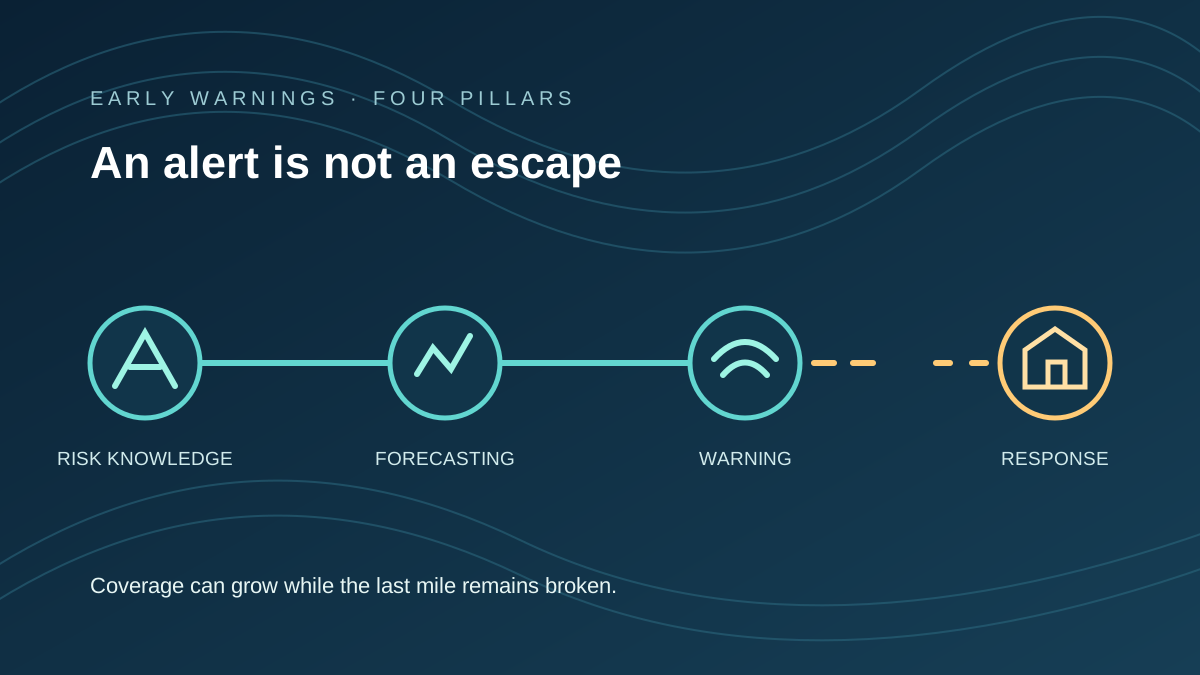
The Early Warnings for All framework divides an effective system into four parts: disaster risk knowledge; detection, observation, monitoring and forecasting; warning dissemination and communication; and preparedness and response. The first asks where hazards and vulnerabilities overlap. The second tracks changes and anticipates events. The third converts analysis into information people can act on. The fourth determines whether households, services and emergency officials can actually respond.
These are not simply four technologies to purchase. Risk maps need to reflect changing settlements and conditions. Forecasts have to reach decision-makers in time. Communications must work across languages, disabilities and interruptions to power or networks. Preparedness calls for evacuation procedures, drills, accessible shelters and coordination. A failure late in the chain can erase the benefit of an accurate forecast at the beginning. The UN initiative itself is built around cooperation between scientific, communications and response organizations.
Sources: Early Warnings for All — four pillars and 2027 target · Early warning systems reach new heights, but critical gaps jeopardize global progress
What the country counts do — and do not — establish
The UNDRR and World Meteorological Organization reported in their final 2025 assessment that 119 countries, roughly 60% of countries, reported having a multi-hazard early-warning system. The official report also found progress in the comprehensiveness of systems, while identifying serious gaps: only 43% of small island developing states reported systems, and fewer than one-third of countries reported capacity for disaster risk knowledge. These findings describe national reporting and assessed capabilities, not universal access within national borders.
The newer figure of 136 countries is also supported by a UN disaster-risk official speaking publicly in September 2026, who described countries reporting some kind of system as of August. But a meaningful year-on-year comparison still needs the final 2026 report and its definitions. Different reporting dates, thresholds or data revisions could affect the apparent change from 119. The draft-based 64-country figure is especially important to keep provisional until the final methodology can be checked.
Sources: Early warning systems reach new heights, but critical gaps jeopardize global progress · UN General Assembly 81st Session SDG Media Zone, Day 2 (transcript)
A message can arrive without creating an escape
A warning can reach a phone and still leave its recipient with few options. The practical obstacles may include no vehicle, limited money, inaccessible shelters, caregiving obligations or a job that cannot easily be abandoned. A notice received too late, or one that does not explain the safest action, may record as successful delivery while offering little actual protection. National averages can conceal these differences between communities.
Reuters also reported results from the Lloyd’s Register Foundation World Risk Poll suggesting a sharp income divide in the ability to act after receiving warnings. It said fewer than half of warned respondents in low- and lower-middle-income countries could take action, compared with roughly three-quarters in upper-middle-income countries. Those figures describe survey respondents, not an audited count of protected residents. They are a reason to measure action and its barriers separately from message reach, not grounds for declaring any whole region safe or unsafe.
Sources: Disaster warning systems race to keep pace with galloping climate risks · Putting risk communication at the heart of disaster preparedness
Local knowledge needs public capacity behind it
Communities often know where warnings fail in ways that national dashboards cannot show. Residents may identify an unmarked drainage channel, a road that floods first or a neighbor who cannot reach a shelter unaided. Local relationships can translate general forecasts into understandable choices. That does not mean governments can transfer their responsibilities to volunteers. Reliable alerts still depend on public infrastructure, training, maintenance and emergency services.
Community programs should therefore be assessed for durability as well as reach. Who covers the cost of communications and equipment? Can volunteers safely operate through a prolonged emergency? Does a local warning connect to a functioning evacuation system? A promising pilot is not proof of sustained national protection. Reuters described a volunteer network in Lima, but detailed claims about its specific operations should await separate primary-source confirmation rather than being treated as independently established here.
Sources: Early warning systems reach new heights, but critical gaps jeopardize global progress · Early Warnings for All — four pillars and 2027 target
The 2027 promise requires different measurements
The United Nations launched Early Warnings for All in 2022 with the ambition of protecting everyone by the end of 2027. That date is a target, not a statement of completed coverage. Reuters reported that UN disaster-risk leadership considered reaching it unlikely. Closing the gap calls for investment not only in observation networks and forecast accuracy, but also in dependable channels for issuing alerts and the resources required to respond.
The next useful evidence will be operational: the lead time of warnings; the share of people who actually receive and understand them; whether people can reach shelter or transport; whether planned responses work during real events; and who remains excluded. The 2025 UNDRR–WMO findings show why country-level capability and comprehensiveness matter, but even a complete four-pillar framework on paper cannot establish that every warning averts harm. The honest measure of progress is the connection between national capacity and actions made possible for people at risk.
Sources: Early Warnings for All — four pillars and 2027 target · Disaster warning systems race to keep pace with galloping climate risks · Early warning systems reach new heights, but critical gaps jeopardize global progress