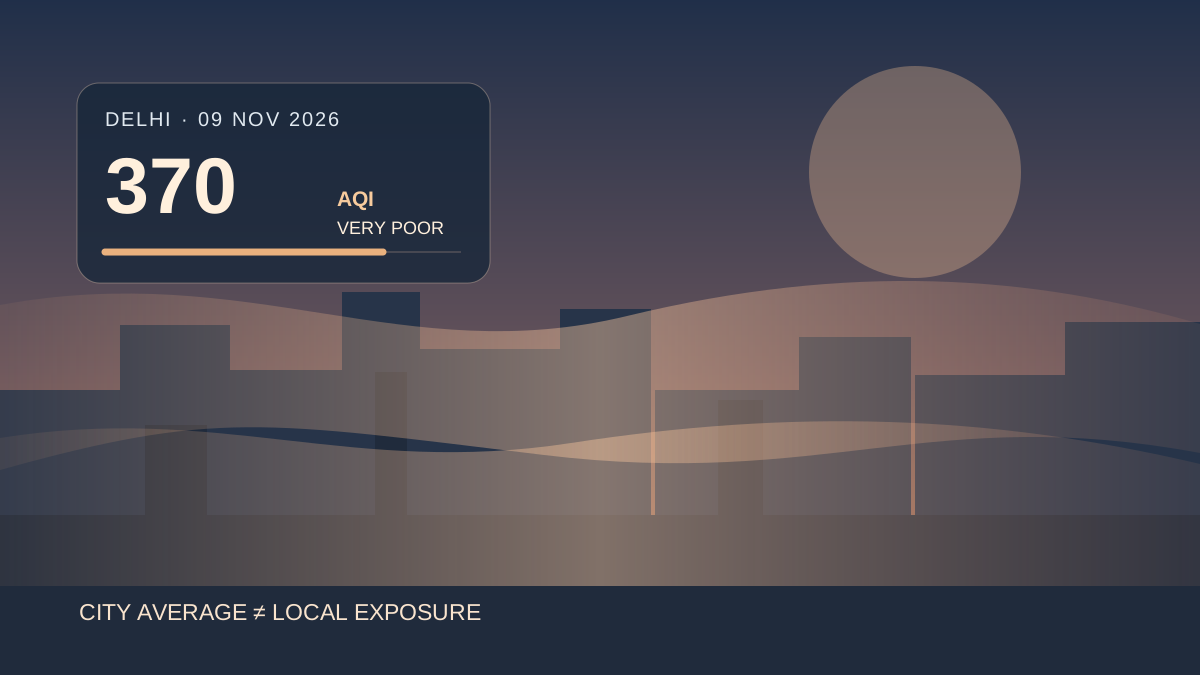
The morning after Diwali brought the first reported 9 November observations: Delhi’s official AQI was 370 at 9 a.m., still very poor, while several neighbourhood monitors recorded severe pollution. The readings turn an earlier forecast into a measurable event but leave important limits on what can be concluded about the city’s full day and the sources of its haze.
Monday’s measured reading replaces Sunday’s forecast
Delhi woke on Monday, 9 November, to an air-quality emergency that could now be described with measurements rather than the previous day's prediction. At 9 a.m. India Standard Time, the capital's Air Quality Index stood at 370, in the 'very poor' band of India's official scale, according to Central Pollution Control Board data reported by Reuters. That figure captures a specific morning reading; it is not a final 24-hour assessment of Monday and does not establish that the whole city was in the 'severe' category.
It is an important distinction after Diwali, celebrated on Sunday. The CPCB defines AQI values from 301 to 400 as very poor and 401 to 500 as severe. The latest citywide figure remained below 401, but it arrived after a night when residents reported fireworks continuing outside court-approved hours. The outcome is not simply a fulfilled forecast: it is evidence of a city experiencing dangerously polluted air while individual monitoring locations recorded even harsher conditions. The change since the previous day's reporting is the availability of actual post-festival readings.
Sources: National Capital Region AQI: CPCB classifications and data limitations · Delhi air quality deteriorates as revellers mark Diwali with illegal fireworks
The neighbourhood picture was worse than the city average
A citywide AQI can obscure what people breathe in different parts of Delhi. Reuters reported that many neighbourhood readings exceeded 400 on Monday morning. Morning data from the Central Pollution Control Board, reported by Press Trust of India, put Burari Crossing at 441 and Sonia Vihar at 441, followed by Vivek Vihar at 437, Delhi Technological University at 434, and Jahangirpuri and Delhi University's North Campus at 433 each. Those station figures belong to their reported observation window and should not be treated as simultaneous with every other outlet's figures or with a later hourly city aggregate.
Another investigation published on Monday counted 15 stations in the severe range and reported that 10 of Delhi's 59 monitoring stations were not providing data at the time it examined the official network. Missing observations complicate any claim about precisely how many locations crossed a threshold. They also caution against comparing an incomplete set of stations with a different day's complete or partially complete network. A single citywide average is nevertheless a summary for public communication, not a measure of what people breathe in each neighbourhood: geographical variation remains substantial.
Sources: National Capital Region AQI: CPCB classifications and data limitations · Delhi morning after Diwali: missing data across monitoring stations · Day after Diwali grey haze darkens Delhi skies
Fireworks added to pollution already trapped over the capital
Diwali fireworks were visible and audible into the night, residents told Reuters, despite judicial limits on the hours and products permitted. Reuters television footage on Monday showed smog around India Gate, while the Associated Press described a thick blanket of smog over the capital on Monday morning. Those observations support an immediate episode of poor visibility and discomfort; they do not by themselves measure how much of the Monday AQI came from fireworks rather than other sources.
Delhi's winter pollution has multiple contributors. Vehicle exhaust, construction dust, industrial emissions and smoke from agricultural residue burning interact with cool air and weak ventilation that slow dispersal. Fireworks can add particulates over a short period, but an AQI reading alone cannot assign a defensible percentage to each source. The timing makes the overnight celebrations relevant, not an exclusive explanation. Describing every part of Monday's pollution as a firecracker effect would go beyond the available measurements and overlook the region's existing pollution burden.
Sources: Delhi air quality deteriorates as revellers mark Diwali with illegal fireworks · New Delhi wakes to toxic smog after Diwali
Emergency restrictions were already in force
The region was not waiting for Monday's readings before intervening. On Friday, 6 November, the Commission for Air Quality Management invoked Stage III of the Graded Response Action Plan across the National Capital Region, with immediate effect. Stage III remained in force on 9 November. The order was a precautionary response to seriously deteriorated air and expected severe conditions, not a declaration that each city or station had already exceeded the severe threshold.
Stage III calls for tighter controls on pollution-generating activities, including construction and vehicle restrictions, while schools have been instructed to shift to hybrid classes for pupils up to Class 5 where online teaching is available. The measures can reduce some additional emissions and exposure; an order's existence, however, cannot be equated with full compliance or immediate improvement in every neighbourhood. For families navigating classes, commutes and outdoor work, the practical question is how local authorities apply the restrictions while polluted air persists.
Sources: CAQM Stage III GRAP invoked 6 November 2026 · Delhi air quality deteriorates as revellers mark Diwali with illegal fireworks · New Delhi wakes to toxic smog after Diwali
The temporary firecracker exception has expired
The legal timeline is unusually clear. In an order dated 29 October and released in early November, India's Supreme Court permitted certified green firecrackers in Delhi-NCR during narrowly defined hours on 7 and 8 November: 6–7 a.m. and 8–10 p.m. The order also barred fireworks in protected zones around medical institutions, educational institutions and designated silence areas. It did not legalise conventional crackers, unrestricted sales or all-night festivities.
The same order restored the broader firecracker ban from Monday, 9 November. Reuters reported that residents observed firecrackers going off late at night in apparent breach of the court restrictions, but those accounts are not a comprehensive enforcement tally. The number of illegal transactions, seizures or violations cannot be inferred from witness reports. Nor does the court's resumption of the ban prove that the city's pollution will immediately decline: weather, traffic and other sources will continue to influence the readings over the following days.
Sources: Arjun Gopal v Union of India, order dated 29 October 2026 (2026 INSC 1181) · Delhi air quality deteriorates as revellers mark Diwali with illegal fireworks
What the figures say—and what remains unsettled
The difference between official monitoring and private rankings matters during an emergency. Reuters cited a live ranking by IQAir placing Delhi third among the world's most polluted major cities on Monday morning and Lahore first with an index reading of 563. That is a snapshot from a private international service, not a second CPCB citywide AQI, and its scale, city selection and timing should not be silently merged with India's official 370. Higher figures from commercial dashboards cannot be substituted for CPCB data simply because they look more dramatic.
The official 9 a.m. AQI of 370 establishes very poor citywide air that morning, alongside severe readings in individual neighbourhoods. It does not settle the full-day average, the duration of each local spike, an exact fireworks contribution or the effect of enforcement. The missing station data make station-count comparisons especially fragile. A subsequent time-stamped CPCB bulletin and fuller monitoring coverage would be needed for those answers. For now, the verified finding is both serious and precise: the morning after Diwali brought severe local pollution while the capital's reported overall index remained just below the severe category.
Sources: National Capital Region AQI: CPCB classifications and data limitations · Delhi air quality deteriorates as revellers mark Diwali with illegal fireworks · Delhi morning after Diwali: missing data across monitoring stations