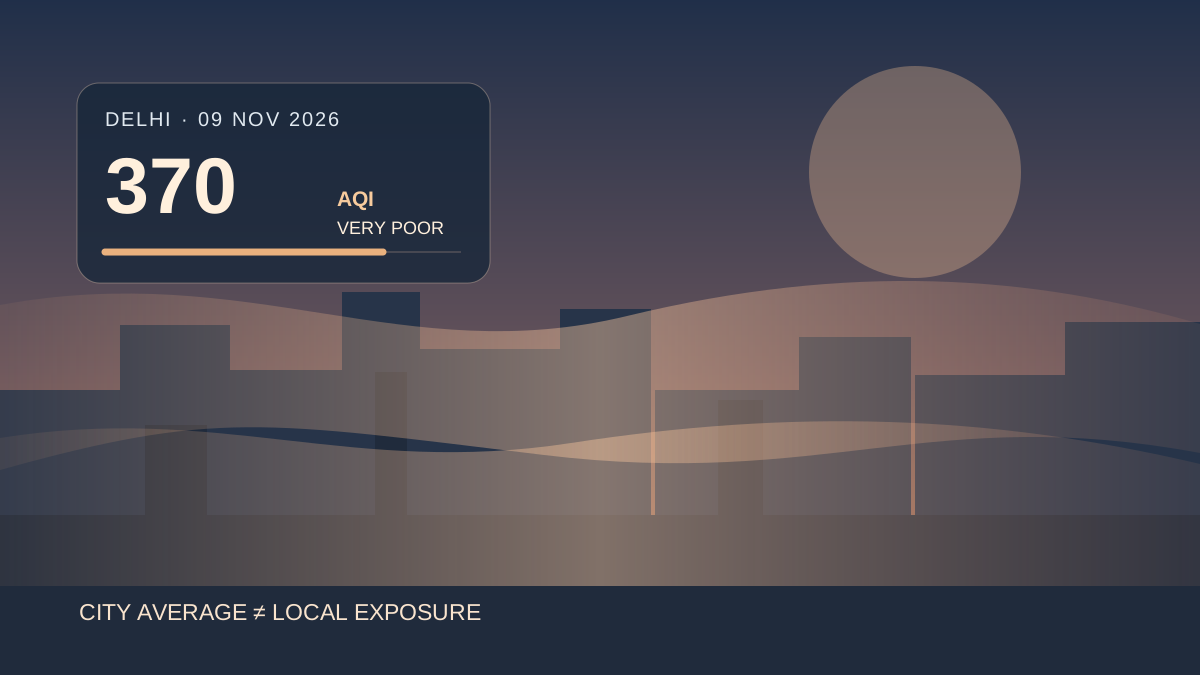
Delhi entered the morning after Diwali with emergency pollution controls already in force and a warning of still-worse air. The capital’s official citywide AQI for 8 November was 376—very poor, not severe—while numerous neighbourhood monitors crossed the severe threshold. The distinction matters as authorities manage school classes, workplace attendance and a renewed firecracker ban: 9 November is the forecast danger point, but its full-day outcome must be measured rather than assumed.
The city average and the neighbourhood extremes
Delhi entered Diwali on Sunday, 8 November, with air that was already classified as very poor. The Central Pollution Control Board’s 24-hour citywide Air Quality Index, reported in its 4 p.m. daily bulletin, stood at 376, up from 369 on Saturday. Under India’s national scale, 301–400 is very poor and 401–500 is severe. The 376 reading is a city-level summary of the period before the evening’s principal celebrations, not a final measurement of pollution accumulated across the following night.
The headline average concealed much harsher conditions in particular neighbourhoods. Press Trust of India reported an 8 a.m. city reading of 383 on Sunday and said 24 of 54 reporting monitoring stations were already in the severe category. Its report cited Jahangirpuri at 450, using the CPCB’s Sameer data service. These are morning, station-specific observations; the later citywide figure uses a different time window. They should not be presented as one simultaneous count or as evidence that the entire capital had reached severe conditions.
Sources: Delhi records very poor air quality on Diwali with 376 AQI · Delhi wakes up to toxic haze on Diwali, close to severe AQI at 383
What forecasters expect after the festival
The post-Diwali risk is forward-looking. Delhi’s Air Quality Early Warning System, operated through the Indian Institute of Tropical Meteorology, forecast severe air quality for Monday, 9 November, in its 8 November weather and pollution outlook. It indicated unfavourable ventilation conditions, meaning that emissions could remain concentrated near the ground rather than disperse quickly. That outlook is an official forecast, not an observed full-day AQI for Monday; a later CPCB bulletin is needed to establish whether the citywide severe threshold was actually crossed.
A separate forecast from Cambridge Judge Business School estimated that Delhi’s daily mean PM2.5 concentration could peak near 282 micrograms per cubic metre on 9 November. That number belongs to the Cambridge model, not the IITM forecast, and it carries substantial uncertainty. For scale, the World Health Organization’s 2021 guideline for a 24-hour PM2.5 mean is 15 micrograms per cubic metre. A predicted concentration and a national AQI score are different measures: the 282 figure must not be described as a measured AQI or an accomplished exposure.
Sources: Air Quality Early Warning System for Delhi: bulletin issued 8 November 2026 · Air Quality Forecasts for Delhi, 1–14 November 2026 · Air quality, energy and health: guideline values by pollutant
Emergency restrictions were triggered in advance
The Commission for Air Quality Management did not wait for a citywide severe reading to act. Its 6 November decision brought Stage III of the Graded Response Action Plan into force across the National Capital Region immediately. The Ministry of Environment’s official release recorded Delhi’s daily AQI at 382 that Friday, still in the very poor band, but said weather forecasts pointed to possible severe pollution ahead. Stage III was therefore an anticipatory intervention, layered on top of the lower-stage controls that were already in force.
The response restricts pollution-producing activity rather than attempting to change a single number on a dashboard. Authorities have been directed to implement the applicable construction, demolition and vehicle-related controls, while the commission urged residents to reduce unnecessary journeys and postpone private gatherings that add traffic and outdoor exposure. A separate CAQM order dated 30 October had already established preventive restrictions for 5–20 November, with exemptions for vital infrastructure and essential services. The two orders have distinct dates and legal purposes, even though their effects overlap.
Sources: CAQM invokes Stage-III of GRAP in Delhi-NCR with immediate effect as Delhi records an AQI of 382 · Implementation of precautionary measures for prevention and control of air pollution in Delhi-NCR during 5–20 November 2026
Schools, offices and the burden on everyday life
School arrangements are among the most visible consequences. Delhi’s Directorate of Education issued a 6 November circular on hybrid teaching up to Class V, covering government, aided and recognised private schools; online participation applies where it is feasible. Reuters separately reported that schools in and around Delhi were instructed to offer online classes as the pollution intensified. A hybrid requirement is not a blanket declaration that every school is closed, and access to online learning may differ across households.
Workplaces are also affected. The CAQM’s 30 October order directs state-government and private offices in Delhi and specified neighbouring districts to operate with no more than half of staff physically present, with the rest working from home, through 20 November. The text expressly exempts workplaces and essential services where that arrangement is not feasible. Reuters’ 6 November account described additional encouragement to work remotely and delay gatherings. Neither source establishes how completely individual employers have complied; the rule and its implementation are separate questions.
Sources: Regarding Conducting Classes in Hybrid Mode for Students up to Class V · India orders Delhi schools to offer online classes as air quality worsens ahead of Diwali · Implementation of precautionary measures for prevention and control of air pollution in Delhi-NCR during 5–20 November 2026
A narrowly timed firecracker exception ends
The regulatory backdrop is unusually specific. In its order dated 29 October and made public in early November, India’s Supreme Court allowed only certified green firecrackers during two limited windows on 7 and 8 November: 6–7 a.m. and 8–10 p.m. It barred fireworks within 300 metres of hospitals, healthcare facilities, old-age homes, educational institutions and designated silence zones. The court also required action against unauthorised products and set conditions for production and sale. This was a temporary relaxation, not an unrestricted Diwali exemption.
The same judicial order reinstates the complete firecracker ban from 9 November. That change matters for enforcement, but it does not by itself establish how many crackers were used, whether all sales complied with certification rules or what fraction of the pollution they produced. Smoke from festivities can add to an already polluted atmosphere, yet a citywide AQI does not identify a unique source. Any firm numerical attribution to firecrackers would require more detailed emissions and monitoring evidence than the available daily index supplies.
Sources: Arjun Gopal v Union of India, Supreme Court order dated 29 October 2026 (2026 INSC 1181)
What the next readings can—and cannot—settle
The immediate air emergency sits within a recurring regional pattern. Vehicle exhaust, construction dust, seasonal burning of agricultural residue and weather that inhibits dispersal all feature in the commission’s assessment and Reuters’ reporting. The CAQM’s October order describes elevated pollution recurring in early and mid-November in previous years; it does not establish that 9 November is invariably Delhi’s single worst day. A forecast of a sharp post-festival peak is plausible within that seasonal setting, but it remains a forecast until contemporaneous measurements confirm it.
The next decisive evidence is a timestamped CPCB citywide bulletin for 9 November, considered alongside station-level readings and the weather outlook. The official AQI may lag shorter pollution spikes because it summarises a longer window. As of this report, no verified full-day Monday figure is used to claim a new record or a severe citywide outcome. Reports of flight disruption and precise source-by-source pollution shares have also been excluded because suitable corroboration was not established. For residents, the central fact is already clear: widespread very poor air and several severe local readings have prompted extraordinary precautions.
Sources: CAQM invokes Stage-III of GRAP in Delhi-NCR with immediate effect as Delhi records an AQI of 382 · Air Quality Early Warning System for Delhi: bulletin issued 8 November 2026 · Implementation of precautionary measures for prevention and control of air pollution in Delhi-NCR during 5–20 November 2026 · India orders Delhi schools to offer online classes as air quality worsens ahead of Diwali