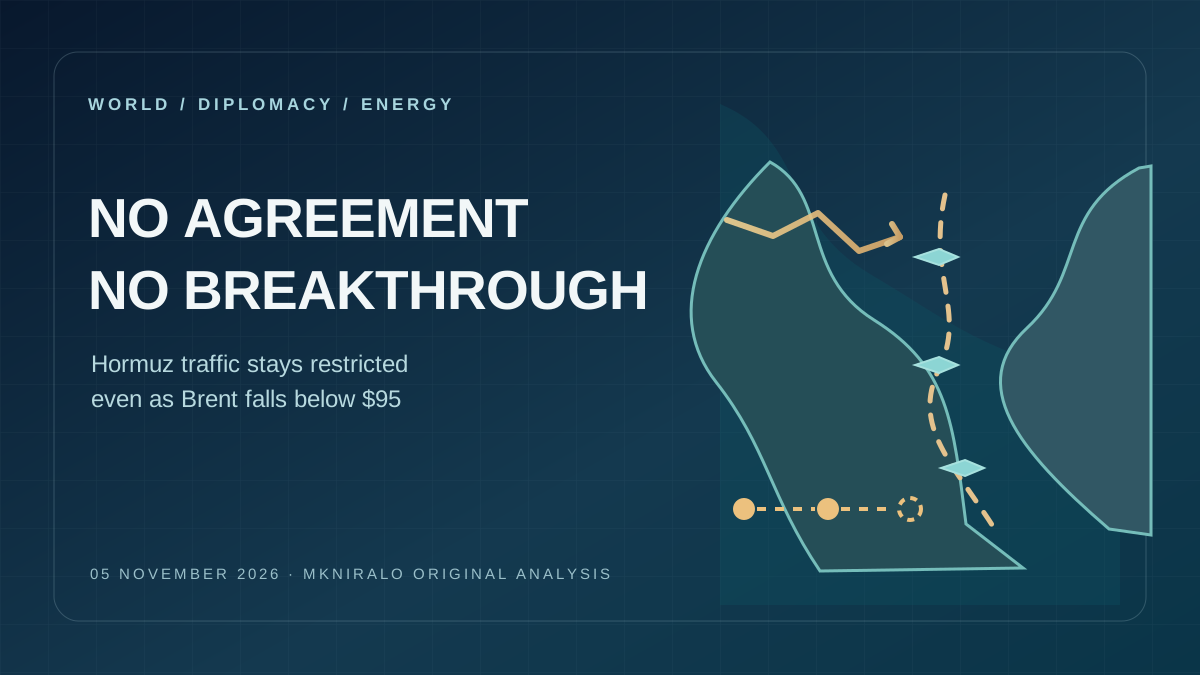
On 4 November, Brent crude settled at $94.62 a barrel, down 8.7% in a day, while ships still crossed the Strait of Hormuz at only a fraction of the normal AIS-visible rate. The market move reflected investors’ expectations that political pressure in Washington could make a negotiated exit from the war with Iran more likely. It did not mean the waterway had reopened or that a deal had been signed. Qatar said it was still carrying proposals between Washington and Tehran, but could announce no specific breakthrough; a senior Iranian official told Reuters the sides remained far apart. The important development is therefore the widening gap between three clocks: diplomacy still searching for terms, merchant ships still confronting danger, and oil futures rapidly repricing the possibility of relief.
The talks have not ended; the deadlock has not lifted
Qatar’s foreign ministry gave the clearest public account on 3 November. Spokesperson Majed al-Ansari said a Qatari delegation had spent roughly three hours in Tehran the previous day, discussing proposals and returning to Doha. Mediators continued exchanging ideas while both sides reviewed them. He described continued engagement as reason for cautious hope but said there was no specific breakthrough to announce. That is a mediator’s description of an active process, not evidence of an agreement.
Reuters reported that Iranian representatives had left earlier talks without a breakthrough, while consultations continued through intermediaries. On 3 November, a senior Iranian official told the agency Washington and Tehran were still far from a settlement. Those accounts are compatible: negotiators can be exchanging proposals without having narrowed the central differences enough to agree. “No agreement, no breakthrough” is more accurate than declaring the diplomatic channel dead.
The distinction matters for a conflict in which announcements routinely move ahead of implementation. A draft, a mediator’s meeting and a public statement can each reduce uncertainty about whether talks exist. None can verify an actual change in port access, security conditions or shipping instructions. For merchants planning a voyage, a credible implementation mechanism matters as much as diplomatic language.
Sources: Advisor to Prime Minister, Official Spokesperson for Ministry of Foreign Affairs: Qatar Continues Its Efforts to Bridge Gap between Washington, Tehran · Iran says contacts over ending war continue after talks finish with no breakthrough · Iran, US still far apart on deal; Trump says ready but in no hurry for strikes
The unresolved question is what happens first
The central dispute is partly about sequencing. Reuters reported Tehran’s position that Washington must meet conditions, including easing oil sanctions, ending its naval blockade of Iranian ports and releasing frozen Iranian assets, before Iran reopens Hormuz or engages on nuclear questions. These are demands voiced by Iranian officials, not concessions Washington has accepted. Reuters also reported that Iran had condensed the seven-step proposal it previously submitted, without changing its fundamental position.
A shorter timetable on paper is not the same as a smaller political gap. One side may want relief from economic pressure before discussing nuclear restrictions; the other may seek verifiable commitments before offering relief. The order determines which side makes the first costly move and what leverage remains afterward. Without an agreed sequence, assurances about reopening a shipping lane cannot be treated as enforceable navigation arrangements.
Qatar has said it remains hopeful a deal could be reached to pave the way for future negotiations. That remains a possibility, not an announced accord. The public record reviewed here does not establish a mutually accepted timetable, a verified implementation mechanism or conditions under which shipping insurers and operators can safely reverse their current decisions.
Sources: Advisor to Prime Minister, Official Spokesperson for Ministry of Foreign Affairs: Qatar Continues Its Efforts to Bridge Gap between Washington, Tehran · Iran says contacts over ending war continue after talks finish with no breakthrough · Iran, US still far apart on deal; Trump says ready but in no hurry for strikes
The shipping numbers show restriction, not a complete stop
The operational measure is unusually stark. At 13:27 UTC on 4 November, the independent monitor hormuz.now reported an average of 9.4 AIS-visible commercial crossings per day over its preceding seven-day window. Its pre-crisis comparison was 84.8 a day, making the observed rate roughly 11% of that baseline. The monitor counts cargo ships and tankers of at least 80 metres that transmit AIS and cross its designated line, with inbound and outbound crossings included. This is a dated snapshot, not a full-day census or an IMO-issued tally.
The number moves as the rolling window updates. A later snapshot on the same website showed 8.9 a day by 23:34 UTC on 4 November. Ships may also switch off transponders for security, while signal interference and different counting boundaries affect the data. IMF PortWatch and other commercial monitors use different vessel categories and methods, sometimes including sources beyond openly transmitted AIS. The safe conclusion is a severe reduction in visible commercial passage, not that exactly 89% of every possible ship movement disappeared.
International Maritime Organization records add a second, different view. Its confirmed-incident list, updated through 3 November, counted 128 confirmed incidents and 24 confirmed seafarer deaths across the Persian Gulf, Strait of Hormuz and Gulf of Oman region. Those are cumulative regional incidents and fatalities, not 128 incidents on 3 November and not a traffic count. IMO says its compilation draws on flag states, coastal states and credible, verified third-party information.
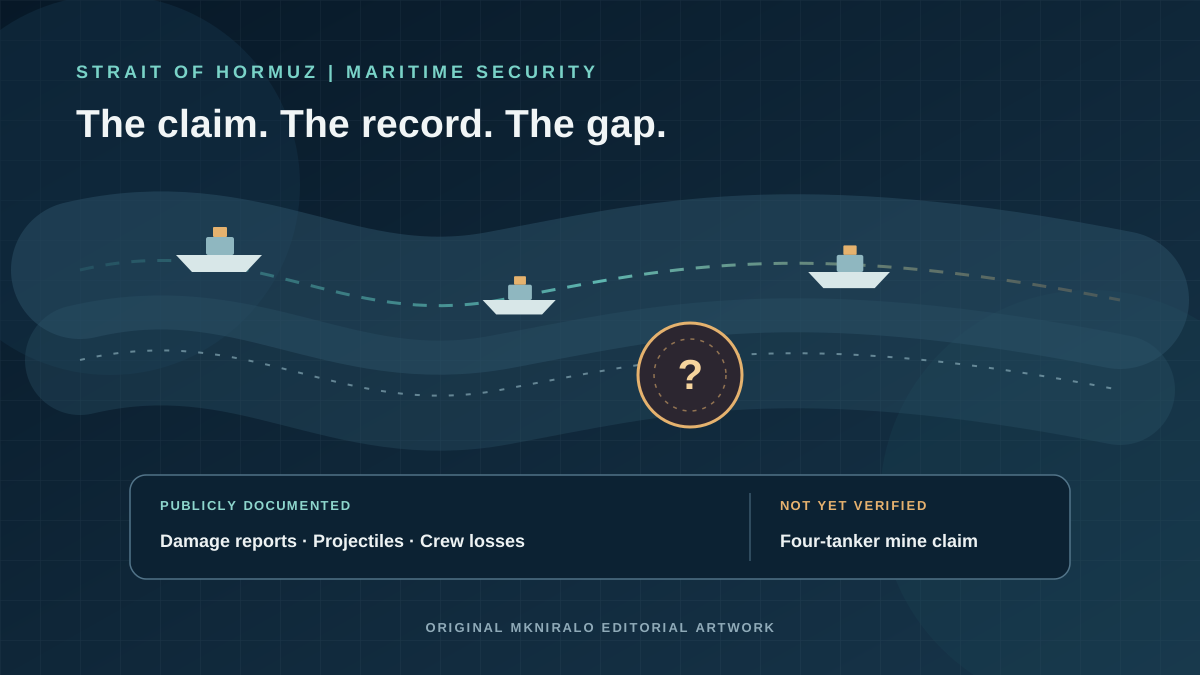
UK Maritime Trade Operations separately reported a 3 November incident northeast of Limah, Oman, in which a tanker security officer said two unknown projectiles struck the engine room; the notice reported no casualties or environmental impact at that time. UKMTO continued advising caution. Such specific risk reports can affect routing and safety decisions without proving any particular allegation about unnamed tankers or the use of naval mines.
Sources: How Many Ships Crossed the Strait of Hormuz Today? — 4 November 2026 13:27 UTC AIS snapshot · How hormuz.now Works: AIS Data, Status Rules and Why Counts Differ · Middle East — Highlighted (Confirmed) Incidents, status as at 3 November 2026 · Middle East / Strait of Hormuz situation and confirmed-incident methodology · UKMTO Recent Incidents — including incident 195-26 dated 3 November 2026
Why reduced traffic can coexist with recovering exports
A ship count cannot be converted directly into barrels of oil. A loaded crude carrier and a smaller general-cargo vessel both register as one crossing in an AIS tally, but they transport radically different quantities and goods. Some vessels may be invisible to that monitor; some export routes bypass the strait entirely. The geography and period covered also change the answer.
Reuters reported that Vortexa tracking data put Gulf exports of crude, condensate and refined products, excluding liquefied petroleum gas, at an average of 17.1 million barrels per day in October. That was down from 18.9 million in September but about three-quarters of pre-war levels. These are an analytics provider’s regional export-flow estimates for October—not November AIS crossing counts for one line across Hormuz. They should be reported side by side, never averaged together or represented as contradictory measurements of the same activity.
The broader exposure remains substantial. The International Energy Agency estimates that about 20 million barrels per day of crude and oil products crossed Hormuz in 2025 and that roughly 80% of those flows went to Asia. It assesses available Saudi and Emirati pipeline capacity that could redirect approximately 3.5 million to 5.5 million barrels per day around the strait. Those figures are a pre-war baseline and potential bypass capacity, not measurements of shipments passing today.
Sources: Oil slumps after midterm election rebuke to Trump raises bets on Iran war exit · How Many Ships Crossed the Strait of Hormuz Today? — 4 November 2026 13:27 UTC AIS snapshot · How hormuz.now Works: AIS Data, Status Rules and Why Counts Differ · Strait of Hormuz — Factsheet (2025 oil-flow baseline and bypass pipelines)
The oil market has moved faster than the ships
Brent settled at $103.60 a barrel on 3 November, according to Reuters. On 4 November the same benchmark settled at $94.62, a drop of $8.98, or 8.7%; U.S. West Texas Intermediate closed at $88.12. Both are futures-market settlement prices at specified dates, not the price of every physical cargo. Describing Brent as “currently around $103” after the 4 November close would be stale.
Reuters linked Wednesday’s selloff to investor expectations that the U.S. midterm election result might constrain further military action and increase incentives to negotiate. That is an attributed account of market sentiment, not proof that the election caused the precise price change or that policymakers have already agreed on terms. Traders also weigh inventory data, alternative supply routes, demand and other conflicts. Markets discount possible futures; captains need present-day navigation information.
Lower prices can reduce some near-term pressure on fuel importers, households and businesses, while exporters may face weaker revenue per barrel. Yet a falling futures price does not instantly undo higher insurance costs, diversions, delivery delays or infrastructure constraints. Conversely, renewed incidents or failed implementation could quickly restore a risk premium. The current contrast between prices and crossings is a reminder that expectations and physical logistics respond on different timetables.
Sources: Oil prices ease to settle near 4-week low on hopes peace talks will end wars · Oil slumps after midterm election rebuke to Trump raises bets on Iran war exit · How Many Ships Crossed the Strait of Hormuz Today? — 4 November 2026 13:27 UTC AIS snapshot · UKMTO Recent Incidents — including incident 195-26 dated 3 November 2026 · Strait of Hormuz — Factsheet (2025 oil-flow baseline and bypass pipelines)
What would make the next headline a real change
There are three separate tests. Diplomatically, is there a publicly attributable agreement with a sequence of reciprocal steps, a way to verify compliance and named mediators or guarantors? Operationally, do maritime advisories change and do consistent traffic datasets show sustained recovery rather than one unusual day? Economically, do insurers, charterers and physical oil traders see cheaper, more reliable routes—not merely a lower futures settlement?
The U.S. Maritime Administration continues to warn of elevated hazards to commercial navigation in the Gulf region. That official U.S. warning is a risk assessment, not a precise estimate of traffic or insurance premiums. It belongs alongside the IMO incident record and the AIS tracker, with each source answering its own question. A genuine easing should appear in several independent kinds of evidence rather than in a single political claim or market price.
For now, the defensible November 5 assessment is narrow but important: mediation continues without a reported breakthrough; AIS-visible shipping was severely restricted in the cited November 4 snapshot; the cumulative regional safety record remains grave; and Brent’s November 4 settlement fell sharply on expectations of de-escalation. These facts may move together eventually. They have not yet converged into a verified reopening or a peace agreement.
Sources: Advisor to Prime Minister, Official Spokesperson for Ministry of Foreign Affairs: Qatar Continues Its Efforts to Bridge Gap between Washington, Tehran · Iran, US still far apart on deal; Trump says ready but in no hurry for strikes · Oil slumps after midterm election rebuke to Trump raises bets on Iran war exit · How Many Ships Crossed the Strait of Hormuz Today? — 4 November 2026 13:27 UTC AIS snapshot · How hormuz.now Works: AIS Data, Status Rules and Why Counts Differ · Middle East — Highlighted (Confirmed) Incidents, status as at 3 November 2026 · Middle East / Strait of Hormuz situation and confirmed-incident methodology · UKMTO Recent Incidents — including incident 195-26 dated 3 November 2026 · 2026-011 — Persian Gulf, Strait of Hormuz and Gulf of Oman: Iranian Attacks on Commercial Vessels