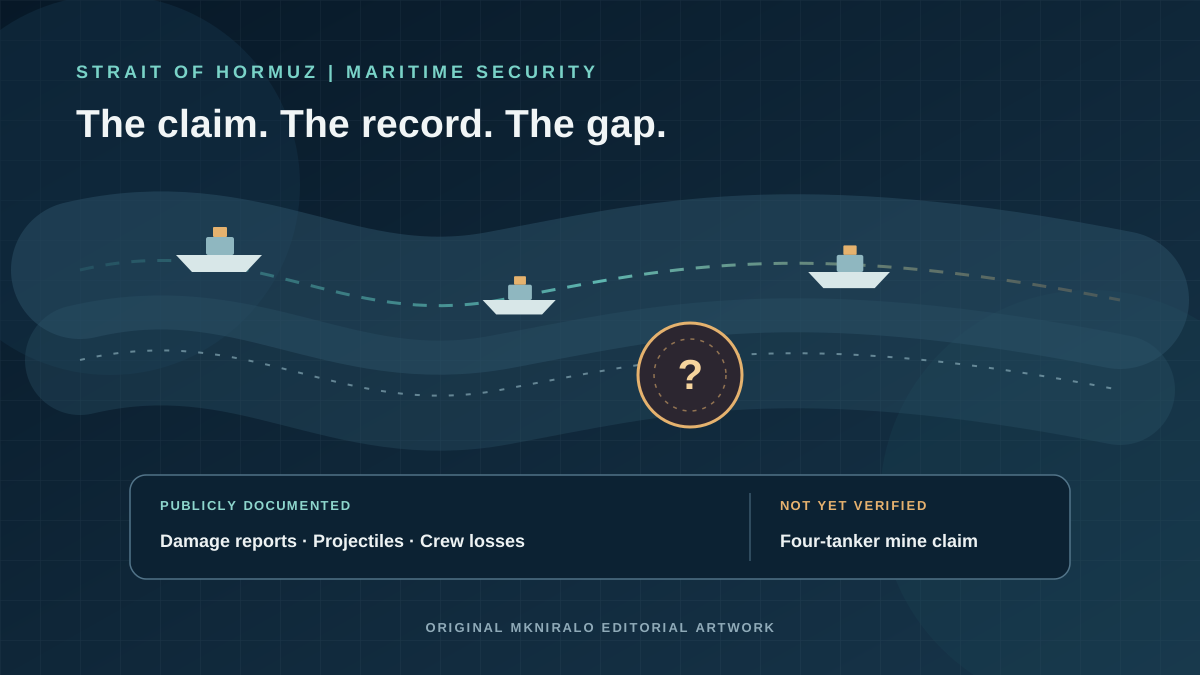
On 4 November, Iran’s Islamic Revolutionary Guard Corps (IRGC) said four oil tankers had been destroyed after hitting naval mines while attempting to use a route south of the Strait of Hormuz that it described as prohibited. The statement added that two other vessels had been stopped. Reuters reported the claim, and Iranian state-linked Pars Today carried the IRGC’s Statement No. 20, citing IRNA. Neither account named the tankers, supplied IMO numbers or flags, or gave coordinates, crew details, cargo information or independently reviewable evidence. The statement must therefore remain an attributed military claim, not a verified four-ship casualty list. That caution does not make the wider danger hypothetical: maritime agencies and governments have documented other attacks, damage and a seafarer’s death in the same corridor. [1][2][3][4][7]
A specific claim, not a verified casualty list
The IRGC said four tanker vessels had struck naval mines in a southern passage it called prohibited and were still burning. It also said two other vessels had been stopped. The statement frames the event as a consequence of ships entering a restricted route. But the published text supplies none of the identifiers normally needed to check a maritime casualty: ship names, IMO numbers, flag states, ownership, exact time and position, crew count, cargo or the condition of the hulls. It does not provide photographs, salvage records or port information that would allow an outside observer to match the claim to particular ships. [1]
Reuters’ 4 November report repeated the statement while attributing it to the IRGC; it did not independently confirm the four losses. Seatrade Maritime had reported a day earlier that the Guards made separate claims about three tankers hitting mines on 3 November and two more on 1–2 November. The trade publication said those claims had not been independently verified and that the vessels had not been identified by name or IMO number. Repeated claims should be tracked, but repetition does not turn an unverified report into a confirmed casualty. [2][7]
Sources: Statement No. 20 on four oil tankers, two stopped vessels and an MQ-9 claim · Iran's IRGC says four tankers ablaze after hitting mines near Strait of Hormuz · Indian seafarer killed in Hormuz Dhow strike
What the public incident record actually shows
The International Maritime Organization maintains a regional list of confirmed incidents, compiled using information from flag states, coastal states and credible, verified third-party sources. Its list, updated on 3 November, counted 128 confirmed incidents and 24 confirmed seafarer fatalities across the Persian Gulf, Strait of Hormuz and Gulf of Oman region. It identified LARGO ATOM (IMO 1034747) as damaged 72 nautical miles east of Ras Al Khafji on 1 November, with no pollution reported, and SELAT STORM (IMO 9266657) as damaged in the Strait of Hormuz on the same date, with pollution status unknown. The entries do not identify either ship as having struck a mine. [3]
UK Maritime Trade Operations (UKMTO) describes several other recent events in more specific but still cautious terms. Its public incident log records a merchant vessel in the Strait relaying a Mayday call that another vessel had been struck by an unknown projectile; a tanker 72 nautical miles east of Ras Al Khafji struck by two unknown projectiles; and a vessel nine nautical miles northeast of Lima, Oman, with a hole on its starboard side after an unknown projectile strike. On 3 November, UKMTO reported another tanker 14 nautical miles northeast of Lima had been struck by two unknown projectiles into its engine room. No casualties or environmental impact were reported in that notice. These are recorded reports of vessel damage; they do not verify the IRGC’s four-tanker mine claim. [4]
Sources: Middle East — Highlighted (Confirmed) Incidents · Recent Incidents — UKMTO
A named vessel, and a human cost
One separately documented event shows why ship-by-ship identification matters. On 2 November, the Indian-flagged commercial vessel MSV AL JUSUFI was attacked near Limah, Oman. India’s Ministry of External Affairs said 14 Indian nationals were aboard: 13 were rescued and one died after sustaining injuries. Shipping Minister Sarbananda Sonowal described the object that struck the vessel as unidentified. UKMTO’s 3 November notice said it was aware of the Indian government’s report of an attack on an Indian-crewed dhow sailing outbound through the Strait and that the Omani Royal Navy had rescued the surviving crew; at the time, UKMTO said it did not know the vessel’s status. [4][5][6]
The death is confirmed by India’s statement, but the weapon and the attacker are not established by the public evidence cited here. MSV AL JUSUFI was a dhow, not one of four named oil tankers. Its place in the same maritime crisis is important, but folding it into an oil-tanker total would distort both the vessel type and the evidence. [5][6][7]
Sources: Recent Incidents — UKMTO · Statement on attack on a commercial vessel off the coast of Oman · Update on attack on Indian vessel MSV AL JUSUFI off Oman · Indian seafarer killed as aerial object strikes cargo vessel off Oman coast, 13 rescued · Indian seafarer killed in Hormuz Dhow strike
A projectile, an explosive device and a mine are not interchangeable
A naval mine is a specific weapon, not a synonym for any blast or damaged hull. A vessel hit by an unknown projectile, an unidentified aerial object or explosive devices attached by a small craft may all suffer fire or structural damage, but each describes a different mechanism and calls for a separate investigation. In a 30 October update on a 29 October incident, UKMTO said a small boat had approached the vessel and attached two explosive devices to the hull above the waterline. The subsequent blasts caused an engine-room fire; the fire was later reported extinguished. That is a reported device-attachment incident, not evidence of a naval mine. [4]
The distinction changes the operational question. A confirmed mine strike would raise questions about where a mine was laid, how it is triggered, whether more mines remain and whether a channel needs to be surveyed or cleared. A projectile or aerial threat calls for different detection, routing, escort and response measures. Without identifying the mechanism, shipowners cannot translate a headline into a reliable hazard map. The available UKMTO descriptions deliberately preserve that uncertainty rather than assigning a weapon type that investigators have not established. [4]
Sources: Recent Incidents — UKMTO
Why uncertainty still matters to energy markets
The Strait’s importance explains why even an unverified claim can unsettle shipping decisions. The International Energy Agency says an average of about 20 million barrels per day of crude oil and oil products moved through Hormuz in 2025, around one-quarter of global seaborne oil trade. About 80% of those flows were destined for Asia. The IEA estimates that Saudi and UAE pipelines could redirect 3.5 million to 5.5 million barrels per day around the Strait, but that is not enough to replace the waterway’s normal throughput. [8]
Insurance is part of the calculation, but it is not a simple on/off switch. In March, the Lloyd’s Market Association said marine war-risk cover remained available for Hormuz transits, while premiums and terms could be renegotiated as risk increased. It said vessel and crew safety assessments, rather than an absence of insurance alone, were driving reduced traffic. That statement predates the 4 November claim and should not be mistaken for a live quote on current premiums. It does show why verified incident data, route risk and underwriter decisions need to be kept distinct. [9]
Sources: Strait of Hormuz — Factsheet · Safety concerns, not insurance availability, driving reduced vessel traffic in the Strait of Hormuz
What evidence would settle the four-tanker claim?
The claim could become independently verifiable if authorities or vessel owners released ship names and IMO numbers, precise coordinates and times, flag-state notifications, crew and casualty information, port or salvage records, satellite imagery or independent inspection findings. A confirmed oil spill or hull loss should also be reflected in relevant coastal-state and IMO reporting. Until such details emerge, the public record cannot show which four ships are being described or whether the claim can be matched to any independently logged casualties. [1][2][3][4]
The safest conclusion is neither that nothing happened nor that four tankers have been proved destroyed by mines. There is a documented pattern of attacks and damage around Hormuz, including the death of an Indian seafarer. There is also a new IRGC claim whose vessel identities and mine attribution remain unverified. Reporting those facts separately is not a semantic nicety. It is the minimum standard for understanding which ships, crews and cargoes are actually at risk. [2][3][4][6]
Sources: Statement No. 20 on four oil tankers, two stopped vessels and an MQ-9 claim · Iran's IRGC says four tankers ablaze after hitting mines near Strait of Hormuz · Middle East — Highlighted (Confirmed) Incidents · Recent Incidents — UKMTO · Indian seafarer killed as aerial object strikes cargo vessel off Oman coast, 13 rescued · Indian seafarer killed in Hormuz Dhow strike