Explosions reported on Iran’s Qeshm Island and later acknowledged by President Donald Trump have sharpened an already dangerous standoff. Washington describes the November 2 operation as a limited defensive strike; Tehran says the aggression has not ended. At the same time, Qatar is still exchanging proposals between the two governments. The immediate question is not simply whether another strike has occurred, but whether military pressure around the Strait of Hormuz can be contained while the unresolved nuclear and maritime disputes remain on the negotiating table.
A limited strike becomes public
On Monday, November 2, U.S. officials confirmed to Reuters and The Associated Press that American forces had carried out limited strikes on Iranian targets on Qeshm Island in the Strait of Hormuz. The officials described the operation as defensive, aimed at Iranian forces using surface-to-air missiles against U.S. assets. Initial accounts did not include a public target list or a verified damage or casualty assessment.
Trump acknowledged the operation on Fox News on November 3, saying U.S. forces had hit a newly completed anti-aircraft facility they had watched being built for about two months. He called it a “minor attack.” The remarks confirmed U.S. involvement but did not independently establish the target’s condition or the damage caused. Reuters said the Pentagon referred questions to CENTCOM, which did not respond.
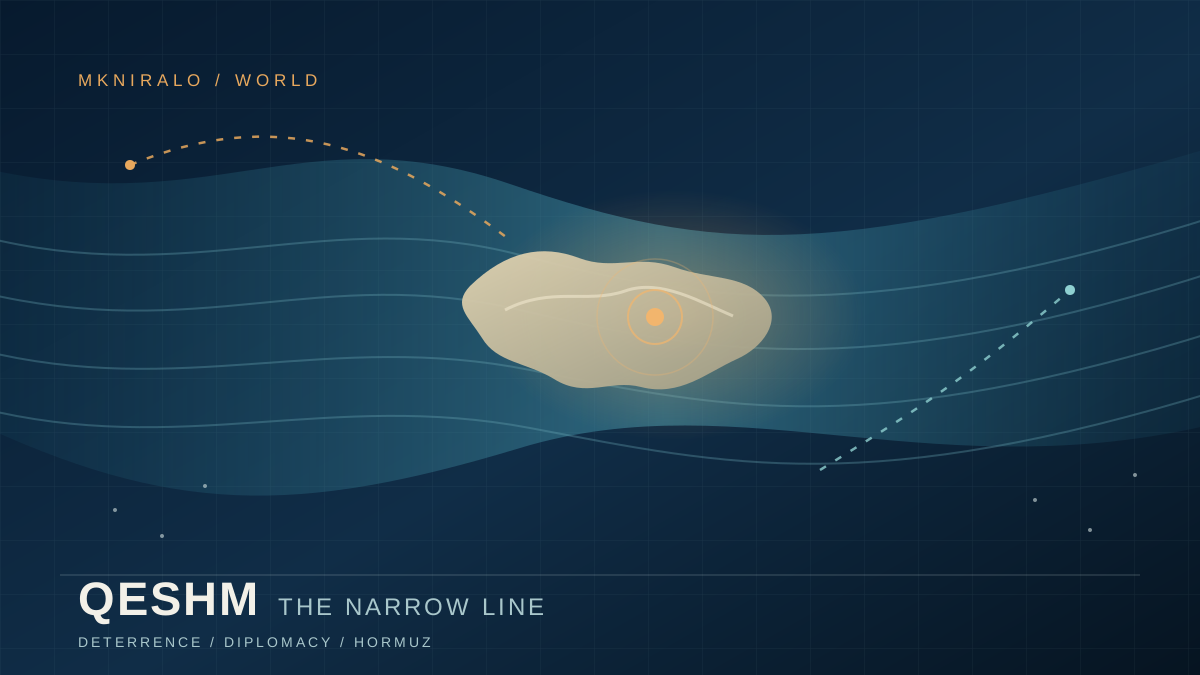
Qeshm lies near the northern entrance to Hormuz. Its importance is not just geographic: the waterway has become a pressure point in the conflict, where restrictions on Iranian shipping, attacks on commercial vessels and naval activity intersect. A limited strike near the strait can carry consequences beyond the immediate target without necessarily marking a return to full-scale air operations.
Sources: US carries out 'defensive' strikes on Iran's Qeshm Island, officials say · US has conducted defensive strikes on Iranian targets in the Strait of Hormuz, US official says · US Conducts Airstrikes on Iran, Latest in Series of Undisclosed Attacks · Trump confirms strikes on Iran as Tehran warns against return to war · Strait of Hormuz
Washington calls it defensive; Tehran says the aggression continues
The U.S. account has been deliberately narrow. Officials told news organizations that the strikes were defensive and did not signal a resumption of major combat operations. Trump used similar language about the scale of the action, while leaving open the possibility of further force. In a separate interview, he said the United States was ready if it needed to act, but suggested there might be no reason to do so.
Iranian officials rejected the idea that the episode could be treated as a contained incident. Deputy Foreign Minister Kazem Gharibabadi said Tehran considered the aggression against Iran to be continuing and retained the right to legitimate self-defence until military attacks had completely and permanently ended. He also said Iran remained prepared for different scenarios while messages continued to pass through mediators.
The two descriptions serve different purposes: Washington presents a limited response to a threat against its assets; Tehran frames another breach in a conflict it says has not ended. The immediate trigger is also disputed. U.S. officials said Iranian forces fired at an American aircraft; the IRGC claimed it downed an MQ-9, while a U.S. official told Air & Space Forces that no U.S. aircraft was believed to have been lost. The public record does not settle every operational detail.
Sources: US carries out 'defensive' strikes on Iran's Qeshm Island, officials say · US has conducted defensive strikes on Iranian targets in the Strait of Hormuz, US official says · US Conducts Airstrikes on Iran, Latest in Series of Undisclosed Attacks · Iran, US still far apart on deal; Trump says ready but in no hurry for strikes · Trump confirms strikes on Iran as Tehran warns against return to war
The nuclear dispute cannot be settled by a strike narrative
On November 3, Iranian Foreign Ministry spokesperson Esmaeil Baqaei said U.S. allegations about Iran’s nuclear programme were being used as a tool of political pressure. He argued that no evidence had been presented to prove that the programme had departed from its peaceful course. That is Tehran’s stated position, not a substitute for independent safeguards verification.
The IAEA’s latest full public safeguards report, GOV/2026/50, dated September 1, said the Agency had received no information during the reporting period about the status of Iran’s declared nuclear facilities or associated material. In a Security Council briefing on October 27, Director General Rafael Grossi clarified that Bushehr was the sole exception: inspectors were conducting verification there, but normal inspection activities elsewhere had not resumed. The Agency still lacked the information and access needed to verify Iran’s previously declared nuclear material.
The often-repeated figure of 440.9 kilograms of uranium enriched up to 60 percent is a historical estimate for June 13, 2025, not a current inventory. The IAEA said it had verified 432.9 kilograms of that amount in uranium hexafluoride form. The old estimate does not prove that Iran has a nuclear weapon; the continuing verification gap also prevents the Agency from confirming the present stockpile or whether all enrichment-related activity has stopped.
Sources: US Nuclear Claims Aim to Pressure Iran: Spokesman · Implementation of the NPT Safeguards Agreement and relevant provisions of the United Nations Security Council resolutions in the Islamic Republic of Iran (GOV/2026/50) · UN nuclear watchdog chief urges Iran to grant IAEA access to verify nuclear material
Qatar’s channel is open, but the gap remains
Qatar’s mediation continued after the Qeshm strike. In a November 3 statement, the Qatari Foreign Ministry said a delegation had travelled to Tehran on Monday and met Iranian counterparts for about three hours. They discussed proposals intended to bridge the gap between Washington and Tehran. The delegation returned to Doha that evening, while communications and exchanges of proposals continued.
The negotiating gap remains substantial. Reuters reported that Tehran wanted the United States to lift oil sanctions, end its naval blockade of Iranian ports and release frozen Iranian funds before the Strait of Hormuz could be reopened and nuclear negotiations could begin. Iran has also proposed a two-day process for reopening the waterway, tied to its wider conditions. These are Iranian demands, not agreed terms.
On November 3, Iranian security official Mohsen Rezaei called Washington’s response to Iran’s seven conditions unconvincing and said the Strait would reopen only if those conditions were addressed. Qatar said both sides were reviewing proposals but that no specific breakthrough could yet be announced. An open channel and an exchange of messages do not mean the parties have reached a deal.
Sources: Iran, US still far apart on deal; Trump says ready but in no hurry for strikes · Qatar Continues Its Efforts to Bridge Gap between Washington, Tehran · Iran says US reply to Hormuz plan ‘unconvincing’; Trump confirms strikes
Why Qeshm matters beyond the island
The Strait of Hormuz gives the confrontation an international economic dimension. The International Energy Agency says about 20 million barrels a day of crude oil and oil products passed through the strait in 2025, around a quarter of global seaborne oil trade. The route also carries most of Qatar’s and the United Arab Emirates’ liquefied natural gas exports. These are pre-war baseline figures, not today’s transit volumes.
Current traffic is difficult to measure. The IEA’s maritime chokepoints monitor warns that many tankers have switched off automatic identification system transponders, while GPS jamming and AIS spoofing have also been reported. The Agency says its figures are likely to understate actual traffic and that real transit volumes are difficult to determine precisely. Claims about the scale of disruption must acknowledge those limits.
That uncertainty does not reduce the waterway’s strategic importance. Another exchange of fire can raise perceived risks for ships, crews, insurers and energy traders even without a formal closure. Gulf governments have a direct interest in preventing escalation that could disrupt their exports or draw neighbouring states into the conflict. The Qeshm operation is therefore both a military event and a test of whether maritime pressure can be kept from overwhelming diplomacy.
Sources: Qatar Continues Its Efforts to Bridge Gap between Washington, Tehran · Strait of Hormuz · Middle East Maritime Chokepoints Shipping Monitor
An election result does not end the military risk
The November 3 U.S. midterm elections added a political signal. Reuters reported on November 4 that Democrats had won majorities in both the House and Senate, and that Iranian officials portrayed the result as a rejection of Trump’s war. Parliament Speaker Mohammad Baqer Qalibaf urged Washington not to disregard public opinion by attacking Iran again. Supreme Leader Mojtaba Khamenei said U.S. hostility would persist regardless of which party held power.
Reuters also reported that Tehran remained on high alert because senior Iranian sources feared Trump might seek to compensate for the political setback with another strike. That concern sits alongside the president’s mixed public signals: he called the Qeshm operation minor, said the United States was prepared to act again if necessary, and suggested there might be no reason to do so. The election changes the domestic political setting; it does not remove military options.
The next indicators are more concrete than rhetoric: whether Qatar can secure a response to the proposals, whether the parties can agree on the sequence for easing the blockade and reopening the strait, and whether Iran and the IAEA can restore a workable path to nuclear verification. A limited strike is not proof that full-scale war has resumed. Continued negotiations are not proof that peace is close.
Sources: Iran, US still far apart on deal; Trump says ready but in no hurry for strikes · Implementation of the NPT Safeguards Agreement and relevant provisions of the United Nations Security Council resolutions in the Islamic Republic of Iran (GOV/2026/50) · Qatar Continues Its Efforts to Bridge Gap between Washington, Tehran · Iran says US reply to Hormuz plan ‘unconvincing’; Trump confirms strikes · Iranian officials gloat as US voters deal blow to Trump