Imagine two people finishing the same entry-level job application. Both can do the work; both need to know whether the wage will cover their rent and travel. One advert states a realistic starting salary and explains its overtime and commission terms. The other promises a range so broad that the applicant can imagine a living wage at the top while the employer expects to offer the bottom. Both adverts contain a number. Only one has given the applicant information capable of changing a decision. This is a hypothetical comparison, not an account of an interviewed worker. It exposes the question behind the United Kingdom's proposed ‘say what you pay’ rule: can revealing pay make it easier for young applicants to find work that suits them, without pretending that better advertisements create more work? Our answer is qualified but testable. Once a rule is enacted and enforced, credible disclosure could improve salary-based screening for active 16–24-year-old applicants in covered vacancies, and occasionally strengthen starting pay where employers compete for talent. It is much less likely, on its own, to increase the supply of accessible jobs or substantially change youth unemployment and inactivity. Between seeing a figure and gaining an opportunity lie several missing steps—and those steps are where the policy should be judged.
A promise at the information layer, not yet a law
On 5 November 2026 the UK Government announced an intention to legislate so that employers disclose pay in recruitment, saying it wanted to act ‘as soon as possible’. The announcement did not bring a salary-advert requirement into force. It left the scope and details to be specified in due course. No honest account can yet assert which employers and occupations will be covered, precisely what pay components must appear, whether ranges will have to be narrow, who is responsible when an agency advertises a vacancy, when compliance begins, or what enforcement will look like. [1]
A consultation on equal pay and pay discrimination had already asked about salary history, information before interview and other elements of pay disclosure. A question about a written fallback for a role not publicly advertised is not evidence that such a fallback has been adopted. The gap between consultation options and enforceable statutory duties matters particularly for young people who enter work through intermediaries, personal networks or recruitment channels where no ordinary public advert appears. For now, claims about the rule's effects should apply only to actively applying young people and vacancies that eventually fall within actual coverage. [2][1]
The starting landscape is not as simple as ‘most employers refuse to name a salary’. In CIPD research published in 2024, 41% of surveyed organisations said they always published salary ranges in external recruitment adverts, while 18% always published a specific salary. ‘Always or sometimes’ brought those figures to 62% and 37% respectively. These were organisation-level self-reports from 832 UK HR professionals and senior decision-makers, surveyed on 3–24 October 2023—not a census of 2026 vacancies, and not measurements of whether the listed amount was useful to an entrant. The distinction prevents a survey of employer practices from becoming a false claim about the percentage of adverts awaiting reform. [3]
Indeed Hiring Lab reported that 58% of UK postings in its data included pay information over the three months to June 2026. That is a posting-based platform measure, not the same denominator as CIPD's organisation-level responses; directly subtracting 41 from 58 would manufacture a trend. Indeed also reported that its posting index was down 11% from the start of 2026 and 32% from a pre-pandemic baseline. Those are indicators of a difficult recruiting environment, not proof that the forthcoming proposal caused or can reverse it. A reform of information should not be mistaken for a reversal of demand. [4][3]
Sources: New ‘say what you pay’ law to help young people into work · Annex A: full list of consultation questions · Pay, performance and transparency 2024 · UK Labour Market Snapshot — August 2026
The difference between a visible number and a usable offer
Start with a deliberately fictional comparison. Vacancy A lists £22,000–£42,000 a year for a full-time starter role, with ‘bonus potential’ and no indication of the typical offer. Vacancy B lists £24,000–£26,000 for 37.5 hours a week, a typical first offer of £24,500 and separately described shift premiums. Nothing in this illustration establishes what real UK firms offer. Its point is that the higher ceiling in A may be less useful than the narrower, explained range in B. Applicants cannot screen for affordability if the range contains every conceivable career stage but does not disclose where a new entrant is likely to land.
The first failure is comparability. Annual salaries cannot be compared without hours; a shift-dependent package is different from fixed base pay; commission that is ‘uncapped’ is not guaranteed earnings. Location, contract length and eligibility conditions also matter. The second failure is credibility: even a comparable range may conceal that the employer routinely makes its initial offers at the floor. A salary signal should specify both the likely starting point and objective criteria for placement or progression. Otherwise transparency measures the ink on an advert more readily than a jobseeker's realistic options. [2][17]
Lee, Park and Chang's US research on pay-range disclosures gives this concern empirical substance. Across a series of studies, range width affected people's application preferences, while information about typical starting salaries and how offers are determined altered the interpretation of wide ranges. These are valuable findings about preferences and range design, not observed UK hiring or pay outcomes for 16–24-year-olds. They do not prove that a particular British range width is ideal; they show why clarity about the expected offer is a different instrument from displaying a large maximum. [9]
This is also why ‘the employer disclosed pay’ should be a measurement category, not an assessment of success. A useful record would contain the wage basis, contracted hours, pay period, geographical context, fixed and material variable components, a credible floor, expected starting point and placement criteria. A broad band is not inherently deceptive: a vacancy may genuinely accommodate different experience levels. Its defensibility depends on whether an inexperienced candidate can tell which part is plausible. The relevant unit is a prospective decision, not merely a compliant advertisement. [9][17]
Sources: Annex A: full list of consultation questions · The Implications of Pay Range Transparency on Job Application Preferences and Negotiations · Pay Transparency in Progress: Valuing Jobs, Closing Gender Pay Gaps
What comparative evidence can—and cannot—tell us about search
The best claim for disclosure is not that people suddenly become more employable. It is that they can direct limited search time toward plausible matches. Samuel Skoda's study of Slovakia's 2018 pay-information requirement found that applicants redirected attention toward firms that had previously concealed salary information and searched across a broader set of opportunities. The study also reports roughly 3% higher wages for new hires at affected firms. Slovakia's rule included a constraint on offers below the advertised fixed-pay amount, an important design difference from an as-yet-undefined UK proposal. Neither the applicant shift nor the wage result is an estimate for British teenagers and young adults. [7]
A randomized field experiment reported in Bank of England Staff Working Paper 1148 provides a different test. Conducted in Addis Ababa, Ethiopia—not Britain—it showed that displaying a wage moved applications toward better-paying vacancies, without a significant average increase in application volume or applicant quality. The interaction that underpins a key sorting result was not pre-specified, so its interpretation needs restraint. The paper demonstrates a plausible direction-of-search response, not that disclosure raised the overall number or quality of candidates, and not that a UK applicant thereby obtained a job. [8]
The contrast is consequential. A candidate who sees lower pay and decides against an application may have avoided wasted effort. Yet a firm can receive fewer applications even when search becomes more informed; a higher-paying firm may receive more without expanding its vacancies. If jobseekers simply redistribute themselves across unchanged positions, the benefits can be real at the individual decision level and small at the economy-wide employment level. Search efficiency and job creation answer different questions. Evidence of one must not be smuggled in as evidence of the other. [7][8]
UK candidate polling suggests that stated preferences make salary disclosure salient. CV-Library reported respondents saying they would not apply without pay information, but such answers are intentions in a platform-linked survey, not a representative observation of how UK 16–24-year-olds actually behaved. The future measures worth collecting are applications avoided below a candidate's stated minimum, withdrawals for pay-related reasons, offer refusals after late disclosure, and actual changes in application destinations. The research reviewed so far establishes a mechanism in other contexts, not a measured fall in British salary-related withdrawals or a rise in successful negotiations. [5][18]
Sources: Candidate Behaviour Barometer 2026: The Recruitment Trust Gap · Directing Job Search in Practice: Mandating Pay Information in Job Ads · Wage Information and Applicant Selection · Salary transparency in job adverts: What candidates want in 2026
The harder step: turning information into pay
A US National Bureau of Economic Research working paper by David Arnold, Simon Quach and Bledi Taska studied state-level job-ad disclosure rules. It reports an approximately 30-percentage-point increase in the fraction of postings carrying salary information and wage gains of 1.3–3.6% across three datasets. It detects no effect on overall employment, posting counts, pay dispersion or skill requirements in the studied setting. This is unusually useful comparative evidence because it distinguishes information from several outcomes; it is neither a UK estimate nor an estimate of starting salaries for UK 16–24-year-olds. A rise in posted pay is not always an increase in the figure a new hire takes home. [6]
There is an attractive mechanism here. If a vacancy's likely wage is known, competing employers can become more visible alternatives, and some may need to make better offers to attract applicants. But a young entrant with little experience may have limited alternatives; information about what other firms pay does not itself create a credible threat to leave. A firm can use the published range as a bargaining anchor, or hold to its lowest defensible offer. In a market with many genuinely substitutable vacancies, information could sometimes become leverage. In a market with few suitable entry routes, the same information may mainly help someone reject a role they could not afford. [6][10]
Research on transparency is not interchangeable across settings. Zoe Cullen distinguishes information about coworkers' pay within a firm from information about compensation at other firms. Horizontal transparency can change internal wage-setting and bargaining differently from cross-firm transparency that reveals outside options. A separate UK study by Blundell and colleagues found roughly a 19% reduction in the gender pay gap under mandatory aggregate employer reporting; the result was driven mainly by slower male pay growth rather than an average pay rise for women. That policy was not job-ad disclosure. Treating either horizontal transparency or aggregate gender reporting as a direct forecast for young entrants' starting wages would conflate different treatments and populations. [10][11]
A conditional starting-pay gain is therefore defensible as a hypothesis: particularly where a real employer competes for candidates, posts a credible narrow range and faces an applicant with plausible alternatives. The threshold is demanding. It requires actual offers, hours and payroll records, not merely figures from adverts. It also requires checking whether a base-wage improvement has been offset by lower bonuses, shorter shifts or less secure contracts. We have comparative reasons to investigate a modest upside, but no direct causal estimate for young UK hires with which to declare it achieved. [6][7][11]
Sources: The Impact of Pay Transparency in Job Postings on the Labor Market · Directing Job Search in Practice: Mandating Pay Information in Job Ads · Is Pay Transparency Good? · Pay Transparency and Gender Equality
The strongest objection: the missing job remains missing
Here is the strongest case against assigning much youth-employment weight to the proposal. Salary transparency improves the description of vacancies that already exist. It does not cause a firm to need another junior employee; supply a first paid work experience; create an apprenticeship; repair inadequate qualifications; make a young person well enough to work; or resolve the practical barriers facing someone outside the labour force. If the binding obstacle is a lack of suitable entry routes, better information may help a minority of active applicants while leaving the number who can actually enter employment little changed. This criticism is not anti-transparency. It is an argument about the limits of the mechanism. [15]
The Milburn Review's interim report describes structural change in occupational demand: approximately 1.6 million fewer mid- and lower-skilled jobs and 6.3 million more higher-skilled jobs over about two decades. It reports that young people are disproportionately represented in declining occupations. These are changes in employment stocks and broad occupational categories, not a measured count of entry-level vacancies newly opened or closed. They nevertheless challenge a simple premise that information is the principal barrier facing first-time workers. If the mix of available jobs demands more experience and credentials, an improved advert does not supply either. [15]
Experience routes add another constraint. The same interim report says apprenticeship starts by under-19s in England fell from roughly 130,000 in 2014/15 to roughly 75,000 in 2024/25. It also reports that about six in ten young people classified as NEET had never had a paid job. Neither statistic says every apprentice place is equivalent to an advertised entry-level vacancy, or that missing experience is the only cause of a particular candidate's rejection. Together, though, they show why a salary disclosure rule cannot be judged as a stand-in for apprenticeship capacity or an employer's willingness to hire and train novices. [15]
Readiness is not simply an employer demand issue. Survey findings cited by the Milburn interim review suggest that approximately 47% of 18–24-year-olds and 36% of NEET young people felt ready for work on leaving education. These are respondents' feelings, not an administrative skills test and not a reliable label for every young person. Still, they signal a question that pay figures cannot answer: what knowledge, confidence, support and transition opportunities would make an applicant capable of taking and retaining a role? Better advertised pay can clarify the prize without changing the preparations needed to reach it. [15]
The categories of unemployment and inactivity are equally important. The Office for National Statistics estimated 981,000 people aged 16–24 were not in education, employment or training in April–June 2026: 13.0% of the age group. Of those, approximately 393,000 were unemployed and 588,000 were economically inactive. These are Labour Force Survey estimates subject to sampling variability, not a census of nearly a million applicants actively searching job boards. Almost six in ten of those counted as NEET were inactive, a group in which health problems, caring circumstances and other barriers may require different responses. Conflating NEET with active search makes the proposed information reform look broader than its plausible reach. [13][14][15]
Evidence about the total number of jobs also gives the critics their due. The US NBER study did not detect aggregate employment or postings gains; Skoda found no increase in overall new hires in Slovakia; Duka and Weber's US analysis found a 1–6% decline in an online posting measure that was not statistically significant in its preferred specification. The detailed Duka–Weber discussion here comes from an author preprint, not an open final journal text, and a posting index is not a count of actual hires. The Ethiopian experiment changed allocation of applications without significantly raising their average number or quality. These studies are diverse, but none establishes the creation of additional jobs from salary disclosure alone. [6][7][12][8]
We concede the central objection. Disclosure is not a substitute for employer demand, training places, work experience, health care, disability accommodation, mental-health support or sustained help into work. Nor can it ensure that a young applicant with limited mobility or caring duties can accept a better-paid vacancy elsewhere. What the objection does not erase is the smaller case: among existing covered jobs, a clearer salary signal could prevent some futile applications, help applicants choose among options and sometimes make wage competition more visible. These are bounded gains worth testing rather than an employment strategy to be credited in advance. [15][13]
Sources: The Impact of Pay Transparency in Job Postings on the Labor Market · Directing Job Search in Practice: Mandating Pay Information in Job Ads · Wage Information and Applicant Selection · The Effect of Mandatory Salary Revelations on Job Postings · Young people not in education, employment or training (NEET): August 2026 · Young people not in education, employment or training (NEET), Table 2: sampling variabilities · Young People and Work: Interim Report
Four ways a disclosure rule could work against entrants
The first risk is pay compression. When salaries become visible, an employer may standardise offers around a common point. That could reduce unexplained differences but could also restrain some workers' pay. Cullen's distinction between within-firm and cross-firm transparency matters here: evidence of compression in one information regime cannot simply be transferred to job-ad mandates. The risk is that a policy promising better pay instead produces a tidier, but not necessarily higher, pay schedule. Evaluating the outcome means inspecting the distribution of actual offers, not assuming uniformity is either equity or harm. [10][6]
The second risk is employer bargaining advantage. Publishing a band can make the employer's ceiling salient while concealing a candidate's bargaining alternatives. For an inexperienced applicant who needs an immediate income, ‘the published scale is the published scale’ could become a convenient refusal to negotiate. Other applicants may use disclosed cross-firm salaries to bargain more effectively. Both responses are possible. The deciding variable is not the mere presence of information, but who can act on it and whether competing opportunities genuinely exist. [10]
The third is range anchoring. A headline range of £22,000–£42,000 may lead an applicant to overvalue a vacancy if the top is practically unavailable to newcomers. Conversely, a clear entry-level floor can prevent false hope and wasted time. Studies of range width and starting-point information support this concern about expectations; they do not show that UK employers have already systematically anchored young applicants to the bottom. The difference will have to be measured by linking adverts with actual offers and documented placement criteria. [9]
The fourth is avoidance and compliance gaming. An employer could post a technically numeric but impossibly broad band, shift reward into opaque commissions, advertise through an intermediary, or rely more on unadvertised recruitment. The OECD's comparative review shows that countries differ in whether they require bonuses and other compensation to be disclosed, and monitoring may leave private recruitment channels less visible. These are plausible loopholes, not established misconduct by British employers under a law that does not yet exist. Their relevance depends on eventual legal coverage, enforcement and the information that regulators can inspect. [17][1]
These risks must be kept separate. Compression concerns the wage distribution. Employer bargaining power concerns who can negotiate. Anchoring concerns the expectations created by a range. Gaming concerns whether legal disclosure can be made nominal or evaded. A single before-and-after measure of the number of adverts with salary figures could miss all four. It might even register success as the usefulness of the figures deteriorates. The appropriate test follows offers, hours, variable pay and entry-level recruiting across channels rather than celebrating compliance alone. [10][9][17]
Sources: New ‘say what you pay’ law to help young people into work · The Impact of Pay Transparency in Job Postings on the Labor Market · The Implications of Pay Range Transparency on Job Application Preferences and Negotiations · Is Pay Transparency Good? · Pay Transparency in Progress: Valuing Jobs, Closing Gender Pay Gaps
The Salary Signal Chain: where the useful story breaks
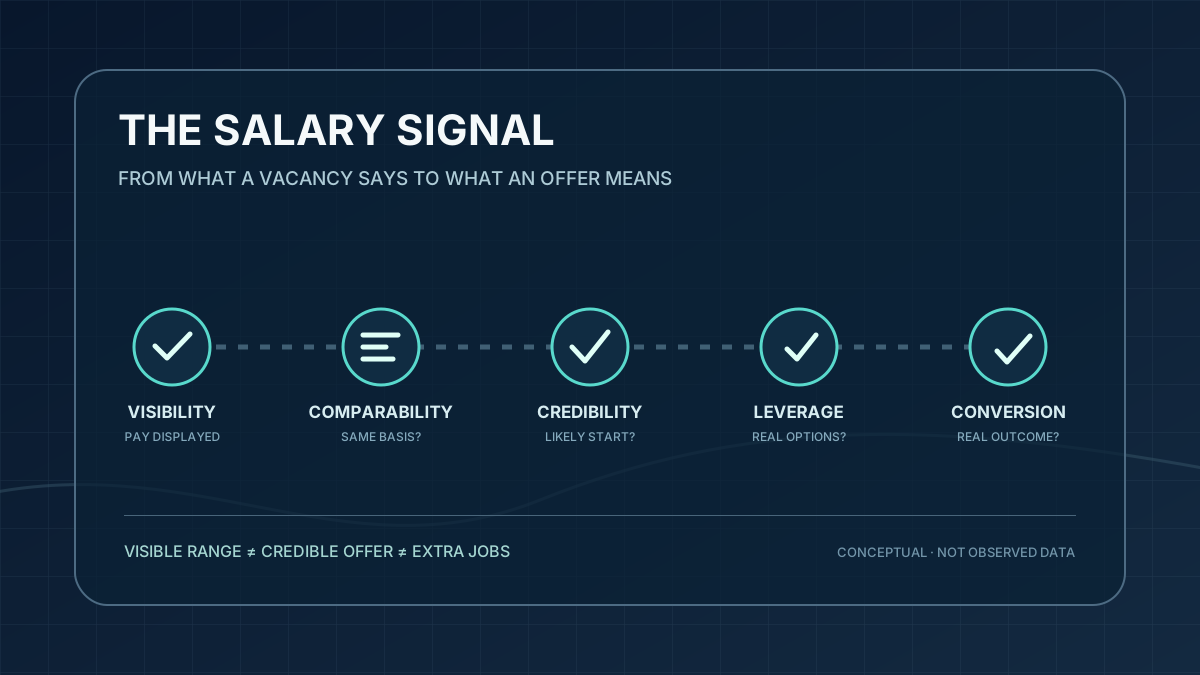
The diagnostic that connects these observations is the Salary Signal Chain: visibility → comparability → credibility → leverage → conversion. Visibility asks whether a covered applicant can see any pay number; comparability asks whether the number has a coherent time basis, hours and compensation terms; credibility asks whether the applicant can infer the likely actual offer; leverage asks whether the information changes a realistic application or negotiation choice; and conversion asks whether a better-informed choice results in real pay, match quality or employment gains. The arrows are hypotheses about necessary transitions, not evidence that each transition occurs automatically. A reform can improve the first stage while leaving the last largely unchanged. [1][9][6]
For measurement, each link needs a different denominator. Track the proportion of covered vacancies carrying usable disclosure, rather than the proportion of surveyed organisations saying they ‘always’ advertise ranges. Compare pay per hour as well as per year and distinguish base from variable earnings. Survey applicants on their stated minimum wages before they see an offer, then observe applications, salary-related withdrawals and offer decisions in recruiting records. Link actual offers to payroll data and check contracted hours and progression. Finally, assess new hires and population-wide employment separately. One useful data collection system cannot be replaced by a public opinion poll or a job-board headline. [3][5][13]
The weakest functional link is credibility. The clearest advert may still mislead if the median new entrant has no chance of receiving the headline figure. A proposed diagnostic is the Range-to-Reward Wedge: compare the advertised interval with the actual base offer and realised total reward. For a bounded range, an offer's position can be calculated as (actual base offer − advertised lower bound) ÷ (advertised upper bound − advertised lower bound). A position near zero is not automatically abusive for a beginner; it becomes troubling if placement rules are undisclosed or the range systematically advertises rewards rarely offered. The arithmetic does not prove misconduct. It tells an evaluator what evidence to collect. [9][6]
The weakest evidence link is conversion. No study in the reviewed evidence estimates the causal effect of a UK job-ad disclosure mandate on starting pay or employment for 16–24-year-olds. That absence should neither be treated as proof of failure nor blurred with the US and Slovak gains. The Disclosure-to-Opportunity Gap names the possibility that usable salary information rises much faster than the quantity or accessibility of actual entry routes. It is an interpretive comparison, not an observed numerical gap. Its usefulness is to keep two outcomes in view: what applicants know, and what they can actually obtain. [6][7][13][15]
Sources: New ‘say what you pay’ law to help young people into work · Pay, performance and transparency 2024 · Candidate Behaviour Barometer 2026: The Recruitment Trust Gap · The Impact of Pay Transparency in Job Postings on the Labor Market · Directing Job Search in Practice: Mandating Pay Information in Job Ads · The Implications of Pay Range Transparency on Job Application Preferences and Negotiations · Young people not in education, employment or training (NEET): August 2026 · Young People and Work: Interim Report
Five tests that could overturn this argument
A thesis about a future rule must declare in advance what would count against it. The following numerical cut-offs are our proposed editorial materiality thresholds, not academic standards, government targets or observed policy effects. They refer to future post-commencement evaluations, with credible counterfactuals and uncertainty intervals. Each is deliberately vulnerable to evidence, and each must be interpreted against the eventual enacted law rather than an announcement. A single national before-and-after comparison would not reliably separate the rule from changes in labour demand, minimum wages, inflation or other employment programmes. [1][14]
1. The information mechanism fails. Within 12 months of commencement, the share of covered UK vacancies carrying usable pay information does not rise by at least 15 percentage points against a credible counterfactual, or the apparent increase consists mainly of ranges so broad or conditional that applicants cannot infer a plausible starting offer. If this happens, the first link in the thesis fails.
2. The search-behaviour mechanism fails. Within 12–24 months, representative applicant or applicant-tracking data show no policy-attributable improvement in salary-related screening—for example, no 5% relative reduction in pay-related withdrawals after interview, avoidable applications to roles below a stated pay threshold, or offer-stage rejection caused by late salary disclosure. If the information changes what is printed but not what applicants do, the ‘better matching’ claim must be killed.
3. The pay-outcome component fails. Within 24–36 months, real starting hourly pay for 16–24-year-old hires in covered roles does not rise by at least 1% relative to matched roles, employers or sectors, including in competitive vacancies with narrow, credible ranges. A null result would mean that better information did not become a material pay gain for young entrants. The test must account for hours, occupation, region, experience, bonuses and changes in job composition.
4. The employment-limit component is falsified. A credible quasi-experimental evaluation finds that the rule itself raises the 16–24 employment rate or reduces the NEET rate by at least 0.5 percentage points relative to a counterfactual within 24–36 months. That would show a larger youth-employment effect than this thesis predicts and require a stronger account of the hiring mechanism. The ONS warns that short-term changes in NEET survey estimates can fall within sampling variability: a single-quarter 0.5-point movement is uninterpretable as a causal policy effect without a power calculation, confidence intervals and pooled or multi-quarter data. [13][14]
5. The policy causes a material adverse effect. If covered employers systematically anchor young applicants at the bottom of ranges, shift compensation into opaque components, or reduce entry-level hiring in a way that survives controls for the wider labour market, the thesis must be revised from ‘bounded benefit’ to a potentially counterproductive intervention. No numerical adverse-effect cut-off has been established in this argument; one should be specified prospectively using offer, reward and vacancy data, not selected after outcomes are known.
Two contrary findings would be especially decisive. A credible UK study showing no meaningful increase in usable information or no change in applicant screening would defeat the claim that this is a matching reform. Equally, a robust and material rise in youth employment or fall in NEET caused by the rule would defeat the expectation that its effects are confined mainly to information and pay-setting. The hypothesis should be willing to lose in either direction. Less decisive findings—such as attractive new salary figures alongside unchanged hiring—would demand a narrower verdict, not a claim of comprehensive victory. [14]
Sources: New ‘say what you pay’ law to help young people into work · Young people not in education, employment or training (NEET): August 2026 · Young people not in education, employment or training (NEET), Table 2: sampling variabilities
A design agenda is not an employment promise
The evidence permits a limited prescription, and it should be labelled as such: the following are questions for policy design, not measures that the Government has already adopted. Should a rule require a realistic floor and a typical starting figure, rather than any positive number? Should employers explain how new entrants are placed within a range and how progression occurs? Should material bonus, commission, shift and overtime terms be separately visible? A rule concerned with usable information rather than nominal compliance would have to answer these before its success could be measured. [1][2][9]
Coverage and enforcement raise another set of questions. Who discloses pay when an agency recruits on an employer's behalf? What happens when hiring takes place through an unadvertised channel? Which job boards and recruitment intermediaries would an enforcement body monitor, and how would regulators know if the same employer consistently offered salaries below the plausible published starting point? The consultation considered written pre-interview information, but no final UK requirement for those channels should be inferred from that consideration. The European Union's Directive 2023/970 offers a comparative legal design, not evidence of UK results: its transposition date was 7 June 2026, Member State reports are due by 7 June 2031, and the Commission report is due by 7 June 2033. [2][16][17]
These are worthwhile questions only if their answers are accompanied by measurable evidence and proportionate enforcement. An evaluation should compare covered and credibly matched uncovered vacancies, account for changes in job mix, and trace the same positions from advert to application, offer and payroll. The question of a wider youth-employment strategy is separate: experience routes, training, accessible work, health support and employer demand cannot be inferred from the publication of salary ranges. A readable figure on a vacancy is a modest public good if it helps a young person decide not to waste a week on a role they cannot afford. That modesty is a reason to measure it properly, not to dress it as a solution to NEET. [15][13]
The next meaningful question is therefore narrower, and harder, than whether the number of salary-bearing advertisements rises. When the first young applicants receive offers under any eventual UK rule, will the wage they can realistically earn correspond to the promise they saw—and will enough alternative vacancies exist for that information to change their choice? If the answer to the first is no, the signal is decoration. If the second is no, it may still save a wasted application, but it cannot by itself make a missing job appear.
Sources: New ‘say what you pay’ law to help young people into work · Annex A: full list of consultation questions · The Implications of Pay Range Transparency on Job Application Preferences and Negotiations · Young people not in education, employment or training (NEET): August 2026 · Young People and Work: Interim Report · Directive (EU) 2023/970 of the European Parliament and of the Council of 10 May 2023 · Pay Transparency in Progress: Valuing Jobs, Closing Gender Pay Gaps