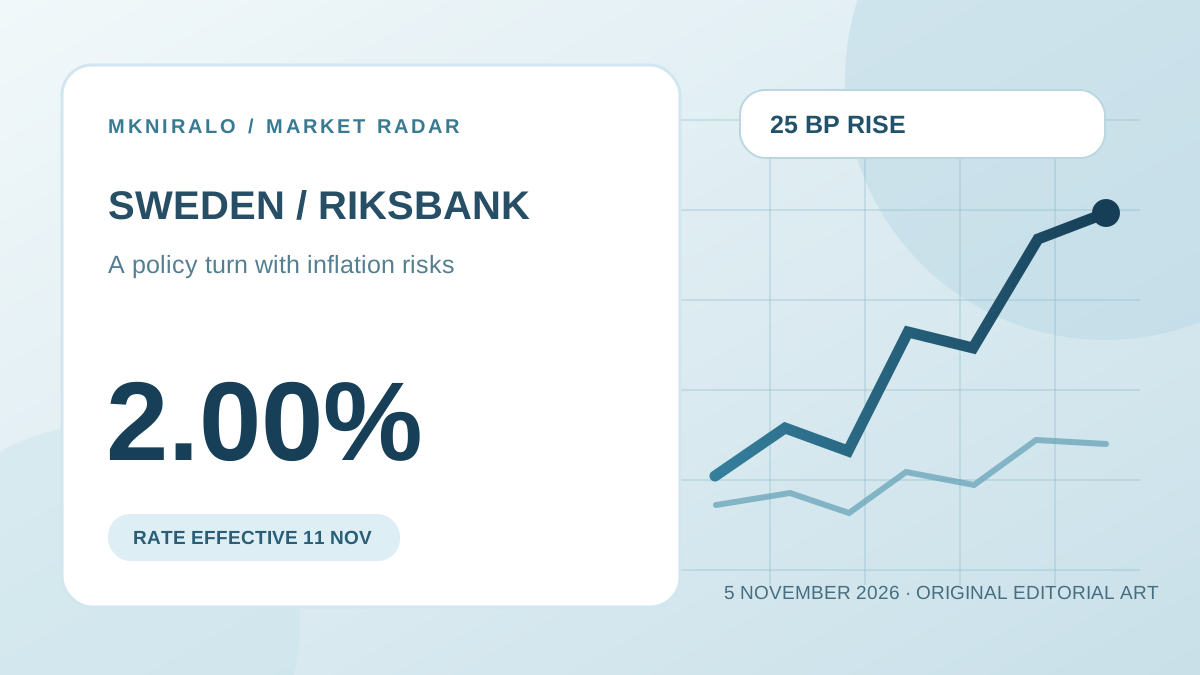
Sweden’s central bank has changed direction. The Riksbank announced on 4 November that it would lift its policy rate by 0.25 percentage points to 2.00%, with the new rate taking effect on 11 November. It is the bank’s first increase since its September 2023 tightening decision, following a period in which rates were eventually reduced to 1.75%. The reversal is striking because the latest headline inflation measure is below the central bank’s target. Policymakers are responding not only to what prices did in September, but also to the possibility that energy disruption, a weaker currency and stronger domestic activity could push inflation higher in 2027.
The decision reverses a long easing cycle
The Executive Board approved the increase on the assessment that Swedish economic activity is strengthening while cost pressures from global supply disruptions are likely to lift inflation. The decision was announced on Wednesday, 4 November, but the operating policy rate does not change until Wednesday, 11 November. That distinction matters for reporting the news: a rate decision and the date from which banks face the new rate are not necessarily the same day.
The historical comparison is also substantive rather than decorative. In September 2023, the Riksbank raised the policy rate to 4%, effective 27 September, as it battled persistent inflation. Subsequently, a sequence of cuts left the policy rate at 1.75% from October 2025 until this week’s announcement. The new rise therefore represents a turn away from easing, not a continuation of last year’s policy direction.
Sources: Policy rate raised to 2 per cent · Monetary policy decision — November 2026 · Monetary Policy Report, September 2023 · Policy rate, deposit and lending rate — historical sequence
Why 1.5% headline inflation did not prevent a hike
September inflation measured by the consumer price index with a fixed interest rate, or CPIF, was 1.5%. That is below the Riksbank’s 2% target and might, in isolation, appear to argue against tightening. But the bank says direct effects of temporary fiscal policy measures are depressing the published number. Excluding those effects, CPIF inflation was 3.0%. These are different readings of price pressure, not interchangeable versions of the same statistic.
The bank reported a further measure that strips out energy prices as well as the temporary fiscal effects; it stood at 1.6% and was slightly below expectation. That creates a genuine policy tension. Some observed underlying inflation measures look relatively contained, yet officials believe the next year may bring higher costs from energy disruption, exchange-rate weakness and firmer demand. The case for the rise is fundamentally forward-looking.
Sources: Policy rate raised to 2 per cent
An improving economy changes the calculation
According to the Riksbank, preliminary figures showed both Swedish GDP and employment increased in the third quarter broadly as expected. It said corporate sentiment continued to improve in October even as household confidence weakened. Those contrasting observations suggest that a recovery may be developing unevenly: stronger business activity can coexist with consumer caution about living costs and financial uncertainty.
The bank expects activity to return toward more normal conditions next year and the labour market to strengthen. But it expressly acknowledged uncertainty about how durable that labour-market improvement will be. A central bank cannot observe next year’s output gap or hiring decisions directly today; it makes a judgment about how current evidence and projected supply costs could interact.
Sources: Policy rate raised to 2 per cent · Monetary policy decision — November 2026
What the central bank can and cannot control
The Riksbank identified supply disruptions linked to the Middle East war, rising international energy prices and a weaker krona this year as forces that could push Swedish inflation above target in 2027. Higher interest rates cannot rebuild disrupted supply chains or directly lower the international price of fuel. They can, however, affect domestic demand, financing costs and the conditions under which companies pass a temporary cost rise through to broader prices.
This means a rate increase comes with an economic trade-off. If price pressures persist and demand strengthens, doing too little could make it harder to return inflation sustainably to 2%. If supply costs fade and hiring slows, tighter borrowing conditions could weigh on households and investment unnecessarily. The press release names risks on both sides, including geopolitical uncertainty and weaker global demand.
Sources: Policy rate raised to 2 per cent
Further hikes are conditional, not scheduled
The Riksbank said another increase during the coming year is likely if the outlook for inflation and economic activity develops as anticipated. The wording is important: the bank has not pre-announced a fixed number of increases or committed to a particular timetable. It links the future path to evidence that will change as energy markets, the krona, wages and demand evolve.
It also noted that this November Monetary Policy Update assessed new information against the existing forecast rather than presenting an entirely new set of forecasts. The next full Monetary Policy Report, with updated projections, is scheduled for 16 December. Readers should not confuse the November commentary with a wholly new forecast track that the bank says was not published.
Sources: Policy rate raised to 2 per cent · Monetary policy decision — November 2026
The next two dates to watch
Minutes from the Executive Board’s monetary-policy meeting are scheduled for publication on 10 November. They should reveal more about the reasoning and debate behind the decision, although the rate increase itself is already public. On 11 November, the new 2.00% policy rate is due to take effect, changing the operational baseline to which financial markets and lending conditions respond.
The next policy meeting is set for 15 December, with the decision scheduled to be communicated on 16 December. By then the central question will not simply be whether September’s CPIF was below target. It will be whether the economy’s improving momentum and globally transmitted cost pressures still justify tighter policy, and how much room remains to support the recovery. The bank’s own conditional wording leaves that question open.
Sources: Policy rate raised to 2 per cent · Publication of the minutes from the monetary policy meeting — 10 November 2026 · Monetary policy decision — November 2026