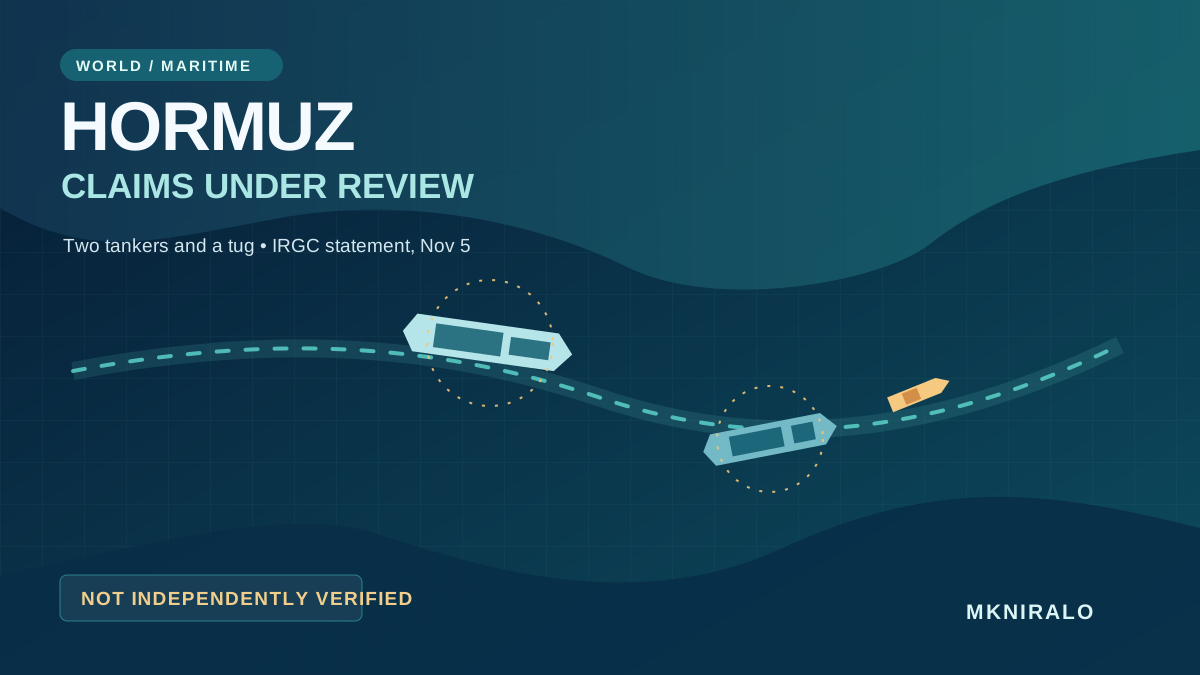
Iran's Revolutionary Guards have described a series of fires involving oil tankers and a tugboat in the Strait of Hormuz. Their November 5 statement is newsworthy because of the waterway's importance to commercial shipping. But the available reporting does not establish that the events happened as described, which ships were involved, or who bears responsibility. The distinction between a reported claim and a verified incident is the central fact of this story.
What the Revolutionary Guards reported
Iran's Islamic Revolutionary Guard Corps said on Thursday, November 5, that two oil tankers and a tugboat had caught fire around the Strait of Hormuz. In the Guards' account, a large tanker struck a mine while trying to use a southern passage Tehran described as unauthorized. The ship allegedly caught fire and stopped. A second vessel, described as a supertanker, reportedly caught fire as it left the route farther east. A tug that approached the second tanker to help fight the blaze also caught fire, the Guards said. Those are the Iranian military's assertions, not a verified sequence of maritime incidents.
The account reached international readers through Reuters, while Iran's Tasnim news agency carried the Guards' statement. The precise wording matters: the reported mine strike concerned the first tanker, and the cause of the second tanker's fire and the tug's fire was not established independently. The original statement framed the route as illegal; that characterization also comes from the Guards. The location and sequence described by the claimant cannot, without additional evidence, identify the vessels or establish how their fires began.
Sources: Two Oil Tankers, A Tugboat Catch Fire after Passing through Hormuz Strait Illegally: IRGC · Iran's IRGC says two tankers and tugboat caught fire in Strait of Hormuz
The ships, crews and damage remain unidentified
The most consequential omissions are practical ones. The Guards did not publicly identify the tankers or tug by name, flag, owner or vessel identifier in the accounts available on November 5. No independently verified report in the sources reviewed establishes the crews' condition, the extent of structural damage, whether any cargo escaped, or whether firefighting and towing operations were completed. A report that a vessel was stopped is not the same as evidence that it sank, was destroyed or remained unable to sail.
Associated Press explicitly said it could not independently verify the Iranian account. Maritime industry outlet SAFETY4SEA likewise described the alleged three-vessel incidents as unverified, while noting the absence of vessel identities and casualty information. Their reporting establishes that the claim circulated and that key details were missing; it does not turn the account into independent confirmation. For seafarers, insurers and cargo owners, the missing facts are central to assessing any actual harm.
Sources: Iran's top diplomat speaks with Gulf leaders about tensions, and other Mideast news · Iran claims two tankers and tugboat caught fire in Strait of Hormuz
An unauthorized route is not a settled finding
The Guards linked the reported fires to ships allegedly using a route without Tehran's authorization. This is part of the claim, not an independently documented navigation violation. Without coordinates, vessel tracks, applicable notices, the ships' accounts and an authoritative assessment of the passage, readers cannot determine what route each ship used or whether the label 'unauthorized' accurately describes its legal or operational status.
The same distinction applies to the suggested mine hazard. A mine strike is a possible explanation asserted for one vessel in the Iranian statement, but it cannot be established from that statement alone. Investigators would need vessel-specific evidence and a reliable incident chronology before identifying the cause of a fire, much less attributing responsibility for an explosive device. Treating an allegation about route choice as proof of fault would skip both steps.
Sources: Two Oil Tankers, A Tugboat Catch Fire after Passing through Hormuz Strait Illegally: IRGC · Iran's IRGC says two tankers and tugboat caught fire in Strait of Hormuz · Iran claims two tankers and tugboat caught fire in Strait of Hormuz
A separate Gulf attack does not corroborate the three fires
There was other maritime-security reporting on November 5, but it requires careful separation. AP reported that a tanker was struck by two unidentified projectiles off Qatar's coast, citing the British military's maritime reporting. SAFETY4SEA described the same separate UK Maritime Trade Operations warning, concerning an incident reported north of Qatar. Neither account identified that tanker as one of the ships in the Guards' Hormuz statement, and the location and reported mechanism were different.
This matters because a cluster of shipping alerts can create the appearance of a single, fully established episode. The Gulf incident reported by UKMTO is evidence of a separately reported threat to commercial shipping, not corroboration that the two tankers and tug in the Iranian account caught fire as described. The reporting available on November 5 did not demonstrate a link between those reports. Combining their details would produce a more dramatic narrative but a less reliable one.
Sources: Iran's top diplomat speaks with Gulf leaders about tensions, and other Mideast news · Iran claims two tankers and tugboat caught fire in Strait of Hormuz
The wider stakes run through shipping and energy costs
The Strait of Hormuz links Gulf oil exporters to international sea routes, so even an unverified report can sharpen questions about passage safety, voyage planning and the cost of moving cargo. Reuters reported on November 5 that oil traders were weighing diplomatic uncertainty surrounding the Iran war. It also reported that crude shipments through the waterway had recovered close to prewar levels according to analysts, but at higher cost. Neither observation measures the effects of the three specific vessels claimed by the Guards.
The practical transmission from maritime danger to energy markets has several steps: operators assess crew and ship safety, insurers price risk, charterers reconsider voyages and cargo buyers assess delays. Those are potential mechanisms, not measured outcomes of Thursday's allegations. Without confirmed vessel identities, load status, damage and traffic disruption, it would be unsound to assign a quantity of lost oil, an insurance increase or a particular price movement to these purported fires.
Sources: Oil rises as investors weigh uncertainties around Iran war · Iran claims two tankers and tugboat caught fire in Strait of Hormuz
What would move the account from claim toward confirmation
The next useful evidence would be concrete and vessel-specific: names or IMO identifiers, flag and operator confirmation, independently documented positions and timing, crew welfare reports, damage assessments, and any dated findings from maritime authorities. Such details would let readers distinguish a fire from a collision, a mine strike from another ignition source, and a temporary stoppage from lasting loss. No single image or unattributed online post would resolve all of those questions on its own.
For now, the verified news is that the Guards issued a serious claim and that Reuters, AP and maritime specialists reported it with important limitations. The reported fires, the alleged mine, the legality of the route and responsibility for any damage remain separate questions. That distinction does not minimize the risks faced by ships in the region; it keeps those risks from being obscured by a military account that has yet to be independently substantiated.
Sources: Two Oil Tankers, A Tugboat Catch Fire after Passing through Hormuz Strait Illegally: IRGC · Iran's top diplomat speaks with Gulf leaders about tensions, and other Mideast news · Iran claims two tankers and tugboat caught fire in Strait of Hormuz · Oil rises as investors weigh uncertainties around Iran war