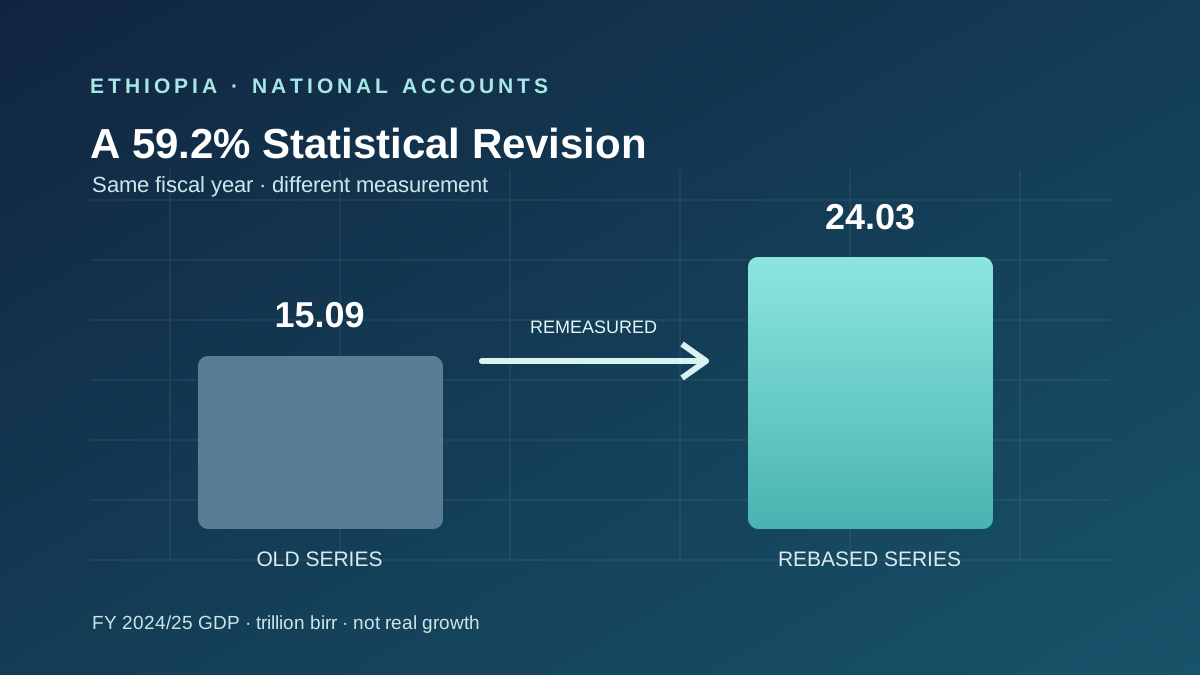
Ethiopia’s government unveiled a much larger estimate of its economy on 4 November 2026. For the 2024/25 fiscal year, the new national accounts put gross domestic product at 24.03 trillion birr, or roughly $201.42 billion, versus about 15.09 trillion birr in the earlier series. The revision is approximately 59.2%. It is a change in how statisticians measure production, not evidence that factories, farms or households suddenly generated 59% more value. A revised GDP denominator can also alter debt and tax indicators without changing obligations or collections.
The numbers describe a new measurement, not a sudden boom
Finance Minister Fitsum Assefa announced the new accounts at a government launch on 4 November, according to the Ethiopian News Agency’s direct report of her remarks. The new benchmark is Ethiopian fiscal year 2017, corresponding to 2024/25, replacing the older 2015/16 reference. The previous estimate for 2024/25 was about 15.09 trillion birr; the revised estimate is 24.03 trillion. That difference is close to 8.94 trillion birr in measured annual output.
Reuters reported the government presentation and described the jump as a 59.2% upward revision. Both the old and new numbers refer to the same fiscal year. They are alternative statistical estimates of a year's activity, not two consecutive years of real economic performance. Calling it 59.2% economic growth would be misleading.
The newly announced series also places 2025/26 GDP at 31.86 trillion birr, or roughly $210.7 billion. That is a different fiscal year and should not be conflated with the $201.42 billion estimate for 2024/25. Those dollar amounts are figures from the announcement, not purchasing-power measures.
Sources: Ethiopia Unveils GDP Rebasing, Economy Reaches 210.7 Billion USD · GDP Rebasing to Lay Foundation for Ethiopia's Long-Term Dev't Ambitions: Minister · Ethiopia: Fifth Review Under the Extended Credit Facility Arrangement (IMF Country Report 26/174) · Ethiopia revises economy up nearly 60% to $201 billion after GDP rebasing
Why updating a base year can reveal activity previously missed
Gross domestic product is an estimate assembled from surveys, administrative records, industry information and accounting rules. As an economy evolves, an old benchmark can cease to capture its composition well. New enterprises appear, services become digital, informal production shifts and economic activities that once received limited coverage become easier to estimate. Rebasing updates the statistical frame used to bring those changes into national accounts.
At the launch, Minister of National Strategy Bereket Fesehatsion said the exercise drew on an agricultural census, an economic-establishments census and household surveys. Officials also described better representation of digital financial services, trade, industry and mining. The available launch summaries do not independently audit each sector’s contribution.
Ethiopian officials said the updated accounts follow the 2008 System of National Accounts. The United Nations describes that system as a common set of concepts, classifications and accounting rules for recording economic activity. Applying an internationally recognised framework is an important methodological commitment, but it does not automatically establish that every underlying survey response, adjustment or source estimate is error-free.
Sources: Ethiopia Unveils GDP Rebasing, Economy Reaches 210.7 Billion USD · GDP Rebasing to Lay Foundation for Ethiopia's Long-Term Dev't Ambitions: Minister · System of National Accounts (SNA) · Ethiopia’s GDP Rebasing Establishes New Benchmark for Long-Term Development Planning — Minister
What the IMF documents confirm—and what they do not
The revision was not an entirely unannounced statistical operation. In its July 2026 fifth-review country report, the International Monetary Fund published the Ethiopian authorities’ plan to rebase national accounts to 2024/25 by December or earlier. The report also recorded a programme of technical assistance and a proposed diagnostic assessment under the Fund’s data-quality framework following the rebasing.
The IMF’s earlier national-accounts figures provide a useful check on the old comparison point. Its table for 2024/25 reported nominal GDP at 15,094 billion birr—approximately 15.09 trillion. That helps establish what was being replaced; it should not be used to imply that an IMF projection from the old series is itself a new IMF endorsement of the November estimate.
Government speakers credited IMF technical assistance with supporting the work. Assistance with methodology, surveys or compilation is not the same as the Fund independently certifying the final 59.2% revision. A subsequent published data-quality review, comprehensive methodology and reconciled historical tables would give readers a stronger basis for judging the result than launch-day statements alone.
Sources: GDP Rebasing to Lay Foundation for Ethiopia's Long-Term Dev't Ambitions: Minister · Ethiopia: Fifth Review Under the Extended Credit Facility Arrangement (IMF Country Report 26/174)
A larger denominator changes debt and revenue ratios
One consequence is mathematical. Debt-to-GDP is calculated by dividing a specified stock of debt by an estimate of annual GDP. If the GDP estimate rises while the debt stock is held constant, the displayed ratio becomes lower. It does not repay debt, renegotiate loans or add foreign currency to the treasury.
The same principle applies to tax revenue measured as a share of GDP. With unchanged collections and a larger denominator, the tax-to-GDP ratio declines on paper. That can change how observers discuss domestic revenue mobilisation, even though public services do not suddenly receive less cash solely because the statistical series has been replaced. A broader estimated tax base may point to areas for future policy research, not automatically to collectable taxes.
Fitsum said the updated figures would inform assessments of debt sustainability, fiscal and monetary policy and revenue collection. Ethiopia is also dealing with external-debt restructuring, as described in IMF programme documentation. Yet a revised ratio cannot by itself settle negotiations: creditors still have to examine actual repayment schedules, financing needs, foreign-exchange availability and the assumptions used in debt-sustainability assessments.
Sources: Ethiopia Unveils GDP Rebasing, Economy Reaches 210.7 Billion USD · Ethiopia: Fifth Review Under the Extended Credit Facility Arrangement (IMF Country Report 26/174) · Ethiopia revises economy up nearly 60% to $201 billion after GDP rebasing
The missing evidence matters as much as the headline figure
The presentation has been widely reported, but headline totals are not a substitute for a publicly accessible technical reconciliation. The key test is whether the old and new series can be compared sector by sector, including methods, survey coverage and adjustments for activities that are difficult to observe. Without that detail, outsiders cannot determine from the headline alone how much of the revision comes from newly counted production or other changes in compilation.
Several circulating reports attach precise new debt ratios or per-person income figures to the adjustment. Those numbers need matching dates, definitions, denominators and directly inspectable official tables before they can safely be repeated. This account therefore does not treat any particular post-rebasing debt-to-GDP ratio or GDP-per-capita increase as verified, nor does it attribute unlocated criticism to the Ethiopian Economics Association.
The reported dollar equivalents also require care. Nominal GDP converted at an exchange rate and GDP valued at purchasing-power parity answer different questions. The official announcement's figures should not be presented as a change in everyday purchasing power, a measured improvement in poverty or an automatic upgrade in living standards. GDP is valuable as an accounting summary, but its revisions do not constitute household-income surveys.
Sources: Ethiopia Unveils GDP Rebasing, Economy Reaches 210.7 Billion USD · GDP Rebasing to Lay Foundation for Ethiopia's Long-Term Dev't Ambitions: Minister · Ethiopia: Fifth Review Under the Extended Credit Facility Arrangement (IMF Country Report 26/174) · Ethiopia revises economy up nearly 60% to $201 billion after GDP rebasing
What to watch after the November launch
The priority is publishing old and revised series, survey inputs, sector coverage and consistent real-growth estimates. The government said the new accounts would become a planning reference and that rebasing would be institutionalised every five years. The usefulness of those plans will depend on transparent and repeatable releases rather than a one-off headline total.
The IMF's July programme documents anticipated both a national-accounts rebasing and a subsequent quality assessment. A published assessment would help clarify whether methodological and data weaknesses remain. Future fiscal reports will also need to say clearly which GDP series underlies their ratios so that readers do not compare a pre-rebasing numerator and a post-rebasing denominator without explanation.
For Ethiopia, the genuine promise of better statistics is improved public decisions: measuring the economy more completely, targeting policy more intelligently and making economic comparisons more consistent. Whether that promise is realised must be tested against forthcoming evidence. For now, the most accurate headline is that a year's measured GDP has been revised sharply higher—not that the country's people became 59% richer.
Sources: Ethiopia Unveils GDP Rebasing, Economy Reaches 210.7 Billion USD · GDP Rebasing to Lay Foundation for Ethiopia's Long-Term Dev't Ambitions: Minister · Ethiopia: Fifth Review Under the Extended Credit Facility Arrangement (IMF Country Report 26/174) · System of National Accounts (SNA)