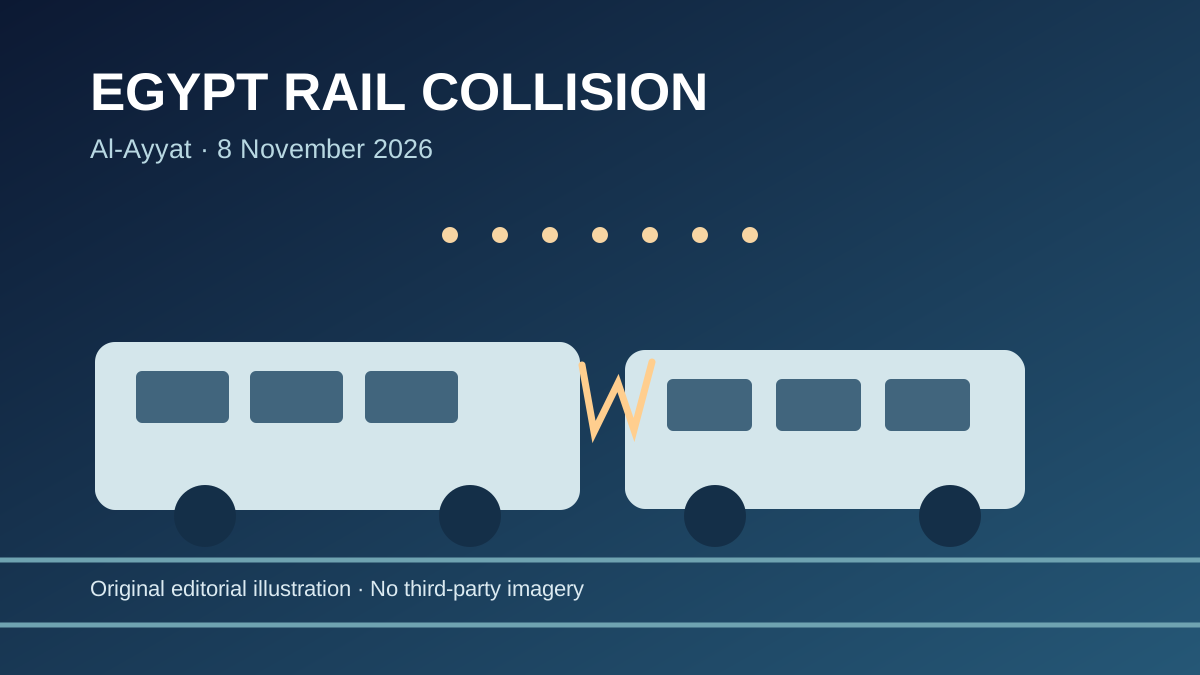
Seven people were reported dead and 125 injured in the chief prosecutor's office's late-Sunday accounting of a November 8 collision between passenger trains in Egypt’s Al-Ayyat district. The preliminary inspection describes one train striking the rear of a stationary service, but investigators have not established why the crash occurred.
A collision south of Cairo
An evening of emergency work followed a collision between two passenger trains in Egypt’s Giza governorate on Sunday, November 8. The crash occurred in the Al-Ayyat district, south of Cairo, where a service heading toward Fayoum struck the rear of a train bound for Aswan. The impact derailed several carriages and left some overturned. By the end of Sunday, Egyptian authorities were reporting seven deaths and 125 injured people. The final technical explanation for the collision had not been established.
The Egyptian National Railways authority identified the services as Train No. 134, travelling from Giza toward Fayoum, and Train No. 2010, running from Cairo toward Aswan. It placed the collision between Kafr Ammar and Al-Raqqa stations. Associated Press reporting located Al-Ayyat approximately 52 kilometres south of Cairo. Emergency teams, ambulances and cranes were sent to the site, where removing damaged carriages became part of the effort to restore rail operations.
Sources: Giza’s El-Ayyat train collision death toll rises to seven, 125 injured · Collision between 2 trains in Egypt kills 7 and injures at least 125 · Train collision in Egypt’s Giza province kills 4 and injures 88, health ministry says
How the casualty count changed
The official numbers evolved through the day and should be read as successive updates rather than conflicting final totals. Egypt’s Health and Population Ministry first announced four fatalities and 88 injured people on November 8. That initial statement described 72 ambulances and the transfer of injured passengers to hospitals in Al-Wasta, Al-Ayyat and Atfih. At that stage, the ministry was still accounting for patients and the dead, while treatment and recovery operations continued.
A subsequent ministry update, reported by Ahram Online and AFP, raised the toll to seven dead and 112 injured. Later on Sunday, the chief prosecutor’s office put the toll at seven dead and at least 125 injured — the toll given by the Health Ministry — a figure also carried by Ahram Online. These are not three separate groups of victims. They are stages in an expanding count. Authorities may revise figures as patients are transferred, examinations are completed and hospital records are reconciled.
Sources: Health Ministry: Casualties of Al-Ayyat train crash surged to 4 fatalities, 88 injuries · Giza’s El-Ayyat train collision death toll rises to seven, 125 injured · UPDATE 2: Giza’s El-Ayyat train collision death toll rises to seven, 112 injured · Collision between 2 trains in Egypt kills 7 and injures at least 125 · Egypt train collision kills 7, injures 112: health ministry
The hospital response
By the later health-ministry update, 71 injured passengers had been discharged after receiving care. Another 43 remained in hospital under observation: 23 at Al-Ayyat Central Hospital, 13 at Al-Wasta Central Hospital and seven at Atfih Central Hospital. Eleven patients had been transferred for continued treatment at other facilities. The breakdown is an administrative snapshot, not a prediction of recovery or a complete account of every individual’s condition. It can change as patients move between hospitals.
Medical officials described injuries including bruises, cuts and fractures involving limbs, the pelvis and vertebrae. Head and facial injuries and chest trauma were also reported. The health ministry said facilities in Giza and neighbouring Beni Suef had been placed on heightened readiness, and Health Minister Khaled Abdel-Ghaffar was monitoring the response. For passengers and their families, the most immediate questions were where relatives had been taken, whether they could be contacted and what further treatment they needed.
Sources: Health Ministry: Casualties of Al-Ayyat train crash surged to 4 fatalities, 88 injuries · Giza’s El-Ayyat train collision death toll rises to seven, 125 injured · Egypt train collision kills 7, injures 112: health ministry
What investigators know — and do not know
Egypt’s Public Prosecution opened an investigation, sending teams to inspect the collision scene and to hospitals to interview injured passengers and examine fatalities. According to the prosecution’s preliminary inspection, the front of the Giza–Fayoum service struck the last carriage of the Cairo–Aswan train while the latter was stationary on the same track. This describes the observed configuration of the crash, not a verified explanation of why two trains occupied the same track in those circumstances.
Prosecutors ordered a specialised technical committee to examine damaged trains, railway infrastructure, operating procedures and safety requirements. The committee’s work is intended to establish the technical reasons for the collision and assess possible operational shortcomings. No final finding of negligence, equipment failure, signalling fault or individual responsibility had been announced in the reports available for this article. Assigning blame before those findings would go beyond the evidence.
Sources: Giza’s El-Ayyat train collision death toll rises to seven, 125 injured · Collision between 2 trains in Egypt kills 7 and injures at least 125
Political response and the safety questions
President Abdel Fattah al-Sisi ordered a prompt investigation and said people found responsible through negligence should be held accountable. The statement was a call for inquiry and accountability, not a declaration that any specific employee or institution had already been proved at fault. Authorities also focused on reopening the affected railway section as recovery teams worked around the damaged rolling stock. The precise timing of a full return to normal service was not established in the initial reports.
The crash raises immediate questions about how train positions are monitored, how movements on the same track are authorised and whether operating safeguards worked as intended. Those questions are legitimate, but they are questions for evidence rather than conclusions. Technical records, control-room communications, signalling information and witness testimony may be important to the inquiry; none should be treated as having already produced a public answer. An investigation can reveal multiple contributing factors, or rule out early speculation.
Sources: Collision between 2 trains in Egypt kills 7 and injures at least 125 · Train collision in Egypt’s Giza province kills 4 and injures 88, health ministry says
Al-Ayyat’s history, and what comes next
The location carries particular weight in Egypt’s railway history. In 2002 a fire swept through a crowded passenger train in the Al-Ayyat area, killing more than 370 people, according to AFP’s historical account. The earlier disaster does not explain Sunday’s rear-end collision; the incidents differ in their reported circumstances. But it makes the district’s name familiar to Egyptians who remember the scale of past losses and underscores why railway safety remains a major public concern.
The next meaningful updates will come from a revised official casualty accounting, details of ongoing patient care, and the prosecution’s technical findings. A tally of seven dead and 125 injured was the later Sunday figure supported by official-health reporting when this article was prepared; it should not be mistaken for an immutable final count. Until investigators disclose the cause, the central fact remains a deadly collision followed by a large medical response and an unresolved question about how it happened.
Sources: Giza’s El-Ayyat train collision death toll rises to seven, 125 injured · Collision between 2 trains in Egypt kills 7 and injures at least 125 · Train collision in Egypt’s Giza kills 4, injures 88: health ministry