Brazilian lender Bradesco and investment platform XP sharply lowered their forecasts for the country’s economy on November 6, setting out a far weaker picture for 2027 while increasing their inflation estimates. The changes follow President Luiz Inácio Lula da Silva’s re-election and renewed questions about interest rates and fiscal policy. The figures are private institutions’ scenarios, not newly released GDP statistics. They also differ substantially from forecasts published earlier by Brazil’s central bank and the International Monetary Fund.
Two forecasts point to much slower growth
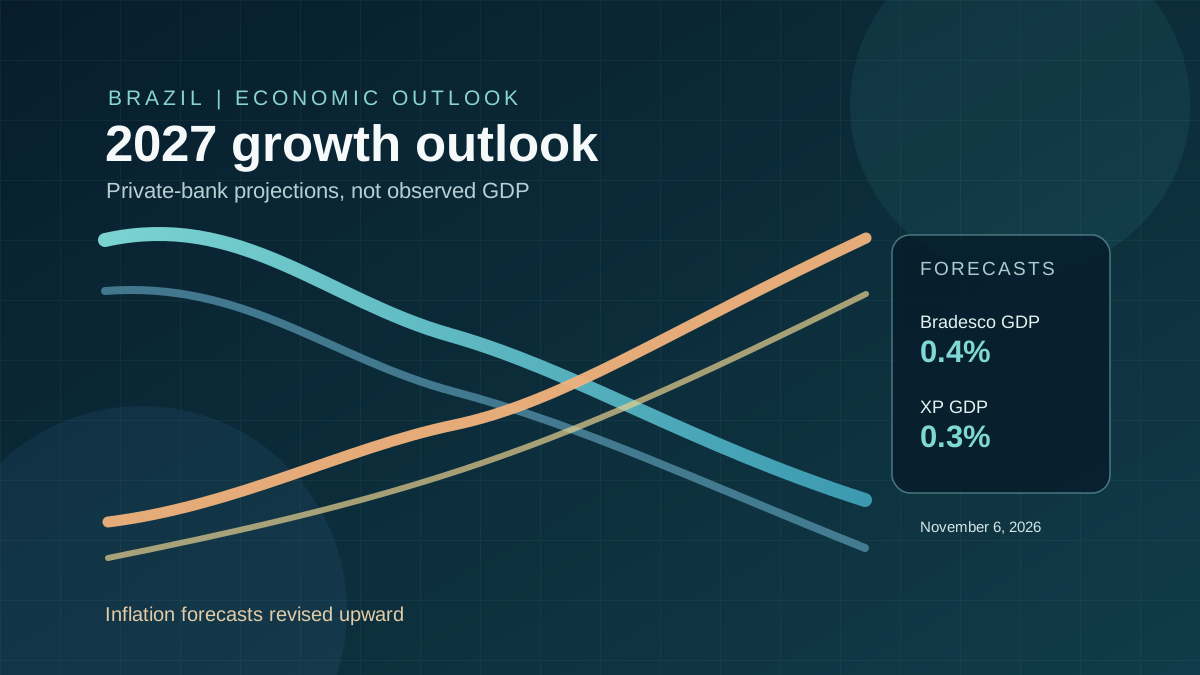
Bradesco lowered its forecast for Brazilian gross domestic product growth in 2027 from 1.0% to 0.4%, according to its November 6 economic report as described by Reuters. XP made a slightly deeper reduction, from 1.0% to 0.3%. Both institutions also cut their 2026 growth expectations from 1.7% to 1.5%. These numbers describe how much output each institution expects to increase over a full year; neither institution is reporting a measured 2027 outcome.
The inflation revisions moved in the opposite direction. Bradesco lifted its forecast for 2027 inflation from 4.1% to 5.3%, while raising its 2026 estimate from 4.9% to 5.5%. XP raised its 2027 inflation projection from 4.4% to 5.5% and its 2026 estimate from 5.1% to 5.2%. The paired changes are striking: both houses now anticipate weaker economic expansion alongside faster price increases than they previously expected.
The banks are changing assumptions about demand and prices at the same time, though the precise outcomes will depend on conditions that have not yet unfolded.
Sources: Bradesco e XP pioram significativamente projeções para inflação e atividade econômica em 2027 · XP reduz projeção do PIB a 0,3% em 2027; dólar vai a R$ 5,50 e Selic fica em 13,75% · Bradesco e XP pioram significativamente projeções para inflação e atividade econômica em 2027
Why the banks expect economic momentum to fade
Reuters linked the reset to uncertainty following Lula’s re-election, noting that the president had not yet announced the economic team or fiscal approach for his next term when the reports appeared. Those political circumstances form part of Reuters’ reporting context, rather than proof that the election itself caused the revised GDP numbers.
Bradesco cited tighter financial conditions, diminished confidence and slowing credit as reasons to expect further loss of momentum in coming quarters. XP pointed to more restrictive financing, heavy debts carried by households and companies, less fiscal support and weak contributions from parts of the economy that are less responsive to the business cycle.
Credit matters because borrowing costs influence decisions to buy homes, expand businesses and finance inventories. But weaker borrowing is not a mechanical guarantee of the same GDP outcome everywhere: exports, commodity prices, public policy and household income could all move differently from the banks’ baseline scenarios.
Sources: Bradesco e XP pioram significativamente projeções para inflação e atividade econômica em 2027 · Brazilian banks cut growth forecasts, raising fiscal stakes for Lula · XP reduz projeção do PIB a 0,3% em 2027; dólar vai a R$ 5,50 e Selic fica em 13,75%
Inflation assumptions add a second problem
The banks’ new inflation forecasts reflect several potential pressures rather than a single observed price shock. According to the Reuters account of its research note, Bradesco identified supply disruptions, currency depreciation, changes to working hours and implementation of tax reform among the challenges. The bank also said its scenario incorporated public spending commitments already made or announced during the presidential campaign.
XP’s research, as quoted by InfoMoney and Reuters, likewise identified risks involving shorter working hours, persistently expensive oil, a weaker currency and tax reform. These are possible transmission channels in its projections, not claims that every proposed change has already taken effect.
Higher projected inflation can make interest-rate reductions harder for the central bank to justify, reinforcing the financing pressures that concern the banks. In its September monetary-policy report, the central bank described inflation risks as elevated and said expectations remained above its 3% target. That was a prior official assessment, not an endorsement of the new private-bank forecasts. It nevertheless helps explain why the growth and inflation revisions are closely connected.
Sources: Bradesco e XP pioram significativamente projeções para inflação e atividade econômica em 2027 · XP reduz projeção do PIB a 0,3% em 2027; dólar vai a R$ 5,50 e Selic fica em 13,75% · Relatório de Política Monetária
Itaú and BTG show the concern extends further
Bradesco and XP did not move in isolation. The previous week, Itaú lowered its 2027 GDP growth forecast from 1.2% to 0.5%, according to Reuters. Itaú also lifted its expected inflation rate for that year from 4.6% to 6.1%. Its inflation figure is higher than the new Bradesco and XP projections, underscoring that even institutions sharing a cautious direction disagree about how severe price pressures may become.
A later Reuters report on November 6 added BTG Pactual to the picture. It said BTG expected 0.6% GDP growth in 2027, while identifying the four institutions’ predictions as ranging from 0.3% to 0.6%. The BTG figure belongs to that later report, not to the earlier Reuters dispatch that focused on Bradesco, XP and Itaú.
The later Reuters analysis also described a possible public-finance consequence: lower-than-expected GDP growth could erode tax revenue when budget commitments are already demanding. It cited a Brazilian Treasury estimate that a one-percentage-point growth shortfall would reduce federal tax receipts by 16.6 billion reais. That is a sensitivity estimate, not an actual loss already incurred and not a direct calculation of the impact of these banks’ new predictions.
Sources: Bradesco e XP pioram significativamente projeções para inflação e atividade econômica em 2027 · Brazilian banks cut growth forecasts, raising fiscal stakes for Lula · Bradesco e XP pioram significativamente projeções para inflação e atividade econômica em 2027
Different vintages explain the wider forecast gap
Brazil’s central bank projected 1.4% GDP growth for 2027 in its September 24 monetary-policy report. The IMF’s October World Economic Outlook subsequently put Brazil’s 2027 growth at 1.9%, a reduction from the Fund’s earlier 2.2% estimate. Both figures are notably higher than the November 6 Bradesco and XP scenarios, but they were published at different times and use different analytical assumptions.
The divergence should not be read as evidence that a final official estimate has been overturned. The central bank’s September report predates the latest election and market developments, while the IMF’s October exercise reflects its own global and country models. The IMF has separately flagged tighter financial conditions and weaker-than-expected fiscal adjustment as downside risks for Brazil.
Actual Brazilian GDP is measured through national accounts compiled by the national statistics agency, IBGE. Its historical quarterly figures are observations subject to statistical revisions; projected 2027 annual growth from a bank or international institution is a different type of information altogether.
Sources: Relatório de Política Monetária · World Economic Outlook (October 2026) - Real GDP growth · FMI reduz projeção de crescimento do Brasil, mas eleva a da economia global · IMF Executive Board Concludes 2026 Article IV Consultation with Brazil
What could change before 2027 arrives
The next significant tests will be policy decisions, economic releases and the evolution of financial conditions, rather than the forecasts themselves. The composition of Lula’s economic team, the proposed fiscal strategy and any subsequent monetary-policy decisions can alter borrowing costs, confidence and the trajectory of domestic demand. Reuters reported that the Finance Ministry was reviewing its macroeconomic assumptions and had not yet supplied an updated forecast when its later November 6 story was published.
Future readings on inflation, credit, employment and quarterly output will help show whether the slowdown the banks anticipate is materialising. Even those readings cannot reveal a full-year 2027 result in advance. Economists will continue to revise assumptions as fresh data and policy details emerge, and different forecasters may disagree about how quickly financing conditions or prices respond.
For now, the news is a substantial change in several major institutions’ expectations. Bradesco sees 0.4% growth in 2027, XP sees 0.3%, and both forecast higher inflation than before. That warns of a more difficult possible economic environment, but it does not mean near-stagnation has already happened. The distinction between a revised scenario and a measured outcome is the central fact readers should retain.
Sources: Bradesco e XP pioram significativamente projeções para inflação e atividade econômica em 2027 · Brazilian banks cut growth forecasts, raising fiscal stakes for Lula · XP reduz projeção do PIB a 0,3% em 2027; dólar vai a R$ 5,50 e Selic fica em 13,75% · Relatório de Política Monetária · IMF Executive Board Concludes 2026 Article IV Consultation with Brazil