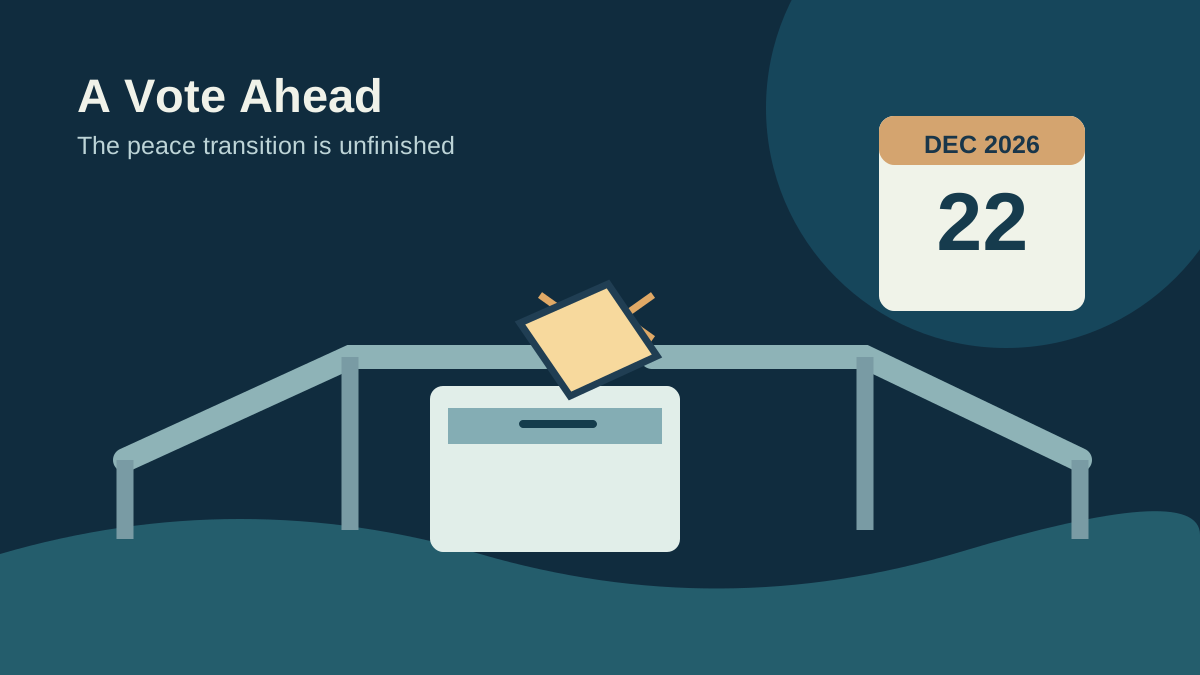
South Sudan’s National Elections Commission has moved the country’s first national presidential and parliamentary elections since independence from December 22, 2026, to Thursday, February 11, 2027. The revised timetable also resets the stages for voter registration, campaigning, counting and dispute resolution. Commissioner Josephine Achiro Fortelo confirmed the change to Reuters, saying the dates followed consultations with stakeholders. The commission gave no reason for the postponement. It does not show, by itself, that the political, security and administrative conditions for a credible vote are in place. The central question is whether the extra weeks can be converted into functioning registration centres, inclusive participation, reliable financing and a process whose results can be trusted. [1][2][3]
A third postponement, not a settled new date
The vote has been deferred repeatedly. The 2022 roadmap recorded that elections were then set to begin on December 22, 2022, before extending the transitional period and moving the expected poll to December 2024. In September 2024, the signatory parties endorsed another postponement, extended the transition from February 22, 2025, to February 22, 2027, and set elections for December 2026. The latest NEC calendar now moves polling again, by 51 days, to February 11, 2027. [8][7][2]
The new date is an announced plan, not a guarantee that the ballot will take place on schedule. Reuters reported that the commission gave no reason for the postponement. Fortelo’s confirmation establishes that the commission has adopted a new calendar; it does not establish that every outstanding task has been completed or that political actors have agreed on the conditions for the vote. Both require further evidence. [1][2]
Sources: South Sudan delays election to February 11, 2027 · NEC pushes elections beyond December deadline set in law · Endorsement of the Parties Signatory to the R-ARCSS for Postponement/Delay of Elections and Extension of the Transitional Period · Agreement on the Roadmap to a Peaceful and Democratic End of the Transitional Period of the R-ARCSS
Registration is the first operational test
The timetable sets voter registration for November 14–28, across 3,161 centres in the country’s ten states and three administrative areas. NEC Chair Gabriel Bol Deng said the commission had recruited and trained 22,127 registration officials. These are NEC figures, not an independent deployment audit. [3]
Bol Deng also said registration materials had reached state capitals and administrative-area headquarters but had not yet reached individual centres. He said the commission had mapped out logistics to complete the onward distribution within two days. That qualification matters: a national count of centres and trained personnel describes planned capacity, not proof that each location opened with equipment, staff and accessible procedures on November 14. The next evidence should be centre-level delivery and actual registration, not another national total. [3]
The registration window is short and geographically demanding. Citizens need to know where centres are, what identification will be accepted and how errors can be corrected. Displaced people and voters in remote communities face additional access questions. The timetable’s dates create a sequence; the commission’s ability to deliver the same service across all 13 administrative jurisdictions will determine whether that sequence is meaningful. [2][3]
Sources: NEC pushes elections beyond December deadline set in law · NEC announces voter registration 39 days before elections
The result timetable runs past the transition deadline
The campaign is scheduled to run for 45 days, from December 27, 2026, to February 9, 2027. February 10 is designated as a silence day, with polling on February 11. The calendar allocates February 11 and 12 for sorting, counting and announcing results at polling centres, followed by further tallying. Final results are scheduled to be declared on February 15 and published on February 16. [2]
The same timetable allows 148 days, from February 17 to July 15, 2027, for election disputes. That window extends well beyond the transitional period’s scheduled end on February 22, 2027. Under the 2024 signatory endorsement, the transition was extended to that date while elections were planned for December 2026. The new calendar therefore places the expected publication of final results just six days before the transition deadline, while the dispute process may continue for months afterward. The documents set out dates, but do not by themselves resolve how a contested result and the end of the transition would interact. [2][7]
Sources: NEC pushes elections beyond December deadline set in law · Endorsement of the Parties Signatory to the R-ARCSS for Postponement/Delay of Elections and Extension of the Transitional Period
The funding figure needs a date, not a headline
At a November 10 Security Council meeting, African Union High Representative Jakaya Kikwete said the NEC had requested $276 million and had received $21 million as of his June visit. He also said that further support had arrived since then, including a contribution volunteered by an African country. The $21 million figure is therefore a historical snapshot from June, not a verified statement of the commission’s cash position on November 14. [5]
The African Union’s Peace and Security Council had already expressed concern in August about significant funding and administrative shortfalls facing the election bodies. It called for predictable domestic funding and urged partners to help close the gap. What remains necessary is an updated, dated account distinguishing money requested, approved, transferred, pledged and spent. Without that reconciliation, repeating the June figure as the current balance would overstate what the available evidence shows. [6][5]
Sources: Sudan and South Sudan — Security Council, 10268th meeting · Communiqué of the 1364th PSC meeting on the latest developments in South Sudan
Security and political participation remain unresolved
Days before the postponement, UNMISS told the Security Council that key preparedness concerns persisted: security arrangements, logistics, the NEC’s ability to deliver within a compressed timeframe and outstanding provisions of the 2018 peace agreement. The mission said armed confrontations between the principal signatories had generally declined, while the number of people killed, injured and displaced had increased. It identified communal violence as a major driver of civilian harm. These findings describe a complex security picture, not a simple claim that fighting has either ended or returned to full-scale war. [4]
UNMISS also said some opposition groups remained outside the inter-party dialogue and that recent political changes fell short of the peace agreement’s 35 per cent quota for women’s representation. The transitional unity government was dissolved on September 22 and replaced by a caretaker administration. The African Union has separately stressed that credible elections require political consensus, open civic space, citizen security, effective dispute resolution and the participation of women, young people and displaced populations. A later polling date cannot substitute for those conditions. [4][6]
Sources: Remarks by Anita Kiki Gbeho to the Security Council [Near Verbatim] · Communiqué of the 1364th PSC meeting on the latest developments in South Sudan
What would make February credible
The next assessment should be practical and public. Are registration centres operating, and are their locations and procedures known? Are voter lists published with enough time for objections and corrections? Can parties nominate candidates and campaign without intimidation? Can domestic and international observers reach the process? Are security arrangements credible across the country, and are counting, tallying and dispute decisions transparent enough for losing candidates and voters to examine? Each question has an observable answer; none is settled by the date printed at the top of a calendar. [2][3][4]
South Sudan’s February 11 schedule is now the commission’s announced plan. The test is whether the extra time produces delivery that citizens can verify: money reaching the work that needs it, materials reaching centres, safe access for voters and candidates, and a credible route for resolving disputes. The calendar has moved. Whether the country is ready will be shown by what happens between now and polling day, and by how institutions handle the results afterward. [4][6]
Sources: NEC pushes elections beyond December deadline set in law · NEC announces voter registration 39 days before elections · Remarks by Anita Kiki Gbeho to the Security Council [Near Verbatim] · Communiqué of the 1364th PSC meeting on the latest developments in South Sudan