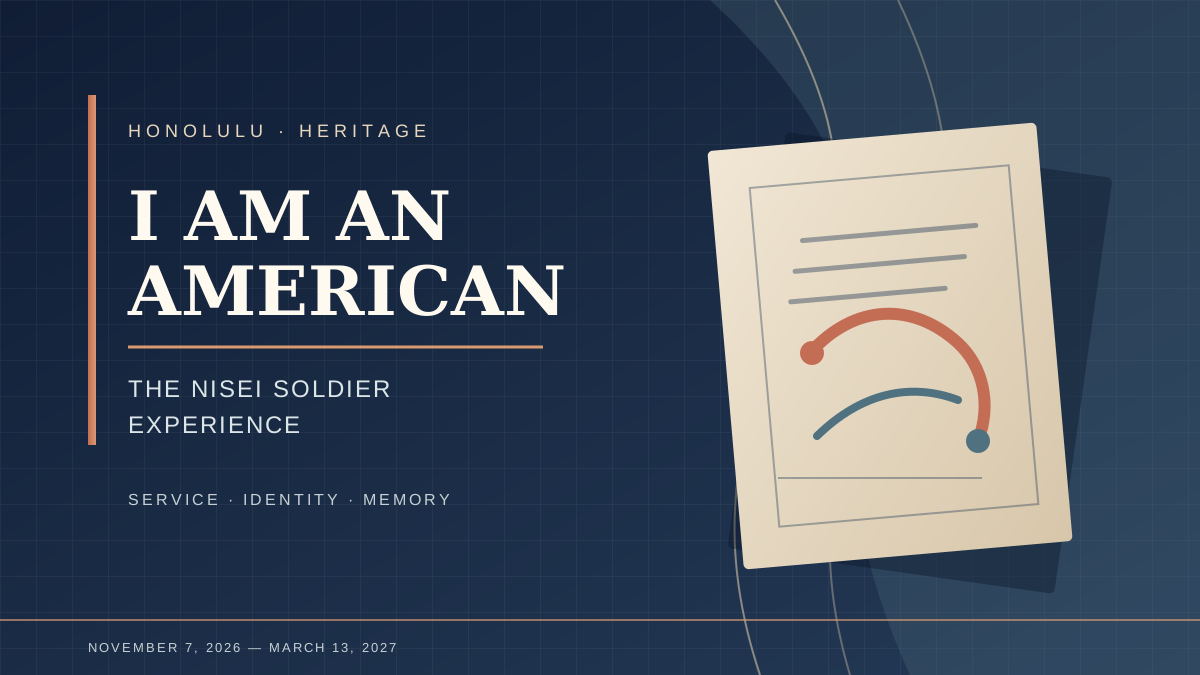
“I Am An American: The Nisei Soldier Experience” opened to the public at 10 a.m. on Saturday, November 7, at Capitol Modern, the Hawaiʻi State Art Museum in Honolulu. It runs through March 13, 2027, and follows second-generation Japanese Americans who served in the U.S. Army while their communities faced suspicion, exclusion and, on the mainland, mass incarceration.
A traveling exhibition arrives in Honolulu
The exhibition opens in the Lēʻahi Gallery on the museum’s second floor, with a public ceremony scheduled for 10 a.m. in the second-floor courtyard. Admission is free and no reservation is required. The Hawaiʻi State Foundation on Culture and the Arts is hosting the presentation, organized by the National Veterans Network with the National Museum of the United States Army and supported by The Army Historical Foundation. The announced run is November 7, 2026, to March 13, 2027.
Honolulu is one stop on a five-year national tour planned for 11 cities. The National Veterans Network says the project was developed with the Army museum to bring the history of Japanese American soldiers to audiences beyond the institutions that preserve it. Its arrival in Hawaiʻi has particular resonance: the islands supplied many Nisei servicemen, while wartime life for Japanese Americans there differed sharply from the mass removal imposed on the West Coast.
Sources: “I Am An American” exhibit at State Art Museum opening weekend events · I Am an American: the Nisei Soldier Experience · “I Am An American: the Nisei Soldier Experience” Traveling Exhibit · Nisei Soldier Traveling Exhibit
Who the Nisei were — and what the war changed
“Nisei” refers to the American-born, second generation of Japanese immigrants. Before and after Pearl Harbor, Japanese American communities were part of the country’s social and economic fabric, but wartime fear turned ancestry into a basis for suspicion. On February 19, 1942, President Franklin D. Roosevelt signed Executive Order 9066, authorizing military commanders to designate areas from which people could be excluded. Though it did not name Japanese Americans, it became the legal foundation for their forced removal from the West Coast.
The National Archives records that about 122,000 Japanese American men, women and children were moved to assembly centers and then confined in guarded camps; nearly 70,000 were U.S. citizens. Many families lost homes, businesses and personal property, often with only days to arrange their affairs. The government did not charge those citizens with crimes or provide a process to appeal their confinement. This is the contradiction behind the exhibition’s title: people who understood themselves as Americans were asked to prove a loyalty their citizenship should already have secured.
Sources: Executive Order 9066: Resulting in Japanese-American Incarceration (1942) · Japanese American Incarceration
Hawaiʻi’s experience was different — but not free of coercion
Hawaiʻi’s history cannot simply be folded into the mainland story. The Territory was placed under martial law after Pearl Harbor, and the military assumed civilian government functions while restricting constitutional rights. The National Park Service describes a different policy from the mainland: officials selectively detained people from Japanese communities because arresting everyone would have severely damaged the islands’ economy. It records 1,330 Japanese American citizens and Japanese nationals incarcerated across 17 island sites.
The first major Nisei combat formation from Hawaiʻi emerged from a different kind of exclusion. In 1942, Japanese American soldiers serving in the Hawaiʻi National Guard, Army Reserve and regular Army were reorganized into the 100th Infantry Battalion. The U.S. Army Center of Military History says it included more than 1,400 Nisei and entered combat near Salerno, Italy, in September 1943. Its performance helped persuade Army leaders to recruit a larger Nisei combat unit. Many mainland volunteers came from incarceration camps; Hawaiʻi’s Nisei soldiers came from a community under martial law and selective detention.
Sources: World War II Japanese American Incarceration: Martial Law · Hawaii's Other Internment Camps · 100th Infantry Battalion in World War II
Service across two fronts
The 442nd Regimental Combat Team, activated in February 1943, brought together Nisei volunteers from Hawaiʻi and men from the ten mainland relocation centers. It trained at Camp Shelby, Mississippi, deployed to the Mediterranean in 1944 and joined the 100th Infantry Battalion in Italy that June. The 100th formally became the 442nd’s first battalion in August. The team later fought in Italy and France, including the Vosges campaign, where it helped rescue a U.S. battalion cut off from its division. It became one of the most decorated units for its size and length of service.
Not all Nisei service took place in infantry units. The Military Intelligence Service recruited Japanese-speaking Americans to translate captured documents, interrogate prisoners, interpret communications and support Allied operations across the Pacific. The National Veterans Network records that 6,000 Nisei graduated from military language schools and were dispatched to combat theaters; Nisei linguists also supported the postwar occupation of Japan. Some mainland soldiers served while parents, siblings or other relatives remained behind barbed wire. That was not every soldier’s story, nor the general experience of Hawaiʻi’s Nisei volunteers; the exhibition brings these different paths into one account of a shared demand to be recognized as American.
Sources: “I Am An American: the Nisei Soldier Experience” Traveling Exhibit · 442d Regimental Combat Team in World War II · Japanese American units of World War II · Military Intelligence Service
Objects that carry family histories
The organizers describe a 2,000-square-foot exhibition arranged around six themes: “I Am An American,” “Hawaii,” “Behind Barbed Wire,” “Theaters of War,” “Price of War” and “Legacy.” It includes approximately 40 historical objects, 120 photographs, interactive programs and audio-visual kiosks. Rather than treating military service as a sequence of unit histories alone, the exhibition combines artifacts with firsthand accounts and family stories. Its structure places the battlefield beside the home front, asking what soldiers carried into war and what their families endured in their absence.
Among the objects highlighted by the National Museum of the United States Army are an M1 helmet worn by 442nd soldier George Sakato, an identification disk associated with Women’s Army Corps veteran Terry Toyome Nakanishi, and a personalized travel bag kept by Gary Kazuo Uchida, a Kauaʻi-born soldier who recorded his experiences on it. These objects make military history intimate: a helmet bears the marks of combat, an identification disk connects a woman’s service to intelligence work, and a travel bag preserves one soldier’s own record of war.
Sources: “I Am An American: the Nisei Soldier Experience” Traveling Exhibit · Nisei Soldier Traveling Exhibit
A living heritage, not a finished chapter
The opening weekend extends the exhibition beyond the gallery. On Sunday, November 8, the National Veterans Network is scheduled to present two free discussions at Capitol Modern: “Family Perspective: Objects and Stories” at 10:30 a.m. and “Medal of Honor: Courage and Sacrifice” at 1 p.m. The first puts relatives and inherited objects at the center; the second turns to extraordinary acts of service. These events are announced in advance, not reported as completed, and give families a role in interpreting the history rather than leaving it solely to institutional labels.
For Hawaiʻi, the exhibition arrives in a place where Nisei service is woven into local memory, but where wartime experience also included martial law, selective incarceration and racial suspicion. For visitors, the story is not a simple equation in which military distinction erases injustice. It is a record of people who served, families who endured separation and communities that carried memories across generations. By bringing photographs, objects and testimony together, “I Am An American” asks what citizenship means when it is questioned — and how those who lived through that contradiction want their history remembered.
Sources: “I Am An American” exhibit at State Art Museum opening weekend events · “I Am An American: the Nisei Soldier Experience” Traveling Exhibit · Hawaii's Other Internment Camps