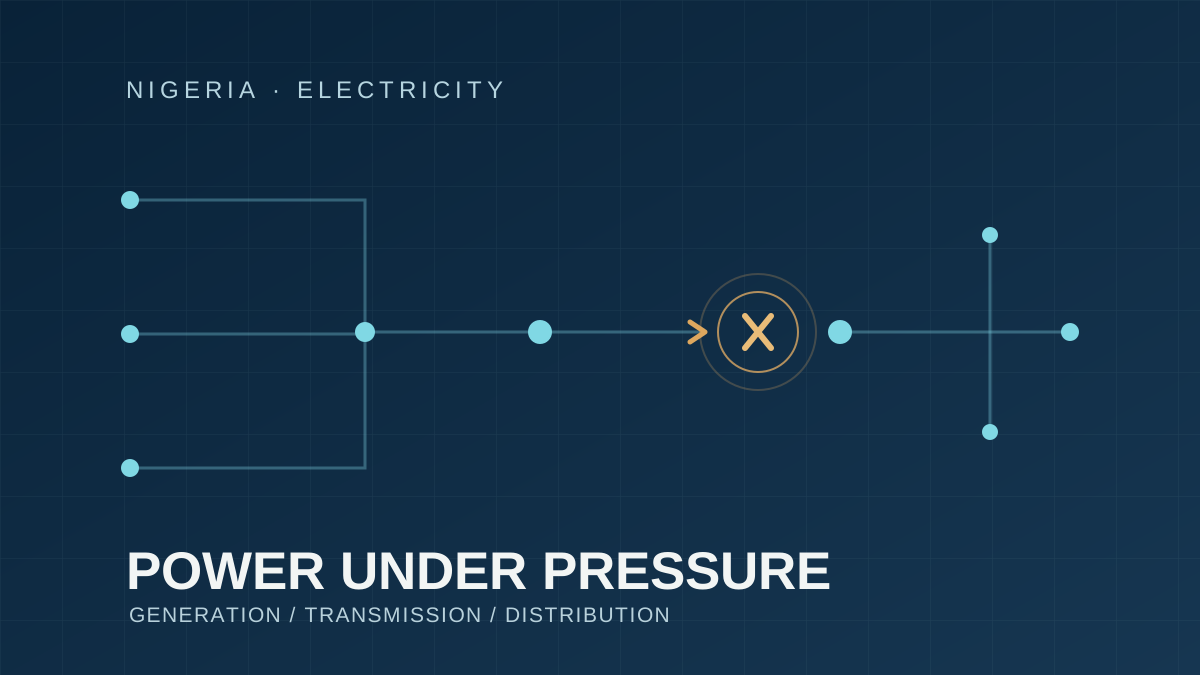
Gas shortages, lower reservoir inflows and maintenance challenges are limiting electricity supply in parts of Nigeria. Officials agree on the broad generation problem, but a dispute over specific feeder outages shows why the cause of a blackout cannot be read from a single label.
A shortage across several cities, not a confirmed national grid collapse
Nigeria's electricity minister has acknowledged renewed power-supply disruptions affecting consumers in Lagos, Abuja and parts of Ogun, Kwara and Oyo states. In a statement issued on Thursday, November 5, through his media adviser Adeola Adelabu, Joseph Tegbe's ministry said it recognised the effects on households, businesses and public services and was coordinating with power-sector operators to improve supply. A separate update followed on Friday, November 6. The acknowledgement came after customers experienced shorter periods of electricity availability, despite what the ministry described as recent improvements in some locations.
The ministry's preliminary assessment did not identify a major or systemic failure of the national transmission grid. Instead, its reported explanation combined operational and maintenance problems with reduced output from generating stations. That distinction matters: a shortage of power produced for the network can leave homes without electricity even when the high-voltage lines themselves have not suffered a nationwide breakdown. The minister's assessment is an official account of the problem, not an independent engineering audit of every interruption.
Sources: FG Expresses Concern Over Poor Power Supply in Abuja, Lagos, Ogun, Others · FG blames gas shortage for power outages in five states · Power Outage: Tegbe assures Nigerians of swift restoration as electricity disruptions hit Lagos, Abuja
Gas shortages and lower water inflows squeeze generation
The Nigerian Independent System Operator, known as NISO, issued a separate clarification on November 5. It attributed weaker electricity generation to two pressures: constraints on natural-gas deliveries to thermal power stations and lower water inflows into reservoirs serving hydroelectric plants. Gas-fired units cannot necessarily run at their available capacity without sufficient fuel. Hydroelectric output can also be constrained when the water entering reservoirs is reduced.
These are supply-side limitations rather than evidence, by themselves, that a transmission tower, substation or entire grid has failed. They also affect stations differently, so a single nationwide explanation does not identify the cause of every local outage. NISO's account said less power was available for allocation to distribution companies, which in turn meant shorter supply hours and additional load shedding in their service areas. The relative effect on a particular distributor depends on its allocation and its own operating circumstances.
Sources: Why power generation has reduced — NISO explains · FG Expresses Concern Over Poor Power Supply in Abuja, Lagos, Ogun, Others
Why available electricity gets rationed
Load shedding is a controlled reduction in demand when the electricity available cannot serve every connected customer at once. It can be used to keep supply and demand in balance and to protect system frequency. For consumers, however, an orderly reduction still feels like an outage: lights go out, equipment stops and businesses may need alternative power. Whether electricity returns quickly depends on when more generation is available and how distributors manage the energy they receive.
That is why figures such as generation at a particular hour, electricity allocated to a distributor and electricity actually delivered to a home are not interchangeable. An allocation describes a quantity assigned to a distribution network at a stated moment. It is not a guarantee that every feeder will carry power continuously, or that every customer will receive the same number of supply hours. Network maintenance, local faults and operational decisions can still affect the last part of the journey.
Sources: Why power generation has reduced — NISO explains · FG blames gas shortage for power outages in five states · Who Does What Under The Electricity Act 2023
TCN challenges Ikeja Electric’s explanation
A second public dispute surfaced on November 6. The Transmission Company of Nigeria, or TCN, rejected Ikeja Electric's November 5 notice that had blamed grid instability for outages on some Band A feeders on November 3 and 4. TCN said that characterisation wrongly placed responsibility on its transmission network when the wider shortage stemmed from insufficient generation and the subsequent distribution allocations. Those are TCN's claims in a disagreement between network participants, not a neutral finding that every affected feeder was fault-free.
TCN also cited NISO's role in establishing system conditions. Nigeria's electricity regulator describes NISO as responsible for dispatch, system frequency and grid operation, while TCN owns and maintains the national transmission infrastructure. That division helps explain why the company objected to a distributor assigning grid-wide root causes on its own. But institutional responsibility does not relieve any participant of the need to investigate interruptions within its own facilities or to communicate reliable information to customers.
Sources: TCN faults Ikeja Electric, blames outages on low generation · TCN disputes Ikeja Electric’s claim of grid instability behind Band A outages · TCN rejects IKEDC’s claim over cause of power outages · Who Does What Under The Electricity Act 2023
The outage statistics cover different dates
In support of its response, TCN reported that 68 percent of interruptions on feeders supplying Ikeja Electric on November 1 and 2 involved frequency-control load shedding associated with inadequate generation. It assigned another 26 percent to either alleged distributor non-compliance with NISO load allocations or faults and work on Ikeja Electric's own network. The remaining 6 percent, it said, reflected TCN's planned maintenance, switching or a line limitation, not an equipment failure or trip on its system.
TCN separately described 46 interruptions on the 33-kilovolt feeders listed in Ikeja Electric's notice: 29 from load shedding, 14 attributed to the distributor and three linked to scheduled transmission maintenance. Crucially, the first percentage breakdown refers to November 1 and 2, while the notice under dispute describes November 3 and 4. Those periods must not be collapsed into one statistic. The figures are TCN's records and classifications; they do not independently settle each customer's experience or establish a single root cause for all November outages.
Sources: TCN faults Ikeja Electric, blames outages on low generation · TCN disputes Ikeja Electric’s claim of grid instability behind Band A outages · TCN rejects IKEDC’s claim over cause of power outages
Restoration depends on generation, not assurances alone
The power ministry said it was working with TCN, NISO and distribution companies to address operating constraints and speed ongoing maintenance. Its public remarks, as reproduced by several outlets, promised further updates as supply improved. They did not provide a verified date by which all affected households would have normal service again. That 48–72-hour estimate covers only the first units returning to service; it is not a date by which all affected households will have normal supply again.
In a separate statement dated November 6, Tegbe attributed the reduced electricity available on the national grid to planned maintenance at Egbin Power Station and constraints in gas supply to some thermal generating stations. He said the affected generating units would return to service in phases, with the first units coming back online within 48 to 72 hours. The statement gave no deadline for full restoration of supply to all affected customers.
The immediate questions are therefore practical. Have gas deliveries resumed sufficiently to restart constrained thermal units? Have reservoir conditions and plant operations improved? How much electricity is NISO able to dispatch, and how do distribution allocations translate into hours of supply? Customers should also be told whether a particular interruption is deliberate load shedding, a local equipment problem or scheduled maintenance. The answer may differ even within the same city. Until operational updates answer those questions, the clearest confirmed development is that authorities acknowledge a generation shortfall and TCN disputes its description as a general transmission-grid failure.
Sources: FG Expresses Concern Over Poor Power Supply in Abuja, Lagos, Ogun, Others · FG blames gas shortage for power outages in five states · Why power generation has reduced — NISO explains · Power Outage: Tegbe assures Nigerians of swift restoration as electricity disruptions hit Lagos, Abuja · Who Does What Under The Electricity Act 2023 · Tegbe Expects First Power Units Back Within 48–72 Hours