Nigeria has completed the 21-day monitoring period for all 62 people identified as contacts of its imported case of Ebola disease caused by Bundibugyo virus (Bundibugyo virus disease, BVD), with no secondary transmission detected, the Nigeria Centre for Disease Control and Prevention said on November 13. The final contact was released from monitoring that day. It is a meaningful milestone in the response, but it is not an announcement that the outbreak is over: a separate 42-day period governs the formal declaration.
A milestone in the response, not an all-clear
The announcement closes one part of Nigeria’s response to its first Ebola case in more than a decade. All 62 identified contacts completed their individual 21-day monitoring periods, and none developed Bundibugyo virus disease. The last person under monitoring was released on November 13, according to the NCDC account reported by Reuters.
Contact monitoring watches people linked to a confirmed case during the virus’s maximum incubation period. Completing that period without a secondary case shows that no transmission was detected in this identified group. It does not show that the virus has disappeared from the wider region or satisfy the separate conditions for declaring an outbreak over.
The distinction is central to the NCDC’s message. Director-General Jide Idris said completion of contact monitoring should not be treated as the end of the outbreak. The development is specific: the 62 contacts completed follow-up without a secondary infection; Nigeria has not declared itself Ebola-free.
Sources: Nigeria ends 21-day Ebola contact monitoring with no secondary transmission · Nigeria records zero Ebola transmission as 62 contacts completes monitoring · Ebola virus disease — Democratic Republic of the Congo · Ebola disease caused by Bundibugyo virus — Democratic Republic of the Congo
What the numbers say — and what they do not
The 62 contacts were identified in connection with Nigeria’s imported case. During monitoring, 13 reported fever or other non-specific symptoms. Laboratory tests for all 13 were negative, Reuters reported. Those symptoms should not be rewritten as Ebola cases.
The NCDC also investigated seven Ebola alerts reported across five states during the preceding three weeks. Nigerian reporting named Adamawa, Rivers, Borno, Lagos and Ekiti. All seven alerts tested negative. These investigations add context beyond the original contact group, but do not increase the number of confirmed Nigerian cases.
The figures describe a response that investigated signals without identifying secondary infection. The seven alerts should not be confused with the 62 contacts: they are separate categories. The evidence supports a narrow conclusion — no secondary transmission was detected among the monitored contacts, and the reported alerts were investigated and found negative.
Sources: Nigeria ends 21-day Ebola contact monitoring with no secondary transmission · Nigeria records zero Ebola transmission as 62 contacts completes monitoring
The imported case behind the monitoring effort
The monitoring followed Nigeria’s first reported Ebola case in more than a decade. Reuters described the patient as a Swiss woman who had travelled to Uganda before returning to Nigeria. She recovered in Switzerland and was discharged from hospital.
The disease was identified as Bundibugyo virus disease. The European Centre for Disease Prevention and Control’s November 12 update described one Nigerian case, recorded 62 contacts and linked the patient’s travel history to Uganda. It also reported continuing community transmission in the Democratic Republic of the Congo.
Sources: Nigeria ends 21-day Ebola contact monitoring with no secondary transmission · Ebola disease outbreak caused by Bundibugyo virus — Multi-country — 2026
Why 21 days is a contact-monitoring period
The 21-day period reflects the maximum incubation period used in Ebola monitoring. It applies to identified contacts; it is not a national outbreak-ending clock that starts automatically when the index case is confirmed. Reuters reported that the final contact’s monitoring period ended on November 13.
Contacts do not necessarily begin or complete follow-up on the same day. The final release means the identified group passed through its observation window without a detected secondary case. It does not answer when authorities may formally declare the outbreak over.
Sources: Nigeria ends 21-day Ebola contact monitoring with no secondary transmission · Ebola virus disease — Democratic Republic of the Congo · Ebola disease caused by Bundibugyo virus — Democratic Republic of the Congo
The separate 42-day countdown
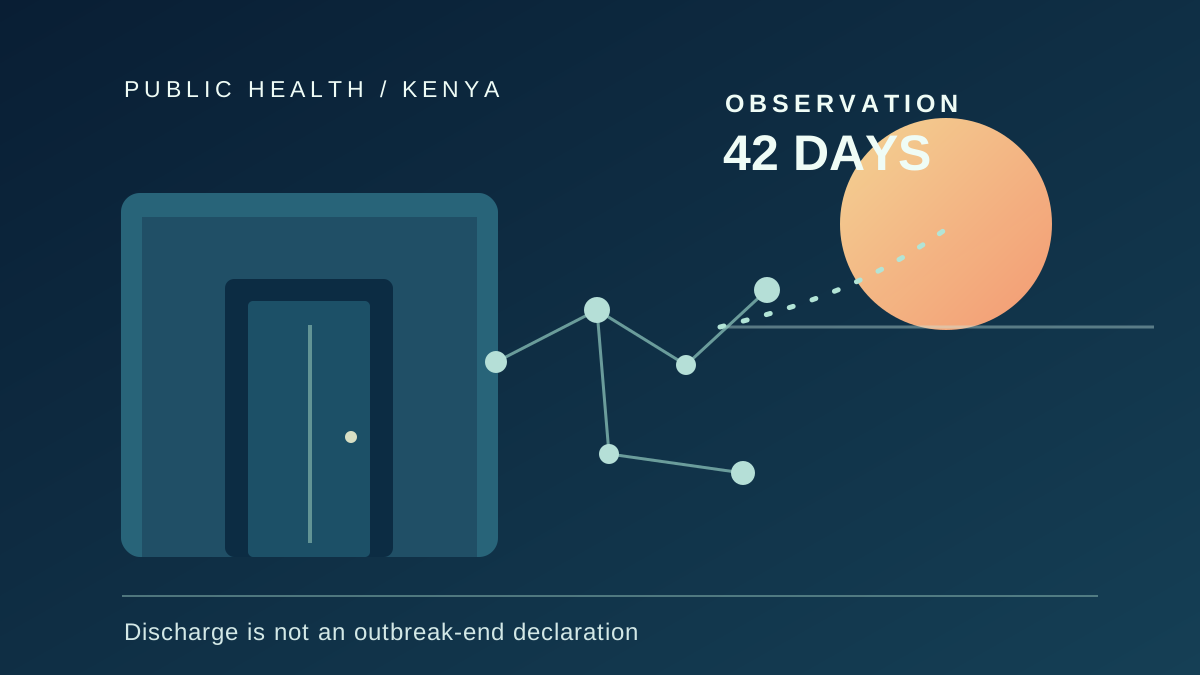
The formal end-of-outbreak declaration follows a different rule. Reuters, citing World Health Organization protocols, reported that a full 42-day countdown from the recovery or departure of the last confirmed patient must be completed before an official declaration. The period is twice the maximum 21-day incubation period.
WHO reports illustrate the rule. In its account of the 2025 Democratic Republic of the Congo outbreak, WHO said the outbreak was declared over after two incubation periods — 42 days — from the last confirmed patient’s negative test and discharge. Its 2026 report on Uganda’s Bundibugyo virus disease outbreak also described a 42-day period following discharge of the last confirmed locally transmitted case.
The starting point is tied to the last confirmed patient’s recovery or departure, not to the date Nigeria completed contact monitoring. The November 13 milestone cannot be used to calculate an end date. No specific date should be inferred, and any conditional estimate by officials is not a formal timetable or declaration.
Sources: Nigeria ends 21-day Ebola contact monitoring with no secondary transmission · Ebola virus disease — Democratic Republic of the Congo · Ebola disease caused by Bundibugyo virus — Democratic Republic of the Congo
Why surveillance remains part of the story
Nigeria’s result is encouraging, but it sits within a wider regional outbreak picture. ECDC’s November 12 assessment reported continuing community transmission of Bundibugyo virus disease in the Democratic Republic of the Congo. Completion of monitoring in Nigeria does not mean transmission elsewhere has stopped.
The distinction between completed contact monitoring and a formal end-of-outbreak declaration describes two different public-health thresholds. It prevents a response milestone from being mistaken for a final status decision. Same-day reporting on November 13 described continued heightened surveillance and preparedness. Idris cautioned against treating the result as proof that the country was out of danger.
As of November 13, all 62 identified contacts had completed 21 days of monitoring; none had developed the disease. The 13 symptom reports and seven alerts across five states all tested negative. The formal end-of-outbreak declaration had not been made. That is the accurate point at which to leave the story.
Sources: Nigeria records zero Ebola transmission as 62 contacts completes monitoring · Ebola virus disease — Democratic Republic of the Congo · Ebola disease caused by Bundibugyo virus — Democratic Republic of the Congo · Ebola disease outbreak caused by Bundibugyo virus — Multi-country — 2026