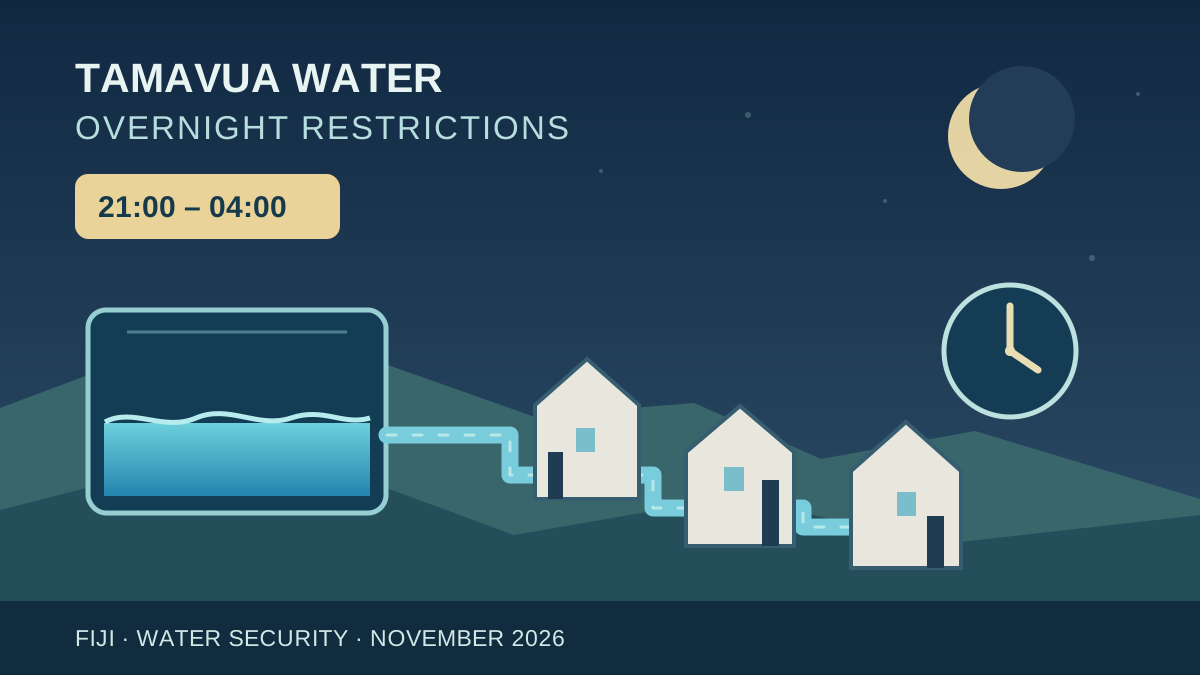
For households on parts of Fiji’s Tamavua water network, a dry spell now has a timetable. The Water Authority of Fiji says it began controlled overnight restrictions on November 5, with valves operated between 9 p.m. and 4 a.m. each day until further notice. Some customers may lose water altogether; others may experience weaker or intermittent pressure. The reported schedule covers named neighbourhoods and streets, not the whole country. It also comes as Pacific climate agencies warn of a drier season across large parts of the region. Those two kinds of information belong together, but they are not interchangeable: a regional forecast describes probabilities over months, while a household needs to know what its local pipes, reservoirs and treatment plant can deliver tonight.
A seven-hour window, not a seven-hour guarantee
The Fiji Times reported that the authority announced its overnight valve programme on November 5. FBC News said the following morning that rationing had begun the previous day. Both describe operations from 9 p.m. to 4 a.m., continuing until WAF issues a further notice. This is a restriction window, not a promise that every address will be without water for seven hours, nor a guaranteed restoration time for every home.
According to the utility’s account reproduced by local outlets, supply may start returning progressively after 4 a.m. Customers in higher areas can experience longer delays because their pressure depends partly on levels in the network and reservoirs. A household with a usable supply at dawn and one at the end of an elevated street may therefore experience the same operating timetable differently. No verified cancellation or revised schedule had been located in the public sources checked for this report. That is not proof that conditions will remain unchanged.
Sources: WAF introduces overnight water rationing in parts of Suva · Overnight water rationing begins · Thousands of people face overnight water rationing as dry weather affects Tamavua water supply
What the reported 15% actually measures
WAF attributes the shortfall to reduced raw-water flows from the Savura Cascade and Headworks 3 catchments after prolonged low rainfall. The authority estimates an approximately 15% fall in raw-water inflow at the Tamavua Water Treatment Plant, significantly affecting treated water production. That number is specific to this treatment system and comes from the operator’s advisory as reported by Fiji Times, FBC and FijiVillage. It does not describe Fiji’s national rainfall, the share of residents without water, or a measured 15% reduction at every household tap.
The explanation for the overnight measures is operational. Lower production puts pressure on stored water, especially when daytime demand is higher. WAF says nighttime valve controls are intended to let the Tamavua Reservoir recover enough storage to support demand later in the day. The announcement does not supply a public series of daily production volumes, inflows, reservoir levels or pressure readings that would let outsiders verify how much storage the controls recover. The reported percentage is therefore useful evidence of the utility’s assessment, but not an independent audit of system performance.
Sources: WAF introduces overnight water rationing in parts of Suva · Overnight water rationing begins · Thousands of people face overnight water rationing as dry weather affects Tamavua water supply
A neighbourhood map made of street names
The affected places are more precise than a broad label such as Suva. The local reports identify elevated portions of Valelevu and Cunningham Stage 4, Caubati Koro, Upper Cakacaka Road, Upper Bay View Heights and Upper Mead Road. They also list streets around Rewa Street and Tip Top; sections of Samabula North, Aiwa Street and Upper Lakeba Street; and Princes Road between Loa Street and Reservoir Road, including feeder roads. The Naboro list includes Naboro Prison, Naboro Complex, the Gilbertese Settlement and Naboro Dairy Farm.
These are locations named in a utility notice reproduced by newsrooms, rather than a verified street-by-street live outage map. Residents should check the complete current list with WAF, particularly where a road is only partly included. Elevation matters because pressure recovery may take longer at higher points, but the public material does not establish how many people actually lost water or for how long. FijiVillage refers to thousands of people potentially facing disruptions; that description is not a verified count of disconnected customers.
Sources: WAF introduces overnight water rationing in parts of Suva · Overnight water rationing begins · Thousands of people face overnight water rationing as dry weather affects Tamavua water supply
El Niño adds context, not a local meter reading
On November 5, the World Meteorological Organization described an outlook for November 2026 through January 2027 in which below-normal rainfall is more likely across substantial parts of the western Pacific. The statement follows a regional outlook issued on October 23 after the Pacific Islands Climate and Ocean Forum. The Pacific Regional Climate Centre Network separately describes likely drier conditions across much of the northwest and southwest Pacific, while identifying wetter-than-normal probabilities in parts of the equatorial Pacific.
That variability matters. The regional network explicitly says its statement is not an official outlook for any single country and directs readers to national meteorological services for local forecasts. Fiji’s meteorological service provides a November climate outlook through its own published outlook portal. Neither a three-month probability forecast nor an El Niño headline reports today’s Tamavua inflow, pressure or reservoir storage. WAF’s specific account of falling catchment flow is the relevant operational claim; the regional outlook explains why managers are watching rainfall risk across many island states.
Sources: Western Pacific faces drier months as El Niño strengthens · Strong El Niño to influence rainfall, temperatures and cyclones into 2027 · Fiji Climate Outlook (November 2026 listing)
What households can act on now
The reported utility advice focuses on essential uses first: drinking, preparing food, personal hygiene and sanitation. WAF asks customers to keep reasonable reserves in clean, covered containers or suitable tanks, repair leaks and reduce non-essential uses such as watering lawns, washing vehicles and filling pools. These are precautionary steps during uncertain supply, not an announcement that tap water has been found contaminated. No tested water-quality failure, disease outbreak or emergency health directive related to this restriction was established by the sources reviewed.
WAF also says water-carting trucks are on standby, subject to operational requirements and availability. Standby is not the same as a confirmed truck delivery to every affected street. The Fiji Times lists WAF contact numbers 3346777 and 5777 for assistance. For households that cannot store much water, a service interruption can create additional time and planning costs; however, the reporting provides no household survey establishing the scale of those burdens. The practical question remains what support is actually available at a particular address when taps run dry.
Sources: WAF introduces overnight water rationing in parts of Suva · Overnight water rationing begins · Thousands of people face overnight water rationing as dry weather affects Tamavua water supply
The next meaningful update is operational
A seasonal climate outlook can alert governments, water managers and communities to a rising probability of dry conditions. It cannot say whether Tamavua’s reservoir has recovered enough tonight, whether a particular valve operation has been adjusted, or whether a specific family has water at breakfast. Those answers require dated local service advisories and measurable changes in catchment flows, treatment output, stored volumes and distribution pressure.
The most useful next WAF notice would state whether the 9 p.m.–4 a.m. schedule remains active, exactly which areas are included, whether additional areas have been added or removed, and how people can obtain emergency assistance. Publishing comparable reservoir and production figures over time would also help readers distinguish a temporary operating response from a prolonged supply constraint. Until such information is available, the most precise conclusion is modest: a Tamavua-specific production shortfall has prompted nightly restrictions in listed areas, while the region’s seasonal forecast describes the wider risk, not an exact timetable for those taps.
Sources: WAF introduces overnight water rationing in parts of Suva · Overnight water rationing begins · Thousands of people face overnight water rationing as dry weather affects Tamavua water supply · Western Pacific faces drier months as El Niño strengthens · Strong El Niño to influence rainfall, temperatures and cyclones into 2027