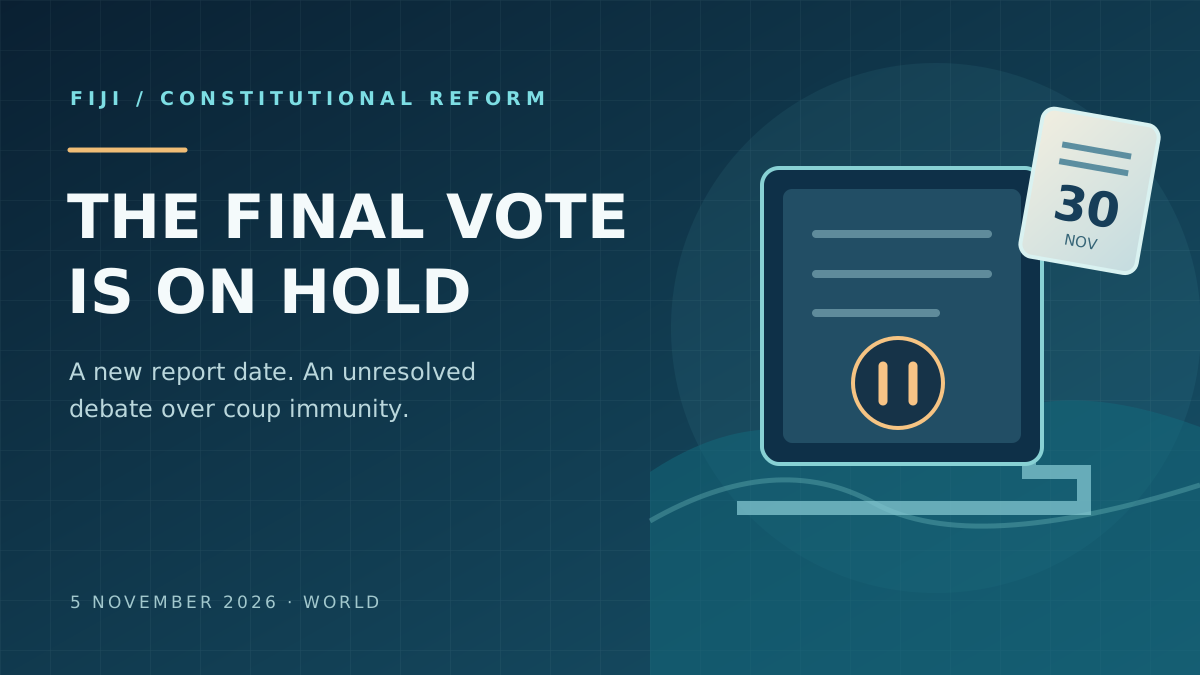
Fiji’s constitutional reform process has paused before its decisive parliamentary vote. On November 2, lawmakers agreed to extend scrutiny of the Constitution (Amendment) Bill 2026 instead of holding the final reading expected this week. Prime Minister Sitiveni Rabuka says a special committee now plans to report on November 30. Meanwhile, the country’s military commander has asked Parliament to remove immunity provisions associated with past coups. Neither development amounts to a new constitution: the amendment bill has not completed its final vote, and the referendum announced for December remains conditional.
The final vote was postponed, not defeated
On November 2, Parliament agreed to allow its Special Committee more time to review the Constitution (Amendment) Bill 2026. The proposed measure had passed its second reading on October 2 and was expected to return for a third reading during the first week of November. That stage has been deferred: lawmakers did not conduct the expected final vote, nor did they enact the bill.
Prime Minister Sitiveni Rabuka, who chairs the committee, said the parliamentary secretariat needed more time to process submissions and that the committee wished to receive additional views. The extension is a decision about the review process. It does not settle which parts of the proposed constitutional text will survive.
ABC Pacific reported that the National Federation Party and SODELPA, two governing coalition partners, had said they would vote against the proposal. Those reported intentions raised doubts about achieving the parliamentary support required for passage. They should not be turned into a prediction of the eventual result.
Sources: Fiji Parliament extends Constitution Bill review as parties raise concerns over rushed process · Constitution Bill report delayed, vote set for December · Rabuka assures election timeline intact · Fiji PM delays final reading of Constitution Amendment Bill
The new committee report target is November 30
Rabuka said the special committee intended to present a written report on Monday, November 30. Fiji Sun reported that members were expected to consider a third reading during the first four days of December. Neither milestone has occurred as of November 4. The report date is the government’s revised target, not a guarantee of delivery.
The prime minister said new written and oral submissions would be invited. Critics of the timetable questioned whether the additional period would be enough for the public and lawmakers to assess major constitutional changes. Further consultation is a confirmed procedural intention; the eventual recommendations and amendments remain unknown.
The sequence matters. A committee report needs to be completed and presented before lawmakers can proceed to the third reading. Only then can Parliament decide whether the constitutional amendment bill passes. Reporting a target date as a completed constitutional act would obscure that distinction.
Sources: Fiji Parliament extends Constitution Bill review as parties raise concerns over rushed process · Constitution Bill report delayed, vote set for December · Rabuka assures election timeline intact
The military wants immunity removed
The Republic of Fiji Military Forces has asked lawmakers to remove constitutional immunity protections connected with past coups. Its commander, Major General Ro Jone Kalouniwai, told the special committee that the military did not want the immunity described in section 206 of the proposed text and wanted Chapter 14 removed, according to The Fiji Times.
The commander said he had signed a declaration on October 16 setting out that position. The military also proposed a truth, accountability and reconciliation approach rather than retaining the existing immunity provisions. These are proposals and statements by the military, not legislation already approved by Parliament.
On November 4, Fiji Sun reported that Rabuka was open to amending the immunity provision or leaving it out, but that legal advisers would need to examine the implications. His openness is not a final government or parliamentary decision. It would be wrong to write that immunity has already been abolished.
Sources: RFMF voluntarily gives up constitutional immunity – Kalouniwai · PM open to removing constitutional immunity
Why a declaration is not a change in law
Immunity in the constitutional debate concerns whether specified conduct linked to past unconstitutional events remains protected from ordinary legal scrutiny. The military’s stance is consequential because an institution associated with Fiji’s history of coups has publicly rejected protections drafted for its benefit.
Kalouniwai presented the declaration as acceptance of civilian authority and accountability. Yet the commander’s position is not a judicial ruling, and his declaration alone cannot amend the constitution, determine the status of any prosecution or establish criminal guilt. Changes to the constitutional text require formal legal steps.
The shape of any replacement accountability mechanism is unresolved. The committee has not published its new report, and the final content of the bill remains subject to parliamentary consideration. These facts are compatible with a strong military statement against immunity and with the absence of any legally completed repeal.
Sources: RFMF voluntarily gives up constitutional immunity – Kalouniwai · PM open to removing constitutional immunity · Bills — Constitution (Amendment) Bill 2026, Bill No. 32 · 2026 Constitution — Process and Status
A December referendum is proposed, not completed
The government announced October 5 that it planned to hold a national referendum on December 9, and that a referendum writ was expected on November 9. That announcement was a schedule for a future public decision following the parliamentary stages, not evidence that registered voters had already cast ballots.
The Electoral Commission and Fijian Elections Office opened postal-voting applications in advance. They expressly warned that accepting applications does not mean the referendum writ has been issued. Their notice also says that if the amendment bill is defeated at the third reading and no writ is issued, referendum preparations would be stopped.
Because the final parliamentary vote has been deferred, the December timetable remains subject to the next legal and administrative decisions. As of November 4 there has been no referendum result, and the announced December 9 date must not be presented as a completed vote or an unconditional outcome.
Sources: NATIONAL REFERENDUM SET FOR 9 DECEMBER 2026 · Open of Postal Voting Applications for Announced National Referendum 2026 · Rabuka assures election timeline intact · 2026 Constitution — Process and Status
The next decision points remain open
The immediate question is whether the committee returns with its report around November 30 and what changes the report proposes. A third-reading vote in early December remains the prime minister’s expectation, not an already recorded parliamentary outcome. The official parliamentary website identifies the Constitution (Amendment) Bill as Bill No. 32 of 2026.
The treatment of immunity is a separate substantive question. Lawmakers could consider removing the relevant provisions, replacing them with a different framework or preserving some protections. No available committee report establishes which path will be chosen. The military’s request does not decide the question on Parliament’s behalf.
Only subsequent formal announcements can establish a valid referendum timetable. The state of affairs on November 4 is therefore a delayed final vote, an expected committee report and a debate over accountability. Fiji has not completed a constitutional referendum or enacted the disputed provisions through this pending bill.
Sources: Constitution Bill report delayed, vote set for December · Rabuka assures election timeline intact · PM open to removing constitutional immunity · Open of Postal Voting Applications for Announced National Referendum 2026 · Bills — Constitution (Amendment) Bill 2026, Bill No. 32 · 2026 Constitution — Process and Status