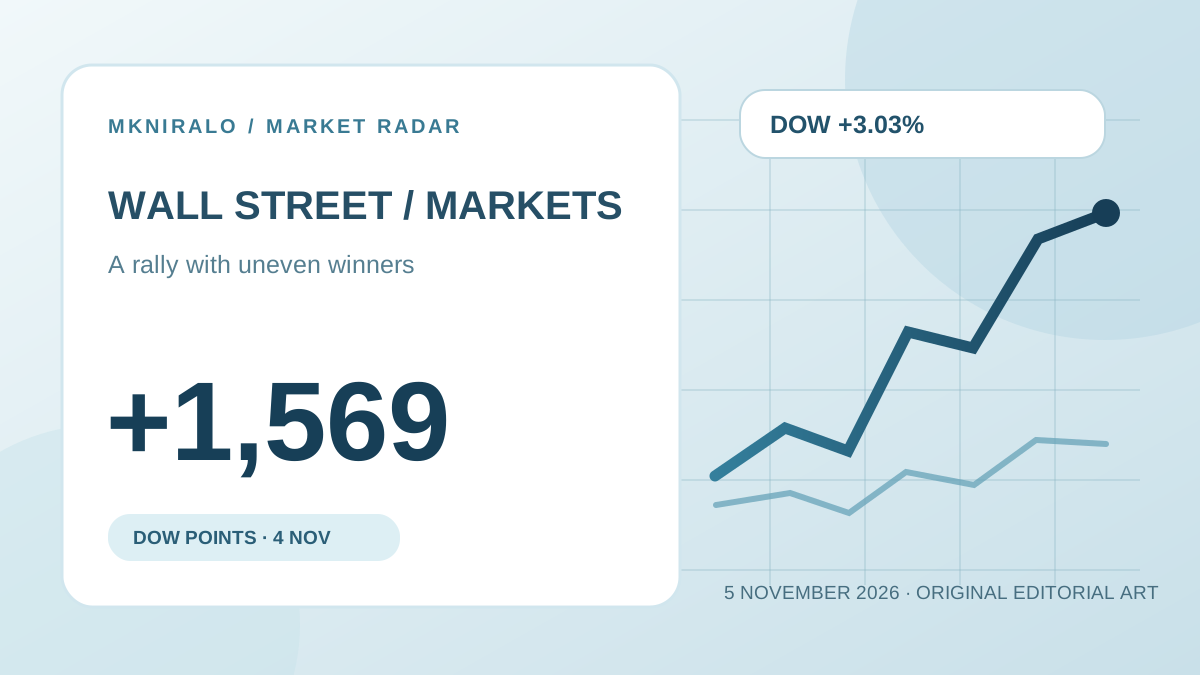
Wall Street ended 4 November with its strongest Dow Jones Industrial Average gain since April 2025, but the session was more than one record-sized index move. The Dow jumped 1,569.40 points, or about 3.03%, to 53,356.12. The S&P 500 climbed 1.58% to 7,688.62 and the Nasdaq Composite advanced roughly 1.44% to 25,736.51. Stocks broadly rose as investors digested the U.S. midterm election result, a sharp retreat in oil prices and the possibility of reduced policy uncertainty. Yet parts of the technology and data-center economy moved against the prevailing market trend.
The closing numbers show the breadth
The Dow finished at 53,356.12, up 1,569.40 points. In percentage terms that was a roughly 3.03% advance, the blue-chip index’s strongest one-day performance since 9 April 2025, according to contemporaneous market coverage. The S&P 500 rose 119.70 points to 7,688.62, and the Nasdaq Composite gained 364.50 points to 25,736.51. The S&P 500’s 1.58% rise and the Nasdaq’s roughly 1.44% move make clear that the advance extended beyond the Dow.
Smaller companies participated too: the Russell 2000 added 44.50 points, or around 1.6%, to 2,856.95. Associated Press reporting described particularly strong demand for hospital operators and retailers serving lower-income households. These patterns suggest investors were repricing several possible channels at once, including consumer costs, future policy decisions and company-specific earnings prospects. Broad participation did not mean the gains were evenly distributed across sectors or individual businesses.
Sources: How major US stock indexes fared Wednesday 11/4/2026 · Dow scores its best day in 18 months in a broad relief rally after Democrats sweep to power in Congress · Stocks surge, and the Dow soars 1,500 points as oil prices tumble following the US midterm elections
The election result changed how traders saw policy risk
Democrats secured control of both chambers of Congress in the 2026 U.S. midterm election, ending one-party control of Washington. News reports linked the rally partly to expectations of checks on the administration’s legislative agenda and possible pressure for a different course on the Middle East war. Those explanations capture market participants’ immediate assessments, not a guarantee that any particular regulation or foreign-policy decision will change.
Markets often respond to an altered range of possible outcomes rather than to a completed policy shift. A divided federal government may reduce the odds of some legislation while increasing the possibility of prolonged negotiations over budgets, energy and industrial policy. Neither Congress nor the executive branch ceased to operate after the election. The stock-market move is therefore better understood as a repricing of expectations under uncertainty than as proof that a specific economic result has already arrived.
Sources: Wall Street ends higher after Democrats win Congress; data center stocks tumble · Stocks surge, and the Dow soars 1,500 points as oil prices tumble following the US midterm elections
The energy move was a backdrop, not the entire story
Oil prices moved sharply lower during the same session. Reports put benchmark Brent crude’s settlement at $94.62 a barrel, down about 8.7%, and U.S. West Texas Intermediate at $88.12, down approximately 8.3%. Lower fuel costs can ease one pressure on households and companies, and financial reporters connected that prospect with the rally. But a single day’s price move does not establish what consumers will pay next month, or whether a military conflict is nearing resolution.
Bond markets also reflected a reassessment of inflation and economic risk: the ten-year U.S. Treasury yield ended near 4.88% in Associated Press coverage. Falling yields can support equity valuations by lowering the discount rate investors apply to future earnings, but the link is not mechanical. Stocks can rise while yields fall for several competing reasons. This article treats oil and bonds as supporting context and leaves the detailed crude-price story to separate coverage.
Sources: Stocks surge, and the Dow soars 1,500 points as oil prices tumble following the US midterm elections
Large technology platforms diverged from infrastructure suppliers
Microsoft and Amazon were among the highly visible large-cap winners. MarketWatch reported that they added roughly $424 billion in combined market value, with Microsoft up about 6.7% and Amazon roughly 6.1%. The point is not simply that all technology companies rallied: investors appeared willing to back established cloud platforms even as they reconsidered the economics and political exposure of expensive infrastructure projects.
Reuters reported that data-center operators and related companies including Hut 8, IREN, Core Scientific and Applied Digital suffered steep losses while some cash-rich cloud groups gained. It also described a drop in the semiconductor index. That divide matters because the AI investment chain contains businesses with very different financing requirements, cash generation and sensitivity to future rules on data-center construction. A broad index advance can conceal severe stress in particular subsectors.
Sources: Microsoft and Amazon combined to see a $424 billion market-cap boost · Wall Street ends higher after Democrats win Congress; data center stocks tumble
What the volatility measures do not say
The market’s biggest one-day gain in many months does not by itself mean volatility is permanently lower. Daily price swings measure changes in expectations under uncertain conditions; they do not demonstrate that the underlying geopolitical, energy or corporate questions have been resolved. The Cboe volatility benchmark reportedly fell sharply during the session, but the provided reports do not establish one definitive, consistently timestamped settlement in the 16.6–17.1 range.
Other commonly cited details also require care. Gold was reported higher, but available summaries differ over the exact intraday and closing level. Reports show that Treasury yields declined, yet the provided 4.90% ten-year figure differs from Associated Press reporting near 4.88%. A precise figure can create false confidence when its timing and instrument are unspecified. The article therefore emphasizes verified closes for the major equity indices and labels less consistent cross-asset observations as context.
Sources: Dow scores its best day in 18 months in a broad relief rally after Democrats sweep to power in Congress · Stocks surge, and the Dow soars 1,500 points as oil prices tumble following the US midterm elections
A one-day rally is not a settled economic forecast
The closing figures are unambiguous about the size of the move: major benchmarks rose, and the Dow had its strongest day since April 2025. They are less definitive about its cause or durability. Investor optimism about less political disruption, lower energy costs and stronger consumer demand was real enough to affect prices. But those expectations can reverse as new policy proposals, inflation releases, corporate results or conflict developments arrive.
The clearest lesson of 4 November is that markets were pricing several narratives simultaneously. Consumer-sensitive sectors and large technology platforms saw opportunities; parts of the energy, defense and AI infrastructure complex saw different risks. Treating the day as a simple oil-price story would miss the political and corporate split. Treating it as an all-clear signal would ignore the unanswered questions that the rally itself exposed.
Sources: How major US stock indexes fared Wednesday 11/4/2026 · Wall Street ends higher after Democrats win Congress; data center stocks tumble · Stocks surge, and the Dow soars 1,500 points as oil prices tumble following the US midterm elections