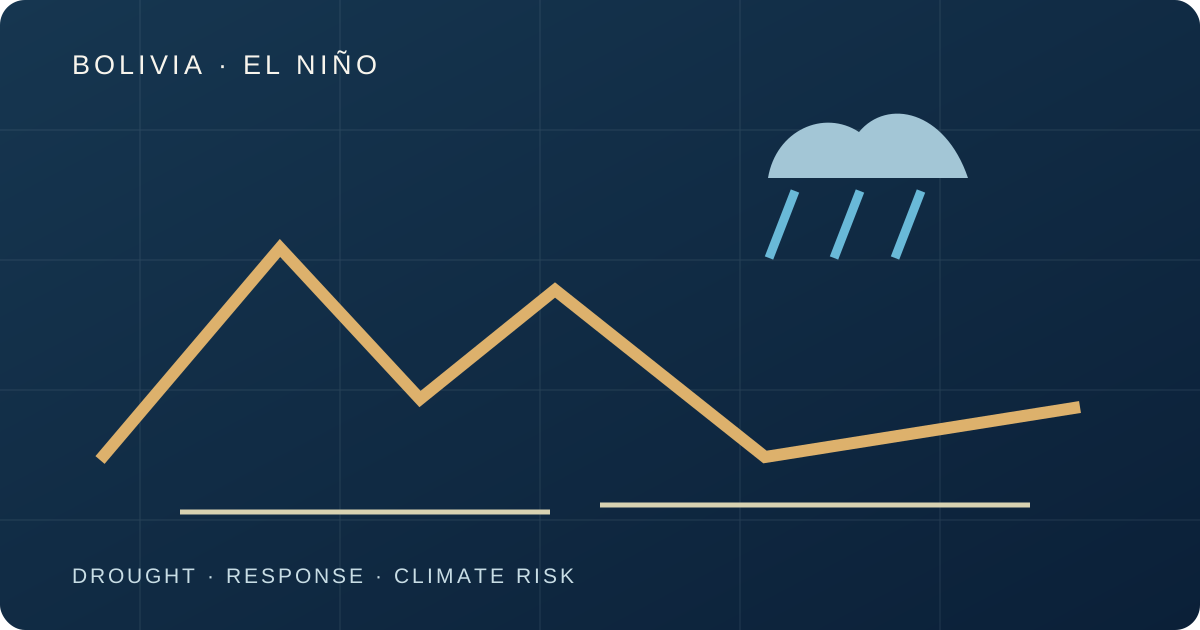
Bolivia declared a national emergency on 31 October under Supreme Decree 5759. Its scope reflects two different realities: drought is already hurting communities, while floods and other weather-related hazards are risks that officials want to prepare for. The legal measure does not mean every listed threat is already occurring or that relief has been disbursed.
What Decree 5759 says
Dated 31 October 2026, the decree invokes Bolivia's risk-management Law 602 and declares a National Emergency Situation because of existing drought and the imminent risk of frost, hail, forest fires, floods and river overflows linked to the 2026–27 El Niño episode.
It cites an earlier recommendation from CONARADE, the national risk-reduction council. The government says the goal is to safeguard lives, health and livelihoods, reinforce preparedness and response, and support activation of contingency financing mechanisms.
Sources: Supreme Decree 5759 dated 31 October 2026 (public legal transcription) · Paz announces national El Niño emergency decree
Drought is real, but the affected-family estimates differ
An EFE report on 1 November cited an earlier civil-defence estimate of 78,217 families affected by drought across seven of Bolivia's nine departments. The president separately described 63 communities already suffering drought and others preparing for possible flooding.
El Deber subsequently reported a defence-ministry figure of 114,048 families across 63 municipalities in six departments. These briefings have different geographic scopes, and the latest publication date does not prove the datasets are directly comparable. Neither should be presented as the uniquely verified total without reconciliation.
Sources: Bolivia declares national emergency over El Niño · El Niño: latest figures cite 114,048 affected families · El Gobierno de Bolivia declara emergencia nacional
Why the same declaration mentions drought and floods
El Niño warms parts of the equatorial Pacific and shifts atmospheric circulation. Depending on season and location, its effects can include reduced rainfall in one area and heavy precipitation in another. Bolivia's rainy season poses different risks from the drought already reported in highland and agricultural regions.
A national hazard declaration is a preparedness measure. A listed possibility such as river overflow is not an observation that a specific river has flooded; local warnings, measurements and emergency notices are needed to establish what actually happened.
Sources: Supreme Decree 5759 dated 31 October 2026 (public legal transcription) · Bolivia declares national emergency over El Niño · Bolivia declares emergency as El Niño intensifies
Coordination and financing: a legal power, not a delivery receipt
President Rodrigo Paz said institutions across the country—including ministries, municipalities, departments, police and armed forces—would coordinate efforts and seek cooperation to speed up emergency assistance. Bolivia TV described a push to mobilise people and resources.
The decree instructs ministries to implement its provisions but does not itself list every transfer to local governments or beneficiary household. Future reporting must distinguish emergency powers, budget authorisations, money actually paid and supplies received by communities.
Sources: Supreme Decree 5759 dated 31 October 2026 (public legal transcription) · Paz announces national El Niño emergency decree
Farmers, livestock and household water supplies
Extended dry weather can affect drinking water, irrigation, fodder and agricultural production. Those losses can spread through incomes, food access and transport networks, while a rapid shift to intense rainfall can create a different set of road and infrastructure vulnerabilities.
Assistance needs will vary by district. The most useful evidence will be observed water availability, livestock support, early-warning coverage, emergency purchases and confirmed local delivery, not only a national announcement.
Sources: Bolivia declares national emergency over El Niño · El Niño: latest figures cite 114,048 affected families · Bolivia declares emergency as El Niño intensifies
What should be checked next
The most urgent follow-ups are a consistent official accounting of affected households; emergency funding authorisations and disbursement dates; which municipalities receive water or agricultural aid; and updated observations as the rainy season develops.
Bolivia has acknowledged a nationwide emergency framework. Its success should be assessed in assistance reaching people and hazards avoided or reduced, with declared risks kept separate from verified events.
Sources: Supreme Decree 5759 dated 31 October 2026 (public legal transcription) · Bolivia declares national emergency over El Niño · El Niño: latest figures cite 114,048 affected families