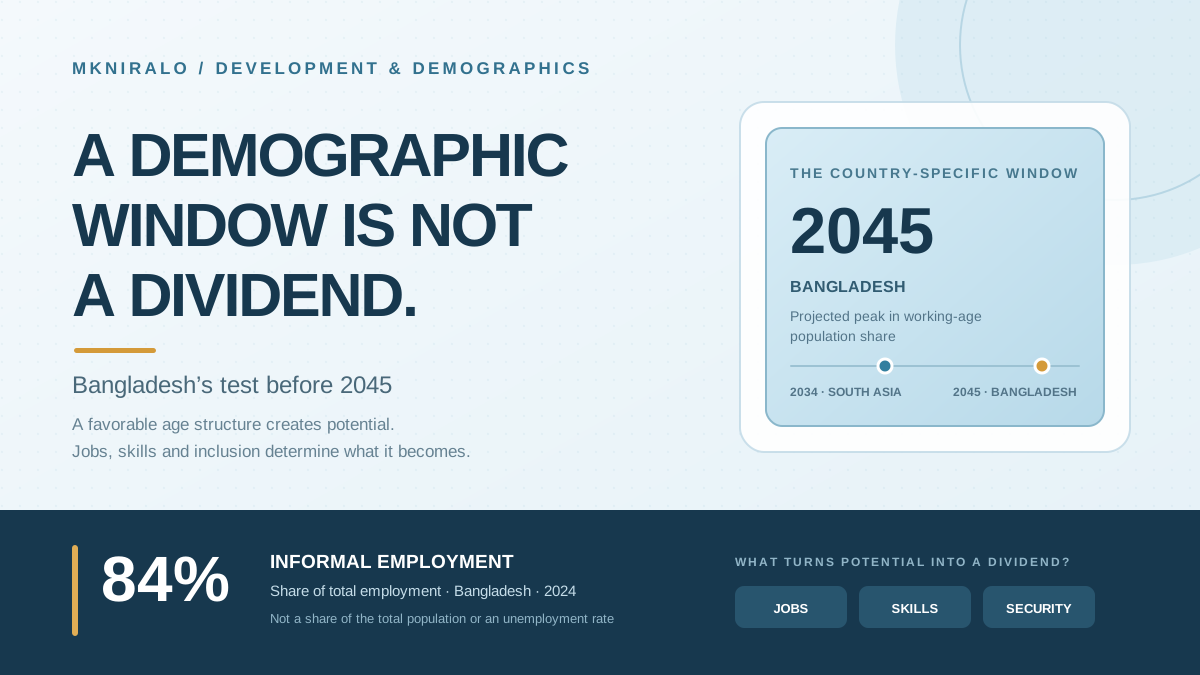
Population forecasts can make a national future look pre-written. A rising share of people in working ages appears to offer a straightforward advantage: more potential workers relative to dependents. But the ratio does not hire anyone. It does not decide whether a firm can expand, whether a woman can enter paid work, whether a graduate finds a productive job, or whether an older worker can retire with security. Those are economic and institutional outcomes, not demographic facts. Bangladesh has a longer window than much of South Asia. The central question is whether the country can use it to build an economy that makes the window matter.
Two demographic clocks, not one
Two demographic clocks are being discussed, and they should not be confused. In its November 3, 2026 report, *Demographic Change in South Asia: From Tailwinds to Headwinds for Development*, the World Bank projects that Bangladesh’s working-age population share will peak in 2045. The same report puts the regional peak for South Asia in 2034. One is a country-specific projection; the other is a regional aggregate. The dates are not competing forecasts for the same population. [1][2][3]
That distinction matters because Bangladesh has around two decades from the report’s publication date before its projected peak, while the regional demographic tailwind begins fading sooner. The report also expects South Asia to reach aged-society status in 2049, while Bangladesh is projected to reach that stage in 2051. In the report’s framework, a population is considered aged when people aged 65 and older account for at least 14 percent of the population. [1][2]
A peak in the working-age share is not a countdown to the disappearance of work or a switch that turns off growth in 2045. It is a turning point in the composition of the population. The size of the working-age group, the number of people actually working, and the output each worker produces are different measures. Treating them as interchangeable turns a demographic projection into a promise it was never designed to make.
Sources: Bangladesh Has a Critical Window to Turn Demographic Change into Opportunity · Demographic Change in South Asia: From Tailwinds to Headwinds for Development · South Asia Has a Critical Window to Turn Demographic Change into Opportunity
The denominator changes the story
The most revealing number in the Bangladesh release may be the least celebratory. The World Bank says about 84 percent of workers—roughly 58 million people—are informally employed. [1] The figure needs its denominator attached. In the report’s chart, informal employment is measured as employed persons in informal jobs as a share of total employment in the relevant age group; Bangladesh’s latest observation is from 2024. It is not 84 percent of the total population, nor a measure of the share of working-age people who are unemployed. [2]
Nor does “informal employment” simply mean “working in an informal-sector business.” Under the ILO’s statistical framework, informality is job-based as well as enterprise-based: an informal job can exist inside a formal-sector enterprise or in a household. The category covers a range of working arrangements, including self-employment, contributing family work and employee jobs that are not effectively covered by formal protections. [4]
That nuance matters. The 84 percent does not mean that 84 percent of Bangladeshi workers do nothing, or that every informal worker has the same experience. It does mean that a very large share of employment sits outside the arrangements that make work more secure and predictable. For a demographic dividend, that is a serious constraint: a large working population can raise output only if the economy can use its labor productively and retain more of the value workers create.
Sources: Bangladesh Has a Critical Window to Turn Demographic Change into Opportunity · Demographic Change in South Asia: From Tailwinds to Headwinds for Development · Informal employment rate
A degree cannot substitute for job creation
Education is part of that equation, but a certificate cannot manufacture demand for skilled labor. The World Bank’s Bangladesh release says 44 percent of graduates are informally employed. It also reports that formal firms add jobs slowly and that small firms have recently shed workers on average. [1] The message is not that education is unimportant. It is that education systems and labor markets must connect to firms that are growing, investing and offering work that uses those skills.
The report’s regional analysis adds another layer: formal firms across South Asia create jobs at roughly half the pace of comparable firms in other emerging-market and developing economies. The report links that gap to constraints including infrastructure, burdensome regulation, weaker innovation and limited workforce training. This is a regional comparison, not a Bangladesh-only estimate, but it describes the environment in which Bangladesh’s firms are competing. [2]
If firms cannot scale, a growing cohort of potential workers can meet a bottleneck rather than a ladder. The policy question therefore extends beyond how many people finish school. It includes whether smaller businesses can obtain finance, whether regulation allows productive firms to grow, whether training reflects actual demand, and whether the economy creates enough higher-productivity work to absorb new entrants. The World Bank’s recommendations on MSME finance, streamlined regulation and worker skills point in that direction. [1][2]
Sources: Bangladesh Has a Critical Window to Turn Demographic Change into Opportunity · Demographic Change in South Asia: From Tailwinds to Headwinds for Development
Who is able to participate?
The labor market also cannot capture a demographic opportunity if a large share of potential workers cannot participate on equal terms. The World Bank’s Bangladesh release identifies low female labor-force participation as one of the constraints on converting the country’s age structure into jobs and productivity. [1]
A separate World Bank Gender Data Portal series, based on ILO modelled estimates, puts Bangladesh’s 2025 labor-force participation rate at 41.5 percent for women and 82.6 percent for men among people aged 15 to 64. This is a participation measure, not an employment rate: it includes people who are working and those actively seeking work. [5] The gap does not, by itself, explain why women are outside the labor force. It does show why a headline about the size of the working-age population can conceal a question about who can actually enter the labor market.
Care responsibilities, safe transport, workplace conditions, access to skills and hiring practices are among the areas policymakers and employers need to examine; the appropriate mix must be grounded in Bangladesh-specific evidence. The point is not to treat women as an unused reserve of labor. It is to recognize that a demographic strategy that leaves participation barriers untouched is measuring potential while tolerating exclusion.
Sources: Bangladesh Has a Critical Window to Turn Demographic Change into Opportunity · Labor force participation rate (% of population): Bangladesh, by sex
The aging clock is already running
The other clock is aging. Bangladesh’s projected 2045 peak in working-age share is followed by a transition to aged-society status in 2051. South Asia’s corresponding regional milestone is 2049. These dates are not a reason to wait until then before building systems that protect people through longer lives. [1][2]
Across South Asia, the World Bank reports that only 17 percent of the working-age population contributes to a pension scheme and only 10 percent of older people receive any pension benefits. These are regional figures, not Bangladesh-specific coverage rates, but they illustrate how thin the safety net is in a region facing rapid aging. [3]
The World Bank’s argument is that the youth dividend and a second dividend from healthier, more financially secure older people require parallel preparation. Better health care, long-term care, pension coverage and savings are not a separate issue to be addressed after job creation is complete. They influence whether people can remain productive, whether households can invest in education and work, and whether aging becomes a shock to families and public finances. [1][2][3]
Sources: Bangladesh Has a Critical Window to Turn Demographic Change into Opportunity · Demographic Change in South Asia: From Tailwinds to Headwinds for Development · South Asia Has a Critical Window to Turn Demographic Change into Opportunity
What would count as cashing in?
Bangladesh should therefore measure the demographic window by more than a population curve. A useful scorecard would ask whether firms are creating net new productive jobs; whether workers move into jobs with more reliable pay and protections; whether women’s participation rises alongside job quality; whether training and education match labor demand; and whether health and old-age income systems are being built before the demographic transition accelerates. These are not a substitute for population projections. They are the conditions that determine what those projections can mean.
Formalization itself should not be reduced to a registration campaign. If the costs of compliance rise without access to finance, infrastructure, skills or predictable rules, smaller firms may struggle to grow. The objective is not to make work look formal on paper; it is to make productive work viable, protected and scalable. That requires the state to create credible rules and public services, firms to invest and expand, and education and training systems to respond to actual demand. This is our analysis of the policy challenge described in the World Bank report, not a claim that one reform alone will deliver the dividend.
Bangladesh has more time than much of South Asia before its working-age share peaks. That is an advantage. But a demographic window is only a period in which choices can matter. The dividend appears only if the economy turns a larger potential workforce into higher productivity, broader participation, secure livelihoods and institutions capable of supporting people as they age. 2045 is a date on a chart. The dividend is an outcome in people’s lives.
Sources: Bangladesh Has a Critical Window to Turn Demographic Change into Opportunity · Demographic Change in South Asia: From Tailwinds to Headwinds for Development · South Asia Has a Critical Window to Turn Demographic Change into Opportunity · Informal employment rate