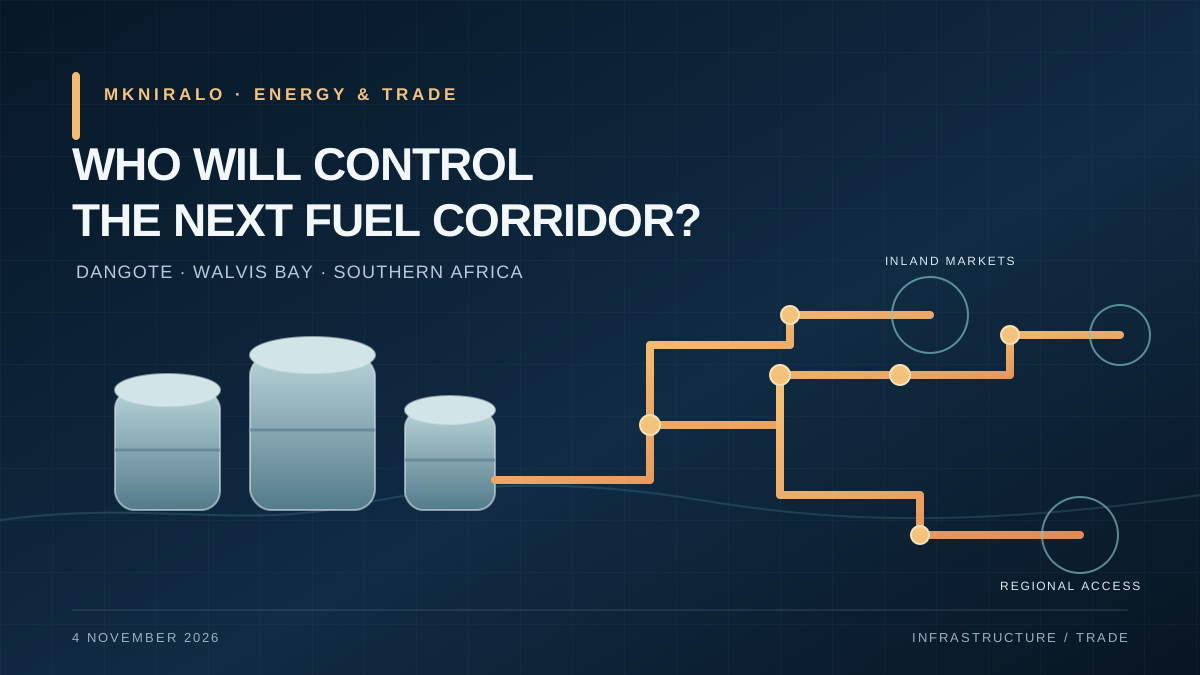
An energy corridor is more than a pipeline drawn between a port and inland markets. It determines where fuel can be stored, who can move it, how quickly it reaches customers and who captures the fees along the way. Dangote's Namibia proposal puts those questions into play on a regional scale—but the launch announcement is only the opening stage of a much longer process.
A launch is not yet a corridor
On November 4, Aliko Dangote launched a fuel-storage and regional-pipeline project at Walvis Bay, Namibia. Reuters put the combined investment at US$2.5 billion, and a separate report quoting President Netumbo Nandi-Ndaitwah also used US$2.5 billion. The available launch-day reports do not provide a capital-cost breakdown for the combined project, so the US$2.5 billion figure should be read as the announced headline estimate rather than a verified cost split.
The proposed tank farm is designed for about 600 million litres of petroleum products—roughly four million barrels—with 360 million litres of diesel and 240 million litres of petrol. Dangote told Reuters that completion could take 18 to 20 months. At that stated capacity, the facility would be eight times the 75-million-litre National Oil Storage Facility already operated by NAMCOR in Walvis Bay. Storage capacity, however, is not the same thing as fuel physically in stock, days of national cover or guaranteed supply.
The site is Farm 58, about 70 hectares and roughly 10 kilometres east of Walvis Bay, according to Dangote's remarks reported by TheCable. The Ministry of Environment's EIA register identifies a live application to subdivide Farm 58 into Dangote portions A to F, with the project status shown as review in progress. The location and scale are therefore more concrete than the proposed regional route—but even the tank-farm site remains inside a regulatory process.
Sources: Billionaire industrialist Dangote launches $2.5 billion Namibia fuel storage project · Dangote pipeline to reduce fuel prices · Dangote project placed under Office of the President · Dangote Group plans 1,700km pipeline linking Southern African countries · Environmental Scoping Assessment for the Proposed Subdivision of Farm 58, Walvis Bay into Portions A-F (Dangote Portions), Portion G (Street), Portion H and Remainder/58 (Municipality) · National Oil Storage Facility · Dangote commits US$2.5bn to Namibia fuel storage and regional pipeline project · Walvis Bay project to cut regional fuel costs: Dangote
Namibia's exposure is logistical as well as external
Namibia does not have to rely on one supplier to be exposed to imported-fuel risk. The Bank of Namibia's March 2026 Quarterly Bulletin says Gulf Cooperation Council countries supplied about 40% of the country's mineral-fuel imports in 2025, down from roughly 50% to 55% in 2023 and 2024. Oman and Bahrain had gained importance, while India, the euro area and South Africa were also among the sources. The pattern shows both concentration and diversification: the proposed Nigerian-linked supply route could add another option, but it would not make Namibia a domestic producer of refined fuel.
The timing of the launch made the logistics question unusually visible. November's fuel-price changes took effect on November 4, with petrol at Walvis Bay rising by N$2 a litre and diesel by N$3. The minister attributed the pressure to a 40% rise in shipping costs and a 64% increase in vessel-waiting costs; the National Energy Fund was expected to pay about N$384 million to cover October's under-recoveries. The government also said national stocks were sufficient and the supply system stable. This was a cost and resilience problem, not an announced shortage.
A larger tank farm can give importers more room to hold inventory, manage vessel arrivals and dispatch products inland. A pipeline can reduce the amount of fuel that must be moved by road over long distances. Neither asset can by itself control international refined-product prices, the Namibia dollar, shipping rates, port delays, taxes or the regulated pump-price formula. Lower retail prices are therefore a possible outcome to test—not a result that follows automatically from a launch ceremony.
Sources: Billionaire industrialist Dangote launches $2.5 billion Namibia fuel storage project · National Oil Storage Facility · Quarterly Bulletin — March 2026 · Petrol prices to rise by N$2 per litre in November
Walvis Bay already has a regional trade system
The project is not being proposed on an empty map. The Walvis Bay Corridor Group coordinates established road and rail routes, including the Trans-Kalahari Corridor towards Botswana and South Africa and the Walvis Bay–Ndola–Lubumbashi corridor serving Zambia and the southern Democratic Republic of Congo. Namport reported about 2.45 million tonnes of cross-border cargo in the 2024–25 financial year; South Africa accounted for 35% of those volumes and Zambia 34%. Those figures cover cross-border cargo generally, not fuel alone, but they show that Walvis Bay already has customers, operators and institutions connected to the hinterland.
A pipeline could change the economics of that system. Bulk fuel that now moves through a combination of ship, storage terminal, road tanker and rail could instead move from a coastal tank farm into inland markets through a dedicated line. That may improve throughput and reduce exposure to road-freight bottlenecks. It may also complement existing port and corridor services: pipelines still need marine unloading, storage, metering, maintenance, security, customs coordination and last-mile distribution.
The headline 1,700 kilometres should be read as a planning scope, not a surveyed route. Reuters described possible connections to Botswana, Zimbabwe and Zambia, with the DRC potentially included. TheCable reported a broader distribution network that also named Malawi and quoted Dangote saying the final alignment and length would follow detailed engineering, route surveys and regulatory approvals. The Namibian described a Nigeria–Namibia–South Africa fuel flow with other regional countries included. These public descriptions are not identical, and none is a final approved route map.
Sources: Billionaire industrialist Dangote launches $2.5 billion Namibia fuel storage project · Dangote pipeline to reduce fuel prices · Dangote Group plans 1,700km pipeline linking Southern African countries · National Oil Storage Facility · Statistics — Namport financial year ended March 2025 · Corridors — Connecting Southern Africa to Global Markets · Dangote commits US$2.5bn to Namibia fuel storage and regional pipeline project · Trans-Kalahari Corridor
The permits matter more than the launch stage
The November 4 event was a project launch, not evidence that the full tank farm and cross-border pipeline had entered construction. The official environmental register lists the Farm 58 subdivision application as review in progress. The environmental scoping assessment reported in August said the current application covered subdivision of the land; a separate environmental impact assessment and approval would still be required before construction of the petroleum-storage facility could proceed.
The launch was attended by the President, and the project carries high-level political sponsorship. That sponsorship may help coordinate ministries and agencies, but it does not replace environmental clearance, land approvals, detailed engineering, route surveys or the regulatory permissions needed in every country crossed by a regional pipeline.
Dangote's 18-to-20-month completion estimate is therefore a stated target, not a verified construction schedule. The public material reviewed for this article does not set out a final route, a country-by-country permit timetable, a published capital-cost split between the tank farm and pipeline, or a complete financing structure. Those gaps are not proof that the project will fail; they are the practical questions that determine whether a launch becomes an operating network.
Sources: Billionaire industrialist Dangote launches $2.5 billion Namibia fuel storage project · Dangote project placed under Office of the President · Dangote Group plans 1,700km pipeline linking Southern African countries · Environmental Scoping Assessment for the Proposed Subdivision of Farm 58, Walvis Bay into Portions A-F (Dangote Portions), Portion G (Street), Portion H and Remainder/58 (Municipality) · Dangote begins regulatory process for Namibia fuel storage terminal · Dangote commits US$2.5bn to Namibia fuel storage and regional pipeline project
The local-benefit question has two sides
The potential gain is easy to describe: construction contracts, terminal operations, pipeline maintenance, port services, warehousing, safety work and technical training could create business for Namibian firms and jobs for local workers. In November 2025, National Planning Commission director general Kaire Mbuende said trucks and rail would carry fuel before a pipeline was built and that use of Namport infrastructure would generate fees and other benefits for Namibia.
But the same infrastructure can redistribute income away from businesses that currently move fuel by road. In that 2025 debate, opposition leader McHenry Venaani warned that a pipeline could threaten local trucking and downstream businesses. He called for 70% of the work to go to Namibian companies and workers and asked how the country would share in the profits. That 70% figure was his political demand, not a published project condition or an agreed contract term.
Namibia's Cabinet approved a National Upstream Petroleum Local Content Policy in August 2026, aimed at employment, procurement, enterprise development, skills transfer and Namibian participation in the upstream petroleum value chain. The policy's stated upstream scope does not by itself establish a binding local-content quota for this midstream storage and pipeline project. A minister said the policy would need an appropriate legislative framework and implementation to make commitments enforceable. The public launch reports do not disclose project-specific procurement targets, local hiring rules, training commitments or subcontracting terms.
Sources: Dangote Group plans 1,700km pipeline linking Southern African countries · Opposition warns N$2.4b Dangote oil pipeline risks Namibian businesses · Namibia approves local content policy for oil and gas sector · Namibia moves to tie oil local content policy to legislation · Dangote commits US$2.5bn to Namibia fuel storage and regional pipeline project
Control will be written into the operating rules
The central question is not simply who owns the tanks. It is who controls access to storage, which suppliers can use the terminal, how pipeline tariffs are set, whether third parties can book capacity, how cross-border volumes are allocated, and how much of the construction and operating spend stays in Namibia. A private corridor can widen supply options while also concentrating commercial leverage in the hands of its owner and anchor supplier.
For Namibia and its neighbours, the strongest test will be measurable: more reliable deliveries, lower end-to-end transport costs, competitive access for fuel buyers, transparent safety and environmental oversight, and local firms able to win work beyond short-term construction. If the pipeline merely moves imported fuel through a new privately controlled channel while replacing existing local transport income, the regional map may change more than the local development model.
The Dangote proposal could turn Walvis Bay into a more important energy gateway. But a 600-million-litre design capacity and a 1,700-kilometre planning figure do not settle who benefits. That answer will be determined by permits, contracts, tariffs, access rules and the share of real economic activity retained along the route.
Sources: Billionaire industrialist Dangote launches $2.5 billion Namibia fuel storage project · Dangote Group plans 1,700km pipeline linking Southern African countries · Environmental Scoping Assessment for the Proposed Subdivision of Farm 58, Walvis Bay into Portions A-F (Dangote Portions), Portion G (Street), Portion H and Remainder/58 (Municipality) · Dangote begins regulatory process for Namibia fuel storage terminal · Quarterly Bulletin — March 2026 · Petrol prices to rise by N$2 per litre in November · Statistics — Namport financial year ended March 2025 · Corridors — Connecting Southern Africa to Global Markets · Opposition warns N$2.4b Dangote oil pipeline risks Namibian businesses · Namibia approves local content policy for oil and gas sector · Namibia moves to tie oil local content policy to legislation · Dangote commits US$2.5bn to Namibia fuel storage and regional pipeline project