An experimental antisense oligonucleotide designed to correct abnormal RNA processing in UNC13A restored several measures of communication between human neurons in laboratory models of amyotrophic lateral sclerosis, according to research published on 11 November 2026. The study also reported molecular evidence in humanized mice, but did not test the experimental molecule in patients or establish clinical benefit. The work offers a more specific account of how loss of TDP-43 can disrupt nerve-cell signalling. Its promise lies in correcting one consequential error within a wider pattern of RNA-processing defects—not in showing that ALS has been reversed or that a treatment is ready for clinical use.
A single RNA error became a functional bottleneck
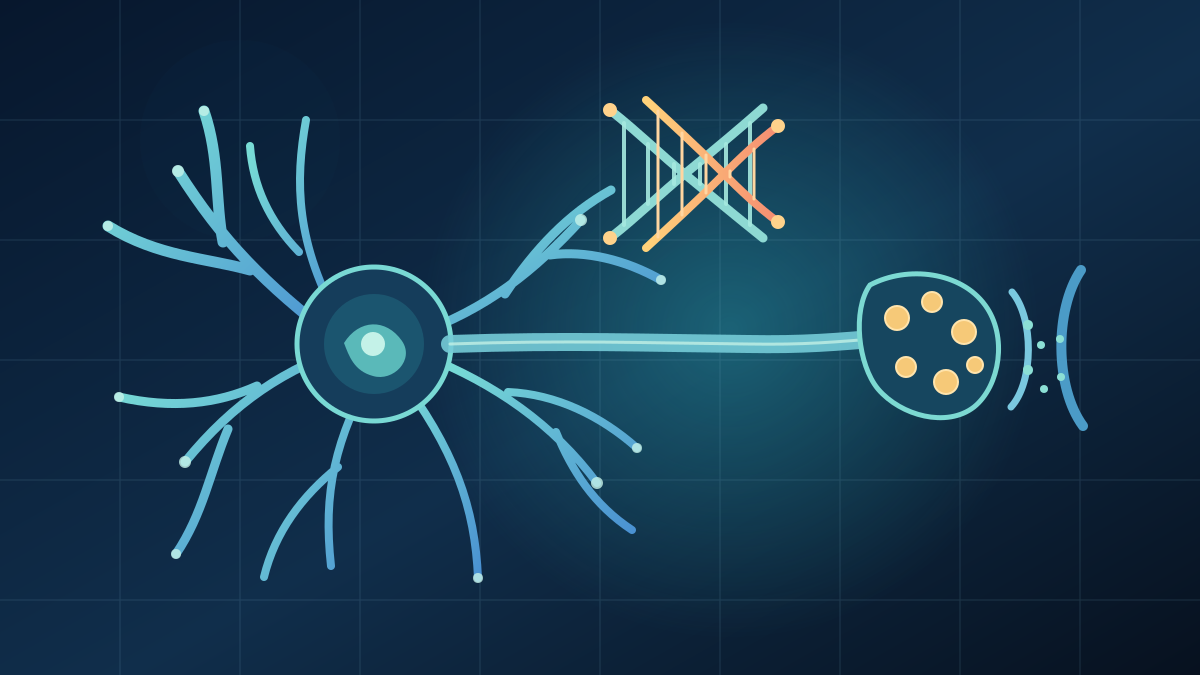
The Nature study, led by researchers from University College London, King’s College London and collaborators, examined what happens when TDP-43 is depleted from the nucleus of neurons. TDP-43 helps regulate how genetic instructions are processed. When it is lost from the nucleus, cells can include hidden or “cryptic” exons in RNA transcripts that would ordinarily be removed. The result can be an incorrectly processed message and a protein that is reduced or fails to function normally. The researchers focused on one such event in UNC13A, a gene involved in releasing neurotransmitter-filled vesicles at presynaptic nerve endings.
In human induced-pluripotent-stem-cell-derived neurons, TDP-43 loss reduced UNC13A at presynaptic sites and weakened excitatory synaptic transmission. Network recordings also showed less coordinated activity. The team found that deleting the UNC13A cryptic exon could restore several defects, indicating that this splice error was a major driver of the communication breakdown in the experimental systems. It was not the only consequence of TDP-43 loss: reduced synapse density, for example, was not corrected by targeting UNC13A alone. [1]
Sources: UNC13A splice correction rescues synaptic dysfunction induced by TDP-43 loss
How the antisense approach redirects RNA processing
The team developed splice-switching antisense oligonucleotides, or ASOs, to bind the UNC13A RNA region around the abnormal cryptic exon and discourage its inclusion. Rather than replacing the gene or editing DNA, an ASO is designed to influence how an RNA message is processed. The researchers screened candidate sequences and chemical modifications, including locked-nucleic-acid and 2′-O-methoxyethyl designs, before testing selected molecules in cell models with reduced TDP-43.
In human neuron models, selected ASOs restored correct UNC13A splicing and increased production of functional protein. Some candidates brought correct splicing above 90 per cent in tested cells; protein recovery varied by molecule and model. The important result was not simply a change in an RNA measurement: the intervention also improved synaptic transmission. These are laboratory measurements under induced conditions, however, and do not establish how a drug would behave after dosing a person with ALS. [1]
Sources: UNC13A splice correction rescues synaptic dysfunction induced by TDP-43 loss
Communication improved at synapses and across networks
The researchers assessed several levels of neuronal function. In cortical-like neurons, treatment increased the frequency of spontaneous excitatory signals and improved evoked synaptic responses. Experiments in spinal motor neurons—cells directly relevant to ALS—also found recovery of evoked transmission after UNC13A splice correction. In network recordings, synchrony was among the most consistently rescued measures, suggesting that the effect extended beyond individual connections to coordinated activity across groups of neurons.
The results were not a universal reset. Synapse numbers remained reduced in some experiments, and the authors noted that correcting UNC13A did not account for every effect caused by TDP-43 depletion. In live imaging, release probability at remaining active synapses showed a favourable trend, but narrowly missed conventional statistical significance. The evidence therefore supports recovery of selected communication functions, not complete restoration of neuronal structure or every aspect of TDP-43 biology. [1]
Sources: UNC13A splice correction rescues synaptic dysfunction induced by TDP-43 loss
What the humanized mouse experiment adds
The team also tested the approach in a humanized UNC13A reporter mouse. The model was engineered so that part of the mouse gene’s intron 20 was replaced with the corresponding human sequence, including the cryptic exon. This recreated a human-specific mis-splicing event that ordinary mice would not reproduce in the same way. Researchers induced TDP-43 knockdown using an AAV and administered the UNC13A splice-correcting ASO into the brain’s ventricular system on the same day. Spinal-cord tissue was examined three weeks later.
The treatment partially reduced abnormal cryptic-exon inclusion in the humanized mice. This is useful in-vivo evidence that the ASO can reach a relevant biological target in an engineered animal model. But the experiment did not demonstrate improved movement, longer survival or slowed disease progression, and it was not a test of safety or effectiveness in people. The mouse result strengthens the molecular case while leaving major translational questions unanswered. [1]
Sources: UNC13A splice correction rescues synaptic dysfunction induced by TDP-43 loss
The 97 per cent figure is about biological relevance
The paper describes UNC13A splice correction as potentially relevant to roughly 97 per cent of people with ALS. That estimate reflects the broad prevalence of TDP-43 pathology outside uncommon genetic forms such as SOD1- and FUS-associated ALS, together with genetic and mechanistic evidence linking UNC13A to disease. It is a statement about the potential reach of the biological target, not a measurement of how many patients would respond to an ASO.
No patients received the study’s experimental ASOs, and the research did not calculate a clinical response rate. The figure cannot be translated into “97 per cent effective”, “97 per cent cured” or a prediction that nearly every person with ALS would benefit. Whether a target relevant across a large disease population can be treated safely and meaningfully will depend on delivery, dose, timing, individual biology and clinical-trial results. [1, 2, 3]
Sources: UNC13A splice correction rescues synaptic dysfunction induced by TDP-43 loss · Potential MND therapy restores communication between human neurons in the lab · Potential MND therapy restores communication between human neurons in the lab
TRCN-1023 is a separate clinical programme
The distinction matters because another UNC13A-targeting ASO, TRCN-1023, is already being tested in people. UCL and King’s said the first UK participants had been dosed in the Phase 1/2 FUNCTION ALS trial, led by Trace Neuroscience. The company’s programme and the trial record identify TRCN-1023 as an investigational treatment designed to restore UNC13A function. It follows a related biological strategy, but it is not the experimental ASO developed and tested in the Nature study. [2, 3, 4, 5]
FUNCTION ALS is an early-stage clinical study designed to examine safety, tolerability and how the drug behaves in the body, alongside biological measures. Entry into a Phase 1/2 trial is not proof that TRCN-1023 works, and its progress cannot serve as clinical evidence for the separate laboratory ASOs in the paper. The new study supplies mechanistic evidence that correcting UNC13A splicing can restore selected neuronal functions. Patient benefit remains an open question, to be answered through clinical trials.
Sources: Potential MND therapy restores communication between human neurons in the lab · Potential MND therapy restores communication between human neurons in the lab · Trace Neuroscience Initiates Global Clinical Development Program for TRCN-1023, an Antisense Oligonucleotide Designed to Restore UNC13A Function for the Treatment of ALS · FUNCtion ALS — A Randomised Phase 1/2 Trial Aiming to Restore UNC13A Function in ALS