Taiwan Semiconductor Manufacturing Co. is reportedly considering making 3D dynamic random-access memory at the request of Nvidia, its largest customer, according to a November 6 report by The Information citing two people with direct knowledge of the matter. TSMC declined to comment on market rumours and reiterated that its core business is dedicated logic foundry work. Tom's Hardware characterised the response as effectively a denial, although the wording did not explicitly say whether internal feasibility discussions had taken place. No production decision has been established. For the world's largest contract chipmaker, this would be a return to memory production after a long absence, not its first-ever entry into the sector.
A reported assessment, not an approved project
The Information said TSMC had begun drawing up plans for a specific advanced-memory technology after a request from Nvidia. The reported assessment is being led by Hsu Kuo-chin, a TSMC vice president responsible for advanced packaging. The two sources described possible routes to production, including building a new factory or buying an existing semiconductor plant and converting it. Reuters independently relayed the report, while making clear that the underlying account came from The Information's sources rather than a public TSMC announcement.
The available reporting does not establish that TSMC has approved an investment, selected a site, allocated a budget or committed wafer capacity. It gives no confirmed product specification, customer-qualification schedule or production date. TSMC's statement neither confirms the reported study nor provides a detailed point-by-point rebuttal. The distinction matters: a company can assess a technology, discuss options or respond to a customer's request without deciding to build a factory or enter a new market.
Sources: TSMC Weighs Making Advanced Memory Chips to Capture More AI Spending · TSMC considers making advanced memory chips, The Information reports · TSMC denies exploring 3D DRAM at Nvidia's request — advanced memory tech is still years from market viability
What 3D DRAM means — and what it does not mean
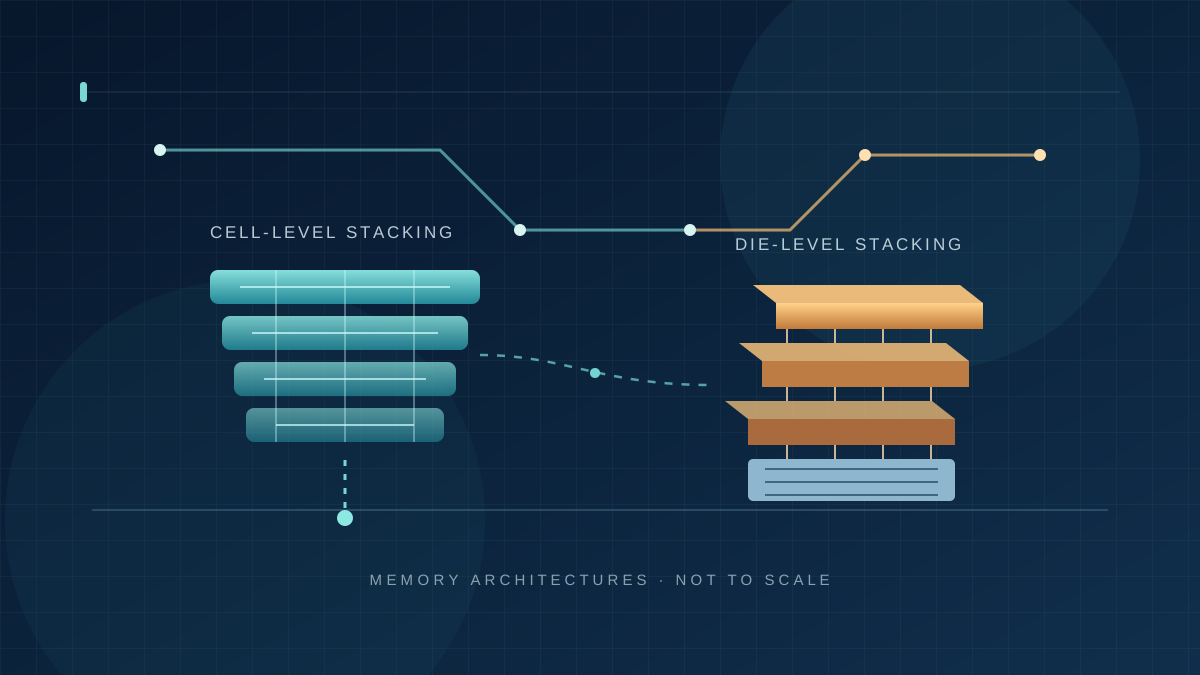
The proposal concerns 3D DRAM, an approach that seeks to arrange memory cells in vertically integrated layers rather than keeping the cells in a conventional single-plane layout. The intended prize is greater storage density within a given footprint. That is a different level of construction from stacking already fabricated memory chips. It would require manufacturers to solve the materials, transistor, interconnect, thermal and yield problems involved in making dense memory-cell structures operate reliably across multiple layers.
It should not be confused with high-bandwidth memory, or HBM. Micron describes HBM as a package that stacks multiple complete DRAM dies vertically above an optional base die, linking them through thousands of through-silicon vias and microbumps. HBM is already used beside AI processors to move data quickly; the reported 3D DRAM work concerns how the memory cells themselves could be built. Both use vertical structures, but they are not interchangeable names for the same product or manufacturing process.
Sources: TSMC Weighs Making Advanced Memory Chips to Capture More AI Spending · High-bandwidth memory (HBM)
The shortage is changing the economics of memory
The timing reflects a market in which AI infrastructure is consuming more memory while suppliers struggle to expand output quickly. Micron's September 30 earnings-call remarks said it expected memory and storage supply-demand conditions to be much tighter in 2027 and 2028 than in 2026. It forecast the DRAM industry would remain supply-constrained in both years and said it could not see when supply and demand would return to balance. That is a company outlook, not a guarantee that every memory product will be equally scarce.
Price pressure has already been substantial in some segments. TrendForce data show conventional DRAM contract prices rose 93–98% in the first quarter of 2026 — close to doubling in a single quarter. The figure applies to conventional DRAM contract prices, not every type of memory sold into PCs, phones or consumer devices. The broader mechanism is clearer than any single price index: AI buyers are competing for high-capacity and high-performance memory, while manufacturers direct investment and production toward products with stronger returns.
Sources: Fiscal Q4 2026 Earnings Call Prepared Remarks · Why the memory chip crunch is greater than expected, and may not ease until 2029
A memory factory is a long, expensive commitment
Even if TSMC's assessment advances, it would not provide a quick fix for today's shortage. Deloitte notes that building new, advanced memory capacity takes longer and costs more, and that the market is likely to be in flux for the next two to four years. Micron's own expansion plans illustrate the lag: its September remarks placed initial wafer output at some new DRAM facilities in 2027 or 2028, with production becoming more meaningful only several quarters after first output. A new entrant would also need to develop processes, qualify equipment and customers, and achieve competitive yields.
The choice between a greenfield fab and an acquired site would shape cost and timing, but neither route removes the technical challenge. A converted facility would still need suitable tools, process integration and a trained manufacturing operation. A new site would add construction, permitting, utilities and clean-room lead times. The Information also highlighted the memory industry's boom-and-bust history: capacity built during a shortage can arrive after demand has cooled, pressuring prices and margins. Even a technically successful process would need a route to high-volume output, predictable reliability and a cost per bit that can compete with established suppliers.
Sources: TSMC Weighs Making Advanced Memory Chips to Capture More AI Spending · TSMC considers making advanced memory chips, The Information reports · Fiscal Q4 2026 Earnings Call Prepared Remarks · Why the memory chip crunch is greater than expected, and may not ease until 2029
Nvidia's HBM supply-chain work is a separate track
The reported 3D DRAM request sits alongside a separate Nvidia effort involving custom high-bandwidth memory. On October 18, The Information reported that Nvidia had asked Samsung Electronics, SK hynix and Micron to use TSMC's 3-nanometre process for the base dies of its next-generation custom HBM, while standardising the memory dies on a newer DRAM generation. Reuters also carried the account, attributing it to South Korea's Seoul Economic Daily. This is a report about foundry-made logic base dies, not proof that TSMC will manufacture the stacked DRAM itself.
The distinction helps explain why the two stories can coexist. TSMC already supplies advanced logic manufacturing and packaging capabilities that can be used in HBM systems, while the memory suppliers make the DRAM dies that are stacked into the product. Micron's prepared remarks separately confirmed that it was working with Nvidia on a custom HBM4E implementation called NVHBM. None of that confirms the alleged 3D DRAM programme; it shows that Nvidia is seeking closer coordination across several parts of the memory and compute supply chain.
Sources: Fiscal Q4 2026 Earnings Call Prepared Remarks · Nvidia Tells Suppliers to Tap TSMC Process for Next-Generation Memory Chips · High-bandwidth memory (HBM) · Samsung to use TSMC technology for Nvidia's next-generation memory chips, Seoul newspaper reports
A possible return, with difficult questions still open
A move into 3D DRAM would be a strategic expansion for a company identified with contract logic manufacturing, but it would not be TSMC's first historical contact with memory. The Information noted that TSMC made standard memory chips from the 1990s through the late 2000s and continued disclosing memory revenue until the second quarter of 2008. The reported proposal would therefore be better understood as a possible return to memory production after a long absence, this time aimed at a more advanced architecture and an AI-led market.
The unanswered questions are substantial: whether TSMC believes the technology can be manufactured at competitive yields, whether Nvidia would make a durable purchasing commitment, how much capital a project would require and whether memory-market economics would justify the risk. Samsung, SK hynix and Micron have decades of experience in memory process development and production. Until TSMC confirms a programme or a further independently sourced report supplies concrete commitments, the story remains a reported assessment — not a new factory, a product launch or a near-term answer to the memory shortage. Those hurdles are why the reported request is strategically notable but still far from a commercial commitment.
Sources: TSMC Weighs Making Advanced Memory Chips to Capture More AI Spending · TSMC considers making advanced memory chips, The Information reports · TSMC denies exploring 3D DRAM at Nvidia's request — advanced memory tech is still years from market viability · Fiscal Q4 2026 Earnings Call Prepared Remarks