TikTok’s newly reported second-quarter enforcement figures put a large number on removals in Kenya. The harder task is interpreting what those numbers can—and cannot—tell the public about online safety.
A quarter of removals, not a measure of everything posted
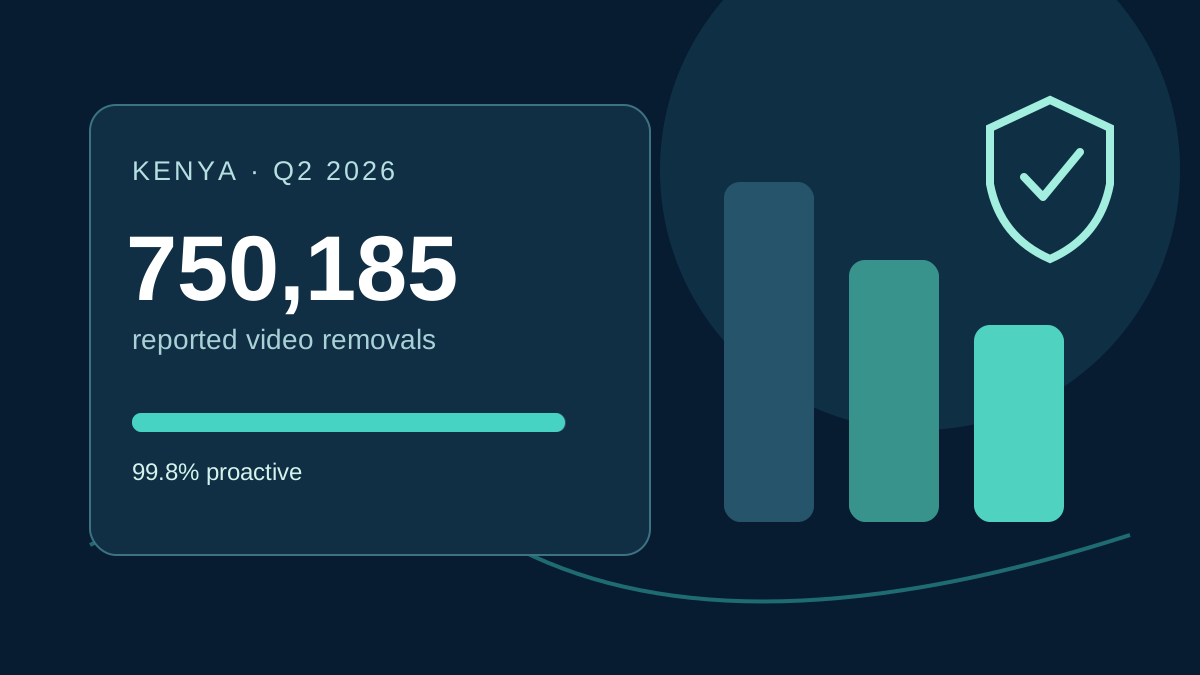
TikTok says it removed 750,185 videos in Kenya between April and June 2026 for breaches of its Community Guidelines. The figure appears in the company’s second-quarter enforcement disclosures, made public on November 9 and reported by several Kenyan newsrooms. It measures videos taken down under TikTok’s own rules, rather than criminal offenses established by a court or all harmful content encountered by Kenyan users. That distinction matters: a platform enforcement tally tells readers what the company acted upon, not everything that happened on the service.
The company says 99.8% of those Kenyan removals happened before a user reported the videos, and 93.8% occurred within 24 hours of posting. Both percentages describe the pool of videos removed, not the total volume uploaded or viewed in Kenya. The numbers suggest an enforcement process built for early detection. They do not, on their own, show how often a problematic video escaped detection, how many people saw it before removal, or how frequently compliant videos were taken down.
Sources: TikTok removes over 750k videos in Kenya over guideline violations · TikTok removes over 750,000 videos for platform violations in Kenya · TikTok interrupts 80,640 Kenyan live sessions over rule violations
What the speed and proactive rates actually mean
A proactive removal means TikTok acted before receiving a user report. It does not necessarily mean that a machine made the final decision without any human involvement. The 99.8% Kenyan proactive rate and the global automation share therefore describe different things. Treating them as interchangeable would exaggerate what the country figures reveal about the technology behind individual decisions.
The 24-hour measure also deserves careful interpretation. Removing a video within a day can reduce the time it remains accessible, but a post can circulate rapidly in its first minutes or hours. A high proportion taken down within that window is not the same as evidence of low exposure. Neither metric tells readers whether a video was widely shared, whether it was later reinstated, or whether its removal was ultimately judged appropriate. Those outcomes require additional measures beyond the two percentages announced.
Sources: TikTok removes over 750k videos in Kenya over guideline violations · TikTok removes over 750,000 videos for platform violations in Kenya · TikTok takes down more than 750,000 videos in Kenya in second quarter · Community Guidelines Enforcement Report
Livestreams and underage accounts are separate counts
TikTok also reported interrupting 80,640 LIVE sessions in Kenya during the quarter for breaches of its rules. Livestream interventions are not the same unit as removed short-form videos: one is a live session that was stopped, while the other is an uploaded video taken down. Adding those figures together would produce a misleading total. The company separately described worldwide actions involving livestream monetisation, including warnings and demonetisation; those should not automatically be read as permanent removals.
In the same Kenyan period, TikTok said it removed more than 46,000 accounts it suspected belonged to children younger than 13. The word “suspected” is important. Account enforcement does not establish the actual age of every account holder, and the company has not presented these figures as a census of children using the platform. Nor do the disclosures show how many account removals were challenged, reversed or associated with repeat registrations. These statistics speak to enforcement decisions, not independently verified identities.
Sources: TikTok removes over 750k videos in Kenya over guideline violations · TikTok removes over 750,000 videos for platform violations in Kenya · TikTok takes down more than 750,000 videos in Kenya in second quarter · TikTok removes 750,000 videos in Kenya in Q2 as regulation looms
AI-related removals need a narrower reading
Nearly 11,000 videos in Kenya were removed under TikTok’s rules governing edited media and AI-generated content, according to the reports. That category must not be simplified into a count of dangerous deepfakes or even a count of videos made entirely with generative AI. The policy scope includes edited media, and the public breakdown cited by Kenyan outlets does not separate every kind of content within that group. It also does not establish that every video in the category caused measurable harm.
TikTok says it asks creators to label realistic AI-generated material and uses a combination of labels, detection systems and Content Credentials technology. It has also promoted an in-app AI Literacy Hub to Kenyan users. Such tools can help communicate provenance and platform rules, but neither a label nor an enforcement count independently proves that viewers correctly recognized synthetic media. The practical question is whether disclosure, appeals and consistent enforcement work for ordinary users and creators—not simply how often a policy category appears in a quarterly spreadsheet.
Sources: TikTok removes over 750,000 videos for platform violations in Kenya · TikTok interrupts 80,640 Kenyan live sessions over rule violations · TikTok removes 750,000 videos in Kenya in Q2 as regulation looms
Why the quarter-on-quarter drop is inconclusive
For context, Kenyan reporting puts TikTok’s first-quarter removal tally at 884,591 videos, compared with 750,185 in the second quarter. The raw count therefore fell by 134,406, or about 15.2%. This is a real numerical change between reported enforcement totals. It is not sufficient evidence that the proportion of rule-breaking uploads fell, that users became more responsible, or that the platform weakened enforcement. Any of those explanations would require information the two totals do not provide.
For example, a lower removal count could reflect fewer uploads, different patterns of user activity, changes in enforcement categories or changes in detection, alongside any change in underlying violations. TikTok did not disclose the total number of videos uploaded in Kenya during the quarter in the reporting reviewed here. Without that denominator, a Kenyan removal rate cannot be calculated. A robust comparison would also ask whether the same definitions and counting methods were used in both periods.
Sources: TikTok takes down more than 750,000 videos in Kenya in second quarter · TikTok removes 750,000 videos in Kenya in Q2 as regulation looms
Global scale does not settle the accuracy question
Worldwide, TikTok said it removed roughly 188.3 million videos during April–June out of more than 42.2 billion posted, approximately 0.4% of uploads. It attributed 97.4% of global video removals to automated systems and said about 6.3 million videos were reinstated after successful appeals. The company also reported large-scale enforcement against accounts it believed belonged to users under 13. Those global figures give a sense of operational scale, but they cannot substitute for equivalent Kenya-specific denominators, appeal results and error-rate measures.
An appeal reinstatement is evidence that a decision changed after review, not a complete accounting of false positives. Some people never appeal; appeal outcomes may turn on additional context; and some erroneous decisions may go uncorrected. Likewise, content that was never detected is absent from a removals tally. TikTok’s disclosures are useful as a record of the actions it reports taking. Judging whether moderation is accurate, equitable and effective requires clearer information about exposure, review decisions, local-language performance and the people affected by enforcement.
Sources: TikTok removes over 750k videos in Kenya over guideline violations · TikTok interrupts 80,640 Kenyan live sessions over rule violations · TikTok takes down more than 750,000 videos in Kenya in second quarter · TikTok removed over 750,000 videos in Kenya for platform violations · Community Guidelines Enforcement Report