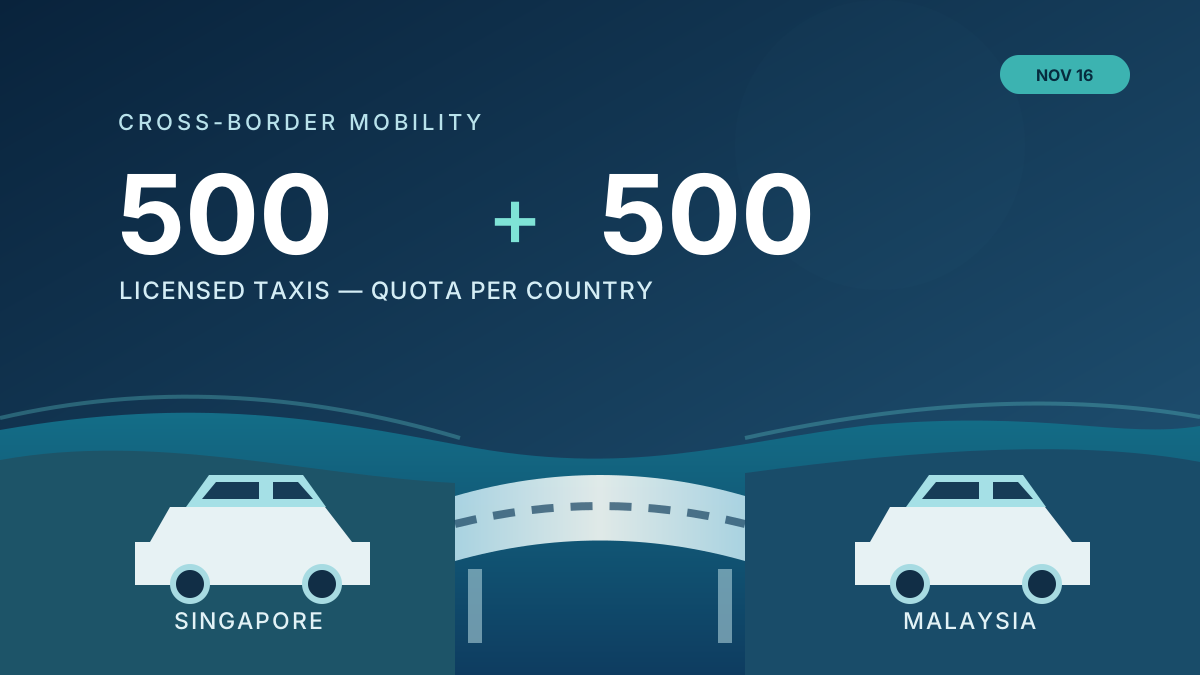
Singapore and Malaysia have agreed to expand licensed cross-border taxi capacity and widen the choice of booking platforms, but the announcement is not an instant promise of more cars, cheaper rides or doorstep collection on both sides of the Causeway. Announced on November 6 and effective November 16, the policy moves the permitted quota to 500 taxis from each country. It also brings CDG Zig and Kumpool into the platform-based system alongside GrabCar. The key for travelers is to distinguish what governments have authorized from what operators can actually provide, and to understand the rules that still govern pickups in the other country.
The new ceiling starts on November 16
Singapore and Malaysia are preparing to raise the number of taxis permitted under their bilateral cross-border scheme from 300 to 500 per country on November 16, 2026. The transport ministries made the announcement on November 6. It gives the scheme a combined maximum of 1,000 licensed taxis, against a current combined ceiling of 600. The operative word is maximum: a larger allowance does not mean 1,000 vehicles have already been licensed, deployed or made available for booking.
Licensing remains a separate administrative and commercial step. The two countries' transport regulators must deal with eligible operators and vehicles, while drivers decide whether to serve cross-border demand. The immediate change is an expansion of permitted capacity, not a measured increase in services delivered.
That distinction matters because the announcement arrives ahead of implementation. As of November 7, customers should treat November 16 as the effective date, not assume the new allocation can be used immediately.
Sources: Joint Statement by the Ministry of Transport, Singapore and Ministry of Transport, Malaysia on the Increased Quota for Licensed Cross-Border Taxis and Two New Ride-hail/E-hailing Operators Under the Cross-Border Taxi Scheme · Singapore, Malaysia to expand cross-border taxi quota to 500 each, add two ride-hailing operators from Nov 16 · Causeway taxi quota to rise to 500 from Nov 16; CDG Zig, Malaysian firm to get ride-hail licences
Three platforms, but not three identical services
Two operators are due to join the licensed platform channel on November 16. Singapore-based CDG Zig and Malaysia-based Kumpool will enter alongside GrabCar, bringing the number of named platform operators under the scheme to three. The joint statement identifies their licensing status and effective date; it does not publish a complete trip menu, operating timetable, vehicle availability or app-specific fare table for either newcomer.
For passengers, the difference between an approved platform and an available car is important. A traveler planning a specific journey should check the operator's current service instructions and confirm that the vehicle being supplied is licensed for this cross-border scheme.
The Business Times reported that CDG Zig and Kumpool would join the existing GrabCar arrangement. That is a change in the number of eligible booking channels, not permission for ordinary private-hire cars to provide unrestricted international trips. Singapore's Land Transport Authority separately explains that cross-border point-to-point services for hire are restricted to appropriately licensed taxis.
Sources: Joint Statement by the Ministry of Transport, Singapore and Ministry of Transport, Malaysia on the Increased Quota for Licensed Cross-Border Taxis and Two New Ride-hail/E-hailing Operators Under the Cross-Border Taxi Scheme · CDG Zig, Kumpool join Singapore-Malaysia cross-border taxi scheme from Nov 16 · Cross-Border Services
Drop-offs are flexible; foreign-country pickups are not
The arrangement gives travelers more flexibility about where a ride ends than where a ride begins on the foreign side of the border. Licensed taxis can drop passengers anywhere in Singapore or inside the specified Malaysian operating areas: Johor Bahru, Iskandar Puteri, Forest City, Kulai and Senai. A taxi may pick up within its own country under the domestic-side permissions, but cross-border pickup while in the other country remains restricted to authorized locations and booking conditions.
The Land Transport Authority identifies Johor Larkin Sentral as an established street-hail pickup terminal for Singapore-registered taxis in Malaysia. It also lists Toppen Shopping Centre, Mid Valley Southkey Mall and Angsana Mall as additional Malaysia-side pickup locations for qualifying ride-hail bookings. For Malaysia-registered taxis in Singapore, the authority identifies Ban San Street terminal for street hails, plus designated booking points near VivoCity, Century Square and Joo Koon.
Street-hail terminals and app-based pickup points are different categories; passengers should not treat every designated location as interchangeable. Some pickup privileges depend on booking through a licensed operator. Expanded drop-off coverage does not create an unrestricted right to collect passengers at any hotel, office or residential address across the border.
Sources: Joint Statement by the Ministry of Transport, Singapore and Ministry of Transport, Malaysia on the Enhancements to Cross-Border Taxi Scheme to Benefit Travellers and Facilitate Fairer Competition between Transport Providers · Cross-Border Services · Cross-border taxis allowed drop-offs anywhere in Singapore, Johor Bahru from May 4
The November move completes a staged quota plan
The new ceiling did not emerge without warning. Following bilateral discussions in late 2025, the ministries set out enhancements in a joint statement dated April 30, 2026, with implementation beginning May 4. At that stage the quota rose from 200 to 300 taxis per country. Officials also introduced more flexible drop-offs, additional booking pickup locations and vehicle categories intended to accommodate larger groups and business travelers.
The April statement described a gradual move toward 500 licensed cross-border taxis from each country. November's announcement therefore marks the next stated quota step rather than a new, unrestricted transport corridor. The Straits Times connected the November increase with that previously signaled target; the ministerial statements supply the governing dates and terms.
Still, a historical progression in quotas tells readers nothing certain about future waiting times. Even with more potential vehicles, realized supply will depend on actual licence take-up, driver incentives, demand and border traffic. No evidence published with the announcement demonstrates that these outcomes have already improved.
Sources: Joint Statement by the Ministry of Transport, Singapore and Ministry of Transport, Malaysia on the Enhancements to Cross-Border Taxi Scheme to Benefit Travellers and Facilitate Fairer Competition between Transport Providers · Causeway taxi quota to rise to 500 from Nov 16; CDG Zig, Malaysian firm to get ride-hail licences · Cross-border taxis allowed drop-offs anywhere in Singapore, Johor Bahru from May 4
Prices and driver livelihoods remain open questions
The extra operator choice should not be translated into an immediate promise of cheaper travel. Official guidance distinguishes street-hail prices from prices for journeys booked elsewhere or in advance. Singapore's LTA lists a range of S$80 to S$210 per taxi for street-hail trips starting at Ban San Street, depending on vehicle type and applicable journey terms. That is not a fare schedule for the incoming apps; customers should confirm quotes, booking fees, vehicle category and availability with each operator.
LTA says licensed Malaysia-registered taxis must hold the relevant Singapore vehicle licences and permits. The authority has warned that vehicles operating illegally may not carry appropriate passenger insurance, adding a safety dimension to the distinction between licensed taxis and informal offers.
Drivers have raised another concern: earnings. CNA reported that the National Taxi Association worried about the pace of expansion from 200 to 300 and then 500 taxis per side in one year. The association requested consideration of phased licence issuance and additional pickup points. Those are concerns about possible effects, not verified evidence that drivers have already lost income as a result of the November change.
Sources: Cross-Border Services · Update for Malaysia-Registered Taxis Entering Singapore · Singapore, Malaysia to expand cross-border taxi quota to 500 each, add two ride-hailing operators from Nov 16
What passengers can check after the launch
The most consequential test begins after November 16, when the higher ceiling and additional platform permissions take effect. Travelers can then check whether CDG Zig, Kumpool and GrabCar actually show eligible cross-border rides for their chosen pickup point and destination. They should confirm the boarding instructions, vehicle class, total quoted fare and any operator-specific cancellation conditions before committing.
Journalists and regulators can also look beyond the headline quota: how many taxis receive licences, how many are active, whether booking coverage grows at different hours, and whether changes help both sides of the border.
The governments have framed the expansion as a way to strengthen everyday connectivity, business links and personal travel. That ambition is newsworthy, but it is still a policy objective. On November 7, the defensible conclusion is narrow: the two countries have announced a higher licensed-taxi limit and two more approved platform operators for November 16. Easier journeys and lower costs, if they materialize, must be demonstrated after the rules take effect.
Sources: Joint Statement by the Ministry of Transport, Singapore and Ministry of Transport, Malaysia on the Increased Quota for Licensed Cross-Border Taxis and Two New Ride-hail/E-hailing Operators Under the Cross-Border Taxi Scheme · Singapore, Malaysia to expand cross-border taxi quota to 500 each, add two ride-hailing operators from Nov 16 · CDG Zig, Kumpool join Singapore-Malaysia cross-border taxi scheme from Nov 16