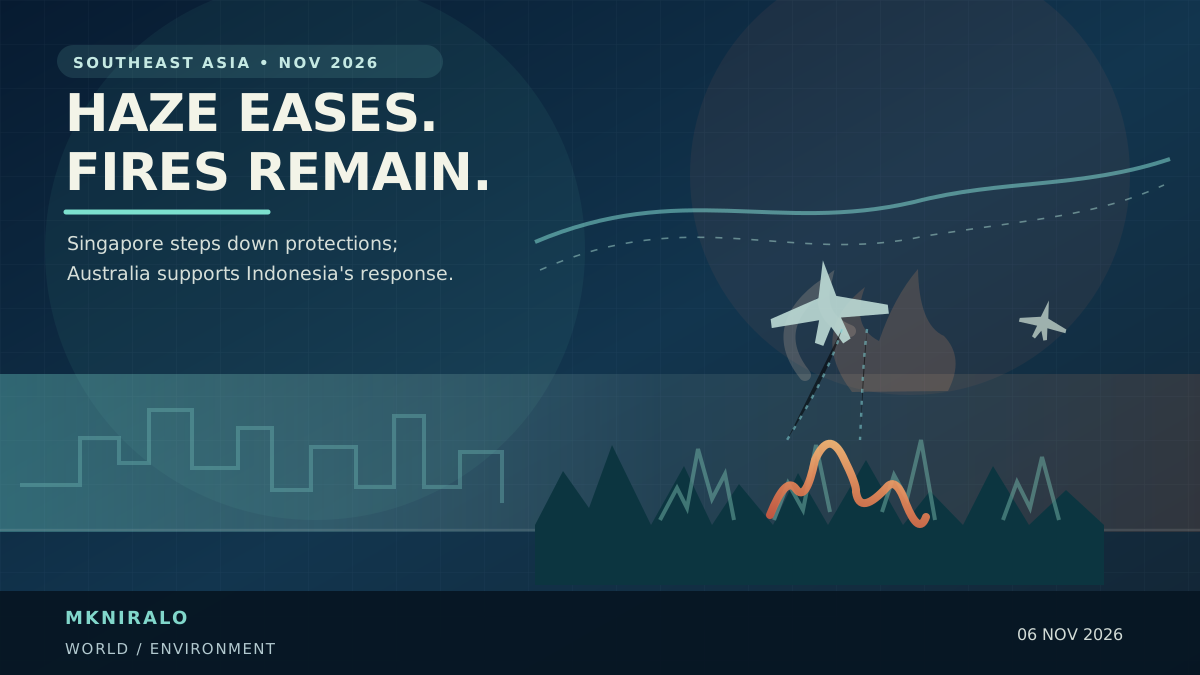
The smoke risk over Singapore is easing, but firefighting in Indonesia is not finished. Announcements issued on November 5 set out two different responses: a scheduled withdrawal of some public protections in Singapore and an Australian aerial deployment to East Kalimantan. What each decision means depends on keeping the dates—and the places—separate.
Singapore sets an exact end time for two protections
Singapore has set 6 p.m. on Saturday, November 7, as the cutoff for its government-supported distribution of N95 or equivalent masks and for air-conditioned rooms designated as haze shelters. The National Environment Agency (NEA) announced the decision on November 5, saying wetter inter-monsoon conditions and an improved regional hotspot picture had reduced the expected risk of smoke crossing into the city-state. It also said the inter-agency Haze Task Force would stand down. The date is a scheduled change, not a closure that had already happened when this article was prepared on November 6.
The two services serve different needs. Eligible residents have been able to collect masks through community clubs and selected vending machines, while designated air-conditioned rooms at community clubs and neighborhood centers provided places to shelter during poor air. Local reporting traces the emergency rollout to October 14, when fine-particle pollution rose sharply. Ending these services is a decision about the immediate need for those protections in Singapore; it does not establish that Indonesia's forest and land fires have ended.
Sources: Cessation of Mask Distribution and Closure of Haze Shelters (5 November 2026) · Mask distribution, haze shelters to cease by Nov 7; haze subsidy scheme to end from Nov 12 · Singapore to end N95 mask distribution on Saturday as haze abates
The health-support timetable has a second date
Not every Singapore measure ends together. The Ministry of Health says its Public Health Preparedness Clinic arrangement and Haze Subsidy Scheme will be deactivated from November 12. That distinction matters for patients: the end of mask distribution and shelter access on November 7 should not be mistaken for the end of subsidized consultations on the same day. The health scheme, activated on October 12, was designed to make treatment for haze-related conditions more affordable to eligible Singapore citizens.
The ministry reports that, as of October 31, participating primary-care clinics had recorded more than 100,000 visits under the scheme, with 60,000 more at polyclinics; it cautions that the counts are preliminary because claims can be submitted later. Those figures describe scheme use, not a verified count of unique people sickened by haze. Singapore's decision to wind down support reflects its assessment of falling exposure risk, while the longer health-support window recognises that different public services operate on different timetables.
Sources: Cessation of Mask Distribution and Closure of Haze Shelters (5 November 2026) · Haze Subsidy Scheme at Public Health Preparedness Clinics and Polyclinics to Cease from 12 November 2026 · Mask distribution, haze shelters to cease by Nov 7; haze subsidy scheme to end from Nov 12
Improved air above Singapore is not a regional all-clear
NEA's November 5 advisory put Singapore's forecast 24-hour Pollutant Standards Index for November 6 at 51–80, in the moderate band. Its recorded November 5 evening readings were also markedly less severe than those seen earlier in the haze season. The agency linked the near-term improvement to showers and shifting, less persistent winds. Those details help explain the policy reversal without suggesting that a single favorable observation can guarantee clean air over every subsequent day.
The same advisory still described moderate to dense smoke plumes confined to southern Kalimantan. The Straits Times likewise reported that Indonesian fires remained active even as Singapore's air improved. The distinction is geographic as well as temporal: smoke conditions over southern Kalimantan are not, by themselves, evidence that the particular fires targeted by Australia's deployment in East Kalimantan produced Singapore's recent exposure. Transport depends on fire location, wind and weather, and the available releases do not establish a source-by-source attribution.
Sources: Cessation of Mask Distribution and Closure of Haze Shelters (5 November 2026) · Mask distribution, haze shelters to cease by Nov 7; haze subsidy scheme to end from Nov 12 · Singapore to end N95 mask distribution on Saturday as haze abates
Australia's deployment targets fires in East Kalimantan
Indonesia's disaster management agency, BNPB, says Australia is providing two aircraft and a 20-person specialist team for a planned November 6–12 operation in East Kalimantan, on Borneo. The aircraft are not two water bombers: one is a New South Wales Rural Fire Service C-130 Large Air Tanker, intended for water drops, and the other is a Cessna Citation lead aircraft to guide operations. BNPB says the personnel include pilots, flight crew and paramedics. Australia's embassy confirmed the deployment in a November 5 release, and Reuters independently reported the planned aerial support.
The embassy says the tanker can carry up to 15,000 litres for a drop. That is an aircraft capability, not a verified daily volume already delivered to a fire. BNPB says the foreign support was selected after a joint technical assessment and is intended to reinforce existing land operations and weather-modification efforts. As of the announcements reviewed here, the seven-day window is a plan; the releases do not establish the total number of sorties ultimately flown or hectares of fire extinguished.
Sources: Dukungan Operasi Udara Australia Targetkan Pemadaman Karhutla Wilayah Kaltim · Australia Supports Indonesia's Response to Wildfires · Australia to join Indonesia's wildfire waterbombing operations
Why East Kalimantan was chosen—and what remains unknown
BNPB identified East Kalimantan as a priority for additional aerial capacity after consultation with Australian specialists. Its November 5 update says hotspots remained in the province and that, on its monitoring, the province ranked behind Central Kalimantan for active hotspots that day. A tanker-and-lead-aircraft pairing offers a targeted response where ground access and the pace of suppression can be difficult. That operational rationale is narrower than a claim that two aircraft can resolve Indonesia's wider fire season.
There is also a useful limit to what the joint announcement proves. Indonesia and Australia describe coordination and planned support, while Reuters confirms the same core deployment from its own reporting. None of those sources supplies a final assessment of successful suppression, verified improvements in regional air quality caused by these sorties, or a quantified reduction in cross-border smoke. Such claims would require later operational reports and measurements. For now, the confirmed development is international assistance directed at a defined part of Indonesia's continuing firefighting effort.
Sources: Dukungan Operasi Udara Australia Targetkan Pemadaman Karhutla Wilayah Kaltim · Australia Supports Indonesia's Response to Wildfires · Australia to join Indonesia's wildfire waterbombing operations
Two responses to one regional hazard, not one joint policy
The contrast across the two announcements is striking but not contradictory. Singapore is reducing short-term protections because it expects less smoke to reach residents under current weather conditions. Indonesia is still mobilizing firefighting resources because fires continue on the ground, with Australian support scheduled for East Kalimantan. The first is a public-health and exposure-management decision in Singapore; the second is an on-the-ground and aerial suppression operation in Indonesia. They should not be merged into a single governmental program or assigned a common completion date.
The larger lesson of this haze episode is that relief in a downwind city can arrive before the sources of a regional hazard are fully controlled. Forecasts, emergency services and firefighting are linked by the same atmosphere but answer different questions: how much smoke may reach people, which protections are needed now, and where active fires still require resources. On November 6, the defensible conclusion is a scheduled easing in Singapore alongside a planned international deployment in Indonesia—not a declaration that Southeast Asia's haze problem is over.
Sources: Cessation of Mask Distribution and Closure of Haze Shelters (5 November 2026) · Haze Subsidy Scheme at Public Health Preparedness Clinics and Polyclinics to Cease from 12 November 2026 · Dukungan Operasi Udara Australia Targetkan Pemadaman Karhutla Wilayah Kaltim · Australia to join Indonesia's wildfire waterbombing operations · Mask distribution, haze shelters to cease by Nov 7; haze subsidy scheme to end from Nov 12