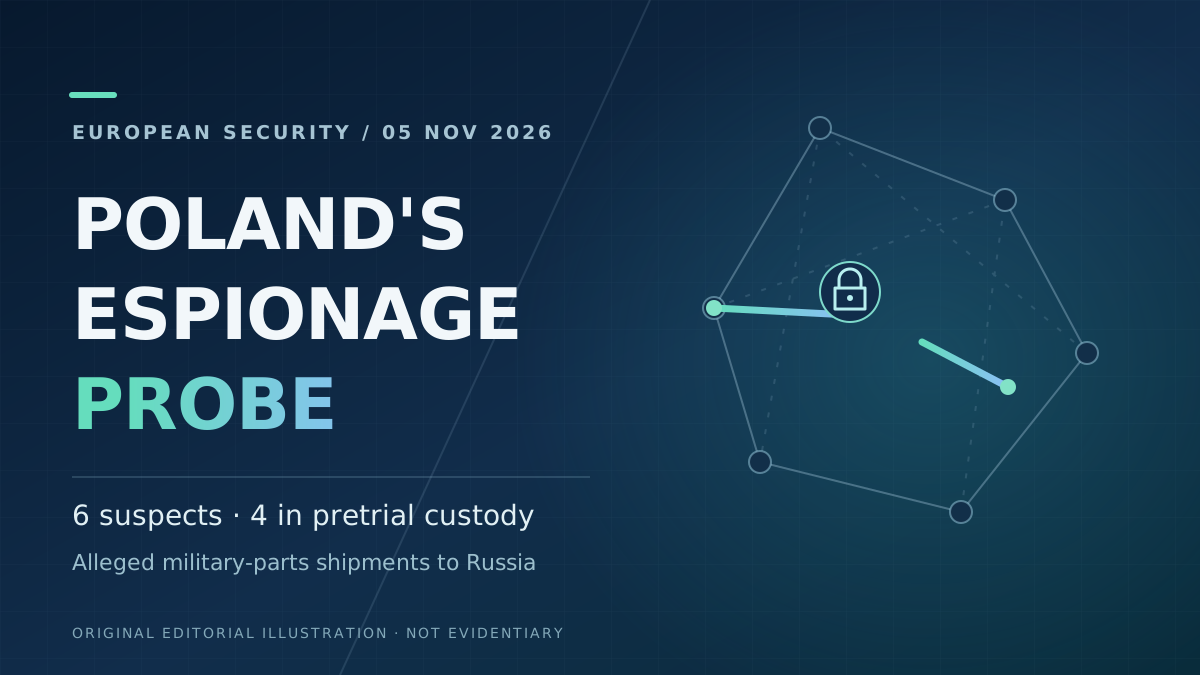
Six people were detained in Poland in an investigation into suspected illegal military-component exports to Russia, authorities announced on November 5. Four of them, including a Russian woman, face espionage charges and have been placed in three-month pretrial detention. The other two face criminal-group allegations but are subject to non-custodial restrictions. The case brings together two questions that must not be confused: what investigators say the group transported across borders, and whether prosecutors can prove the much more serious allegation of work on behalf of Russian intelligence.
Six detainees, four espionage charges
Poland’s Internal Security Agency, known as ABW, said its officers detained six people suspected of membership in an organised criminal group. Four have also been charged with espionage, and a court ordered them held in pretrial detention for three months at prosecutors’ request. The remaining two are under non-custodial preventive measures. That distinction is central to the case: all six were initially detained, but only four were placed in continuing pretrial custody on the espionage charges.
The six include five Polish citizens, aged 25 to 52, and a 37-year-old Russian woman, according to Tomasz Siemoniak, Poland’s minister responsible for coordinating its special services. The agency specified that the Russian woman was among the four facing espionage charges. None of those descriptions establishes guilt. The arrests, the filing of charges and the court’s decision about custody are procedural developments, not criminal convictions.
Sources: Poland arrest four in probe into military supplies sent to Russia · ABW uderza w grupę działającą na rzecz rosyjskiego wywiadu. Sześć osób zatrzymanych, cztery w areszcie pod zarzutem szpiegostwa · ABW zatrzymała sześć osób. Polacy i Rosjanka podejrzani o szpiegostwo
The military components at the center of the accusations
Investigators allege that the group obtained and exported substantial quantities of components with military applications, including items used in ammunition and weapons systems. Poland’s National Prosecutor’s Office, as reported by Rzeczpospolita and other outlets, identified cartridge cases and projectiles among the goods involved. Prosecutors say the shipments left Poland for Russia without the required permissions and that four suspects acted for Russian intelligence.
The suspected violations therefore have two overlapping dimensions: controls on cross-border trade in strategically sensitive goods, and a separate accusation of activity on behalf of a foreign intelligence service. The materials’ precise uses, the complete inventory, their eventual recipients and the defendants’ individual roles have not been independently established by the reporting reviewed for this article. Military-use components should not be described as finished weapons merely because investigators believe they could support arms production.
Sources: ABW uderza w grupę działającą na rzecz rosyjskiego wywiadu. Sześć osób zatrzymanych, cztery w areszcie pod zarzutem szpiegostwa · ABW zatrzymała sześć osób. Polacy i Rosjanka podejrzani o szpiegostwo · Poland arrests six suspected of spying for Russia and supplying its military
A claimed route running through Kaliningrad
According to the prosecution account reported in Polish media, the alleged operation ran at least from June 2023 until December 2025 and involved activity in Poland, Lithuania and Russia. Investigators say members ordered and purchased goods, arranged collection and moved them toward Kaliningrad, the Russian exclave between Poland and Lithuania. Some purchases allegedly took place through online shops; vehicles with concealed compartments were reportedly used for transport.
Prosecutors also say some shipments were intercepted by Polish border guards and that the value of ammunition components purchased and illegally exported exceeded 2 million zlotys. Those are investigative findings attributed to prosecutors, not an independently audited valuation or a judicial determination. The claimed route matters because it would connect ordinary-looking purchasing and vehicle movements with controlled items crossing an external European Union border, but the publicly described evidence does not establish every link of that chain.
Sources: ABW zatrzymała sześć osób. Polacy i Rosjanka podejrzani o szpiegostwo · Six detained in Poland on suspicion of exporting military components to Russia · Poland arrests six suspected of spying for Russia and supplying its military
What the security operation has publicly disclosed
ABW said its operation covered October 21 through November 2 and included searches at 21 locations in the Warmian-Masurian, Pomeranian and Greater Poland regions. The agency’s November 5 announcement therefore reported an investigation already underway, not six arrests necessarily made that day. Polish regional public broadcaster TVP also reported the searches and the four decisions to place suspects in pretrial detention.
The case is overseen by the National Prosecutor’s Office unit in Białystok that handles organised crime and corruption, while ABW officers based in Olsztyn conduct investigative work, according to the agency. Searches show the scope of enforcement activity, not the final volume of material that prosecutors will be able to prove was exported. Officials said the investigation remained open, leaving the possibility of additional evidence or revised allegations.
Sources: ABW uderza w grupę działającą na rzecz rosyjskiego wywiadu. Sześć osób zatrzymanych, cztery w areszcie pod zarzutem szpiegostwa · Akcja ABW. 4 osoby są podejrzane o szpiegostwo
Why this is more than an ordinary smuggling allegation
The allegations fit a security concern at the intersection of export restrictions and wartime supply chains. Poland is a NATO and EU member, supports Ukraine, and faces Russia across the border with Kaliningrad. If components were exported unlawfully for use in Russian ammunition or weapons production, the relevance would extend beyond lost customs control to the effectiveness of restrictions intended to limit access to sensitive military goods. Whether this particular group actually supplied that capability remains the question for investigators and the courts.
Siemoniak described the suspected activity as an attempt to bypass restrictions on supplying Russia. He also said that nearly 100 people had received suspect status in ABW espionage and sabotage investigations since January 1, 2024. That figure is an official aggregate spanning separate proceedings; it is not a count of members of this alleged group, not a tally of convictions and not proof that all the cases are connected. Treating such figures as convictions would substantially overstate what is known.
Sources: Poland arrest four in probe into military supplies sent to Russia · Six detained in Poland on suspicion of exporting military components to Russia · Poland arrests six suspected of spying for Russia and supplying its military
The questions that remain for the courts
The public statements do not themselves provide trial-tested proof that each defendant knowingly served a Russian intelligence organisation. They also do not settle how the goods were classified under export controls, which suspect allegedly handled which shipment, or how investigators calculated the value of the transfers. The prosecution’s account may be tested against documents, witness testimony and other evidence in further proceedings. Until then, the distinction between an allegation and an established finding is more than a legal formality.
Reuters reported that the Russian embassy did not immediately answer its request for comment; it also noted the Kremlin’s broader denials of sabotage in NATO countries, which should not be mistaken for a case-specific response from the defendants. The immediate, verified development is narrower and significant enough: six people face criminal-group allegations, four of them are in pretrial detention on additional espionage charges, and Polish investigators say they are examining an alleged channel for military-use components to Russia. The investigation, not a conviction, is the story as of November 5.
Sources: Poland arrest four in probe into military supplies sent to Russia · ABW uderza w grupę działającą na rzecz rosyjskiego wywiadu. Sześć osób zatrzymanych, cztery w areszcie pod zarzutem szpiegostwa · Six detained in Poland on suspicion of exporting military components to Russia