Poland’s Constitutional Tribunal moved from a dispute over its leadership to contested institutional action on 3 November 2026. Eight judges gathered in Warsaw, endorsed a draft budget for 2027 and drew lots to select disciplinary panels. On the same date, the National Prosecutor’s Office disclosed seven applications seeking permission to pursue criminal responsibility against two Tribunal judges. The meeting took place and the applications were announced; neither fact resolves the quarrel over the assembly’s validity, removes judicial immunity or establishes criminal guilt.
What the November 3 assembly actually did
An assembly convened by Anna Korwin-Piotrowska met at Poland’s Constitutional Tribunal in Warsaw on 3 November 2026. Contemporary accounts from Polish Radio, Radio dla Ciebie and Notes from Poland describe eight judges attending the sitting. The participants endorsed a draft income-and-expenditure plan for the Tribunal for 2027. This was an internal budget-planning decision, not the final passage of Poland’s national budget.
The participants also drew lots to select panels for disciplinary matters involving tribunal president Bogdan Święczkowski and vice-president Bartłomiej Sochański. Selecting panels is a procedural step, not a disciplinary judgment, a ruling on criminal culpability or a grant of permission to prosecute either judge. Święczkowski disputes the authority of the gathering, and its legal effect remains contested.
Sources: Disputed Polish constitutional court holds first meeting after takeover by government-backed judges · Spór o Trybunał Konstytucyjny przeniósł się na Radę Bezpieczeństwa Narodowego. Prezydent i premier wymieniają oskarżenia · Zgromadzenie Ogólne Sędziów TK. Co wydarzyło się podczas obrad?
Why eight judges said there was a quorum
Korwin-Piotrowska said twelve judges were eligible to take part and that a two-thirds threshold therefore required eight participants. Those attending accepted that interpretation. Their calculation excluded Święczkowski and Sochański because of the suspension orders she issued on 30 October, as well as Jarosław Wyrembak because of a dispute over his appointment.
This arithmetic is not a neutral finding about who legally holds office. The Tribunal has fifteen seats, and critics argue that the disputed exclusions cannot change the statutory denominator or the requirements for convening an assembly. An analysis published by Ordo Iuris before the meeting argued that the assembly would lack the required quorum and that its resolutions would have no legal effect. Other legal commentators have also raised doubts, while those who attended maintained that their votes were valid. The dispute has not been resolved merely because the participants voted to recognise their own quorum.
Sources: Disputed Polish constitutional court holds first meeting after takeover by government-backed judges · Spór o Trybunał Konstytucyjny przeniósł się na Radę Bezpieczeństwa Narodowego. Prezydent i premier wymieniają oskarżenia · Poland’s Constitutional Tribunal Session of November 3 Is Invalid: Ordo Iuris Identifies Nine Defects in the Convening of the General Assembly · Zgromadzenie Ogólne Sędziów TK. Co wydarzyło się podczas obrad?
A proposed budget is not a settled institutional settlement
The 2027 financial plan matters because a functioning constitutional court must be able to prepare and defend its proposed expenditure. It also explains why a meeting on a seemingly routine administrative question became a test of competing claims to direct the Tribunal. Approving a draft at a meeting establishes what those present decided; it does not, by itself, establish that every other state institution must treat that act as legally effective.
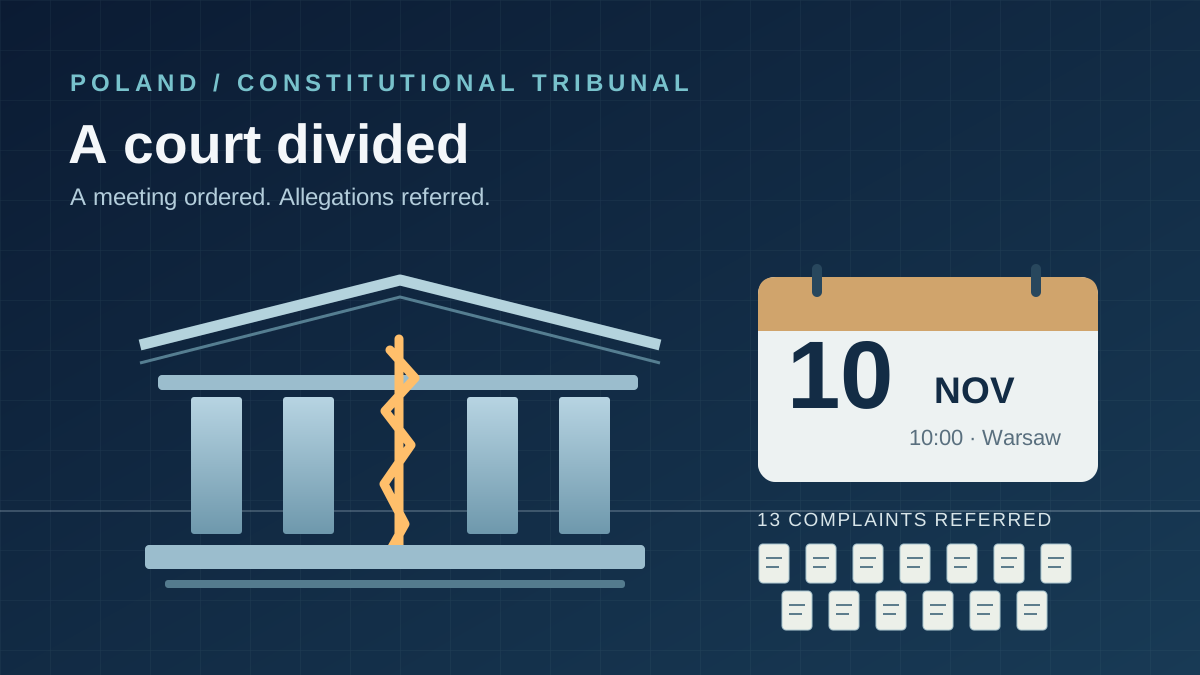
The disagreement reaches beyond one meeting. Święczkowski and those supporting his position reject Korwin-Piotrowska’s claimed authority to suspend him and convene the judges. Conversely, Korwin-Piotrowska and the judges who attended say the sitting could proceed under their reading of the rules. The next test is how relevant bodies handle the draft budget, panel selections and any challenges to the meeting’s validity. None of those future responses should be reported as already decided. As of 8 November, PiS leader Jarosław Kaczyński had appealed, through party spokesperson Rafał Bochenek, for demonstrations linked to the Tribunal dispute scheduled for 8–9 November to be called off during national mourning. This was a political appeal, not a court order or proof that all gatherings had ceased: Fakt reporters found protest tents and a stage still in place outside the Warsaw Tribunal on the morning of 8 November, with a small number of participants present. Separate published Tribunal notices, as reported by Polish media, schedule a General Assembly for 10 November at 10:00 to consider changes to the Tribunal’s rules and another for 17 November at 09:00 to consider prosecutors’ immunity applications concerning Święczkowski and Sochański. Both meetings remain prospective as of 8 November; their scheduling is not a ruling, a grant of immunity waivers or a resolution of the wider dispute.
Sources: Disputed Polish constitutional court holds first meeting after takeover by government-backed judges · Spór o Trybunał Konstytucyjny przeniósł się na Radę Bezpieczeństwa Narodowego. Prezydent i premier wymieniają oskarżenia · Poland’s Constitutional Tribunal Session of November 3 Is Invalid: Ordo Iuris Identifies Nine Defects in the Convening of the General Assembly · Atak na rynku w Krakowie. Prezes PiS wystosował apel · Kaczyński apelował o odwołanie protestów pod TK. Sprawdziliśmy, jak wygląda sytuacja · Zgromadzenie Ogólne TK. Korwin-Piotrowska wydała zarządzenie · Immunitet i zgoda na zatrzymanie Święczkowskiego. TK zbierze się 17 listopada
Seven prosecutorial requests, submitted on two dates
In a statement dated 3 November, Poland’s National Prosecutor’s Office said Prosecutor General Waldemar Żurek submitted six applications seeking consent to hold Święczkowski criminally liable and one concerning Sochański. Crucially, the office said those applications were sent on 30 October and 3 November. The announcement does not say that all seven were newly filed on 3 November.
These were requests for the Tribunal’s consent to pursue criminal responsibility, not notices that immunity had already been lifted. The prosecutor’s office cited Article 196 of Poland’s Constitution and the statute governing Tribunal judges: consent must be given through the relevant judicial procedure. The judges concerned have a right to explain their position and do not participate in deliberations or votes on applications relating to themselves. No approval of the seven requests is established by the 3 November statement.
Allegations are not findings of guilt
The prosecution statement describes suspected conduct in several investigations. Its allegations concerning Święczkowski range from interference with other judges’ ability to work to actions connected with his earlier service as national prosecutor, including issues involving surveillance material and procurement. It describes a separate application relating to Sochański’s alleged involvement in restrictions affecting other judges. These descriptions are the prosecutors’ positions, not court findings.
That distinction is particularly important in an institutional conflict in which decisions about judges’ status are themselves contested. An application can present evidence and legal arguments while still requiring an independent decision about whether prosecution may proceed; a subsequent criminal case would have its own evidentiary and procedural tests. Neither the applications nor the drawing of disciplinary panels should be described as convictions, validated criminal charges or an accomplished removal from the Tribunal.
What the international statements did—and did not—say
On 3 November the OSCE Office for Democratic Institutions and Human Rights urged Polish authorities to safeguard the Tribunal’s independence, impartiality and effective functioning, and to respect legal certainty and due process. Its press release was a public institutional position, not a ruling that the disputed assembly had been valid or invalid.
The International Commission of Jurists also issued a 3 November statement calling for a lawful resolution of the crisis and criticising actions that bypass established legal procedures. This organisation is often abbreviated ICJ, but it is not the United Nations’ International Court of Justice. Its statement is advocacy by an independent legal organisation, not a decision by the world court. What happens next will depend on verifiable rulings, tribunal procedures and official responses, not on treating disputed claims or external recommendations as final judgments.
Sources: ODIHR stresses the importance of ensuring the independence, impartiality and effective functioning of Poland’s Constitutional Tribunal · Poland: The Constitutional Tribunal crisis must be resolved by law, not by force
The Supreme Court’s November 3 Assembly Did Not Pass a New Resolution
Another institution entered the dispute on 3 November, but its outcome must be distinguished from the Constitutional Tribunal’s own meeting. First President Zbigniew Kapiński said the Supreme Court’s extraordinary General Assembly of Judges had not reached the quorum required to adopt a formal resolution on the Tribunal crisis. He identified a lack of quorum in the Civil and Criminal Chambers. The General Assembly therefore did not pass a new resolution.
Instead, the position being discussed had already been adopted by the Supreme Court’s College (Kolegium Sądu Najwyższego), a separate internal body. Its resolution opposed what it described as the removal of the Constitutional Tribunal’s president and vice-president from their duties without a required legal basis and outside statutory procedures. Kapiński reported that all 55 Supreme Court judges present on 3 November supported that existing College position. Their unanimous support was recorded as support for the College’s resolution; it was not a new resolution passed by the full General Assembly.
The distinction matters because the two bodies acted differently: the College adopted a position, while the General Assembly did not adopt a separate resolution. Neither the 55 judges’ support nor the College’s statement settles the contested legal status of the suspended Tribunal leaders, resolves the disputed quorum at the Constitutional Tribunal, or establishes the legality of either side’s actions. This is a domestic judicial position, not a new formal statement from an EU institution.
Sources: Sąd Najwyższy nie podjął uchwały w sprawie Trybunału Konstytucyjnego. 55 sędziów poparło stanowisko Kolegium · Chaos wokół Trybunału Konstytucyjnego. Sąd Najwyższy kwestionuje odsunięcie prezesa · Sąd Najwyższy sprzeciwia się działaniom podejmowanym w TK
November 10 Update: A Rules Vote Meets a Competing Order
A second contested General Assembly of judges at Poland's Constitutional Tribunal met on 10 November and adopted a resolution amending the court's internal regulations, according to Polish reporting drawing on a document published on the Tribunal's website. The meeting had been called by Judge Anna Korwin-Piotrowska, whose authority to manage the institution is disputed by Bogdan Święczkowski. The resolution, identified in contemporary reporting as No. 1/2026, set out changes intended by its proponents to give judges a greater role in the Tribunal's administration. Reported provisions include a role for the assembly in considering the court administration's budget-execution report and arrangements for bringing matters before the judges. These are descriptions of what the disputed assembly adopted, not a finding that its amendments are legally operative.
The rival camp responded with another administrative directive. Wirtualna Polska reported that, in Order No. 18/2026 dated 10 November, Święczkowski asserted that judges and employees were bound by orders from the Tribunal's president or vice-president, rejected the legal effect of organisational and employment measures issued by people he considered unauthorised, and named Judge Stanisław Piotrowicz as the person exclusively empowered to direct the Tribunal's work in the president's or vice-president's absence. Wirtualna Polska reported that the order relied in part on an authorisation dated 28 April, whose documentation and circulation had already been questioned. Those provisions represent Święczkowski's asserted authority, not an independently established ruling that Korwin-Piotrowska's decisions are void.
Prime Minister Donald Tusk said the amendment resolution would be submitted for official publication, and Polish outlets reported that the resolution contemplated taking effect the day after its announcement. A reported intention to publish, publication of a document on the Tribunal website, and promulgation in the official journal are distinct steps. At this update's verification cutoff, official-journal promulgation was not independently confirmed. Nor does the reported vote determine whether the assembly met an undisputed statutory quorum or whether either side's acts will ultimately be recognised as valid. The existing article's account of the 3 November assembly and the seven prosecutorial immunity applications is unchanged. The separately scheduled 17 November meeting remains a future event, not an immunity decision.
Sources: General Assembly called for 10 November 2026 · Na zgromadzeniu w TK zwołanym przez Korwin-Piotrowską uchwalono zmiany w regulaminie Trybunału · Kluczowa decyzja w TK, uchwalono zmiany w regulaminie · Spór o TK trwa. Święczkowski wydał nowe zarządzenie · Pierwsza taka publikacja od lat. Donald Tusk ogłasza początek nowej ery · Na stronie TK opublikowano dokument nazwany uchwałą w sprawie zmiany Regulaminu TK