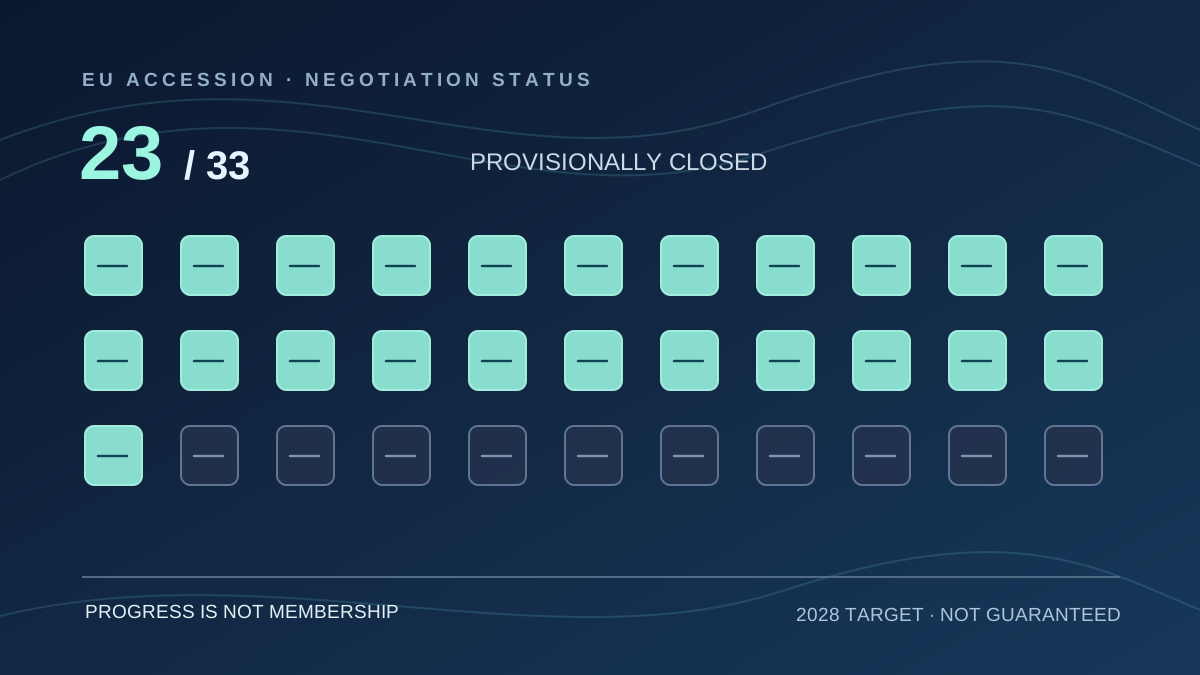
On 6 November 2026, the European Union and Montenegro provisionally closed two more accession negotiation chapters, bringing the total to 23 of 33. The achievement makes Montenegro the leading candidate in the Western Balkans, but the remaining steps are substantial. A provisional agreement can be revisited, the most politically sensitive chapters are still open, and concluding talks is different from joining the EU. Here is what the numbers—and the government’s 2028 target—actually mean.
A milestone, but not the end of negotiations
Montenegro moved closer to European Union membership on 6 November when the 30th Accession Conference in Brussels provisionally closed Chapter 1, covering free movement of goods, and Chapter 12, covering food safety, veterinary and phytosanitary policy. The total is now 23 provisionally closed chapters out of 33. Crucially, all 33 chapters had already been opened. This meeting closed two areas of negotiation; it did not open the final two.
The advance followed a 12 October conference that provisionally closed Chapters 17, 18 and 19, on economic and monetary policy, statistics, and social policy and employment. Montenegro is widely regarded as the candidate closest to completing EU negotiations, a position supported by the Commission and reported by Reuters. But the 23-chapter figure measures progress through negotiations, not the number of EU membership conditions permanently discharged.
Sources: Enlargement: EU and Montenegro close accession negotiations on free movement of goods and food safety · 2026 Enlargement Package shows that reform commitment delivers progress towards EU membership · Montenegro could sign accession treaty with EU in June 2027, European Commission says · Crna Gora na korak bliže EU: Zatvorena još dva pregovaračka poglavlja
Why the word “provisionally” matters
A negotiating chapter is a policy area in which a candidate must bring domestic rules and enforcement closer to the EU body of law, known as the acquis. Provisional closure signals that the EU and candidate have reached an agreement sufficient to set that chapter aside for now. It is neither the same as permanent certification nor proof that every practical change has been completed.
The Council expressly says that agreements on individual chapters are not final until there is an overall agreement on all chapters. It also reserves the right to return to chapters if needed. That rule matters for readers trying to interpret celebratory headlines: even the chapters provisionally closed on 6 November remain subject to continuing scrutiny of how Montenegro applies EU requirements. The progress is real, but it can be revisited.
Sources: Enlargement: EU and Montenegro close accession negotiations on free movement of goods and food safety · How EU enlargement works
The hardest test remains rule of law
Ten of the 33 ordinary negotiating chapters are not yet provisionally closed. Among them are Chapter 23, on the judiciary and fundamental rights, and Chapter 24, on justice, freedom and security. These cover institutions whose performance cannot be measured by passing legislation alone: independent courts, credible enforcement, corruption cases and protections that work beyond the written statute.
The EU acknowledged in June 2024 that Montenegro had met the interim benchmarks for both rule-of-law chapters, allowing the process of setting and meeting closing benchmarks to proceed. That was an important threshold, not their final provisional closure. Montenegro’s European affairs minister Maida Gorčević has described further work on judicial reform and high-level corruption cases, while the Commission continues to stress implementation and lasting political commitment.
Chapter 27, concerning the environment, poses a different kind of challenge. Austrian Green MEP Thomas Waitz, co-chair of the EU–Montenegro parliamentary committee, pointed to the cost and time needed for wastewater treatment and waste management. Closing a negotiating chapter and making public infrastructure function are related goals, but they do not necessarily follow the same timetable.
Sources: 2026 Enlargement Package shows that reform commitment delivers progress towards EU membership · Vajc: 26 država članica EU jasno je poručilo da bilateralna pitanja ne smiju biti prepreka pristupnom procesu Crne Gore · Gorčević: Crna Gora ima osnov da završi pristupne pregovore sa EU do kraja 2026. godine · Sixteenth Accession Conference with Montenegro, 26 June 2024
Croatia is an obstacle to manage, not a confirmed veto on Chapter 23
Another uncertainty lies outside a conventional reform checklist. Croatia wants Montenegro to address unresolved questions ranging from compensation connected to wartime detention and missing people to the Jadran training ship, property claims and maritime boundaries. Croatia’s foreign ministry publicly set out those concerns in July, linking good-neighbourly relations to the final phase of accession. These are Zagreb’s stated demands, not findings that every claim has been legally settled.
Euronews reported in September that Croatia had opposed the provisional closure of several chapters amid these disagreements. More recently, Montenegrin reporting described efforts to seek compromises. That evidence supports describing a live political and diplomatic risk, not asserting that a formal, irreversible veto on Chapter 23 has already occurred.
Andrea Popović Milošević, executive director of the Network for European Policies, has argued that the Croatia dispute could delay Chapter 23 until early 2027. That is her forecast, not a confirmed EU decision. Waitz argues that bilateral disagreements should not obstruct accession. The contrast shows how much the remaining timetable depends on consent from governments as well as Montenegro’s reforms.
Sources: Crna Gora na korak bliže EU: Zatvorena još dva pregovaračka poglavlja · Darmanović: Podrška Brisela velika, ali ne treba se zavaravati da će nas primiti bez ispunjavanja uslova; Popović Milošević: Članstvo prije 2029. teško ostvarivo · Vajc: 26 država članica EU jasno je poručilo da bilateralna pitanja ne smiju biti prepreka pristupnom procesu Crne Gore · Resolution of outstanding issues between Croatia, Montenegro essential for completion of EU accession talks · Montenegro's EU accession bid faces race against time to solve bilateral issues with Croatia
Two clocks: closing talks and becoming a member
The European Commission’s enlargement package was released on 4 November, before the latest two chapters were provisionally closed. It said negotiations could realistically finish by the end of 2026 if Montenegro continues the necessary reforms and EU member governments agree. Its indicative route envisages work on an accession treaty in 2027, with June discussed as a possible signing date. Both the Commission and local reporting treat these dates as conditional, not fixed appointments.
After negotiations, an accession treaty still has to establish the membership terms, obtain the European Parliament’s consent and unanimous Council approval, and then be ratified by Montenegro and every existing EU member state under their own constitutional procedures. Only after those steps can the date specified by the treaty take effect. Even rapid agreement on the remaining chapters in December would therefore not put Montenegro in the EU on 1 January.
Montenegro’s government wants its country to become the EU’s 28th member in 2028, a position Gorčević has publicly defended. The government can prepare laws and negotiate, but it cannot set the speed of 27 other countries’ ratification processes. This is the gap between the political target and a legally secured accession date.
Sources: 2026 Enlargement Package shows that reform commitment delivers progress towards EU membership · Montenegro could sign accession treaty with EU in June 2027, European Commission says · Crna Gora na korak bliže EU: Zatvorena još dva pregovaračka poglavlja · Gorčević: Crna Gora ima osnov da završi pristupne pregovore sa EU do kraja 2026. godine · Još deset poglavlja do kraja: Crna Gora zatvorila 23 od 33, Ugovor o pristupanju očekuje se u junu · How EU enlargement works
Why 2028 is possible but not promised
There is a credible case for momentum. Montenegro has moved from 21 to 23 provisionally closed chapters in less than a month, the Commission sees a realistic route to finishing negotiations in 2026, and leading EU figures have spoken in favour of enlargement. Government supporters can reasonably argue that the institutional effort has reached an unusually advanced stage.
But the sceptical reading cannot be reduced to a footnote. Popović Milošević thinks early 2029 is a more realistic entry point, even if talks move quickly, because the remaining chapter decisions, Croatia-related concerns and ratifications take time. Waitz believes completion of negotiations around mid-December is achievable, while emphasising that this would not itself deliver membership and that environmental implementation remains demanding.
The useful question is no longer whether Montenegro has opened enough chapters: it has opened all of them. Watch instead for EU agreement to provisionally close the remaining chapters, credible progress in rule-of-law enforcement, progress in bilateral talks, a final accession treaty and completed national ratifications. Until those separate decisions happen, 2028 remains an ambition with a plausible route—not a membership date the EU has guaranteed.
Sources: Enlargement: EU and Montenegro close accession negotiations on free movement of goods and food safety · 2026 Enlargement Package shows that reform commitment delivers progress towards EU membership · Montenegro could sign accession treaty with EU in June 2027, European Commission says · Darmanović: Podrška Brisela velika, ali ne treba se zavaravati da će nas primiti bez ispunjavanja uslova; Popović Milošević: Članstvo prije 2029. teško ostvarivo · Vajc: 26 država članica EU jasno je poručilo da bilateralna pitanja ne smiju biti prepreka pristupnom procesu Crne Gore · Resolution of outstanding issues between Croatia, Montenegro essential for completion of EU accession talks · Još deset poglavlja do kraja: Crna Gora zatvorila 23 od 33, Ugovor o pristupanju očekuje se u junu · How EU enlargement works