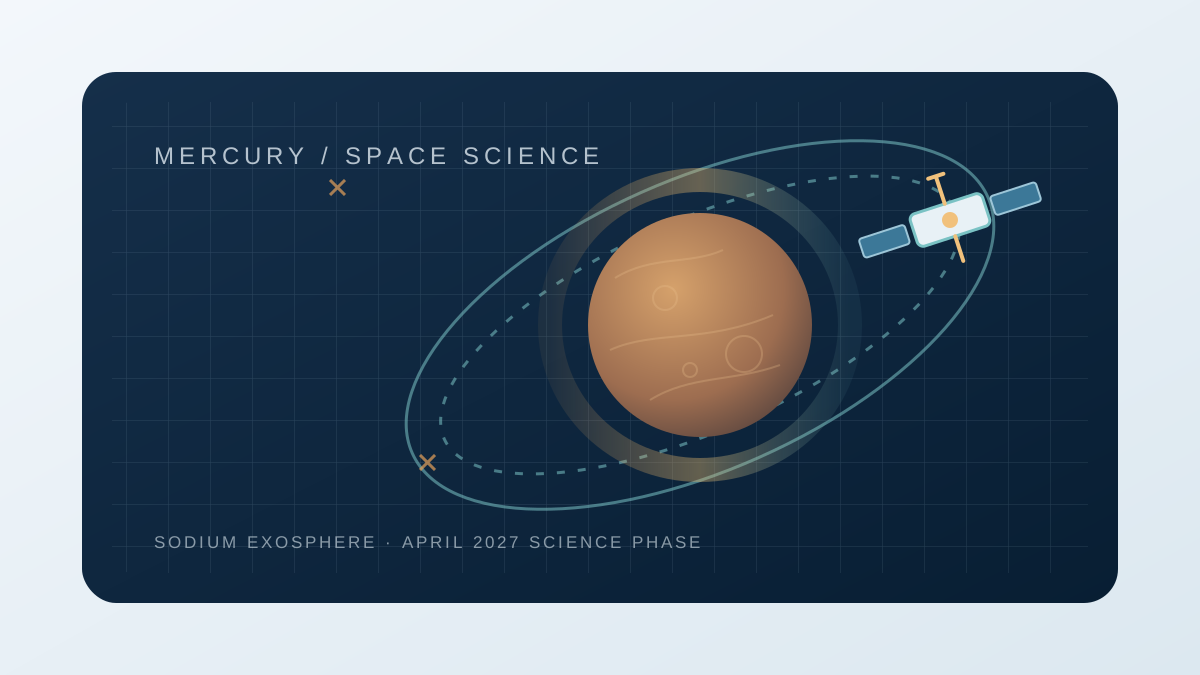
The joint ESA-JAXA BepiColombo mission is due to enter Mercury orbit in November 2026, with science operations scheduled to begin in April 2027. Japan’s Mio orbiter carries an instrument that will make spectral images of sodium in Mercury’s extremely thin exosphere. That is a more precise description than saying Mio will simply take its first pictures of the planet: the instrument is designed to map a faint atmospheric signal, not photograph the surface.
April 2027 marks the start of science, not a promised first-image date
The ESA-JAXA BepiColombo mission is entering its final approach to Mercury. The European Space Agency says the spacecraft stack is scheduled to enter orbit around the planet on November 21, 2026, with the European Mercury Planetary Orbiter (MPO) and Japan’s Mercury Magnetospheric Orbiter, Mio, due to separate on December 9–10. The mission’s science phase is scheduled to begin in April 2027.
That timeline supports the broad idea that Mio will begin close-up observations next spring, but it does not establish a public date for its first image. The official mission updates specify the start of science operations, while JAXA describes what Mio’s imaging instrument is designed to measure. The careful formulation is therefore that Mio’s science observations are scheduled to begin in April 2027—not that a first photograph has already been assigned a confirmed day.
Sources: Latest updates: BepiColombo’s arrival at Mercury · Mercury Magnetospheric Orbiter MIO / BepiColombo · BepiColombo timeline
Mio is one half of a joint Japan-Europe mission
BepiColombo is not a single Japanese spacecraft. It is a joint mission led by the European Space Agency in close collaboration with the Japan Aerospace Exploration Agency. It carries two scientific orbiters: ESA’s MPO, which is designed to investigate Mercury’s surface and interior, and JAXA’s Mio, which focuses on the planet’s magnetic field, magnetosphere, thin atmosphere and surrounding dust.
The spacecraft launched together on October 20, 2018 and used a long sequence of planetary swing-bys to reach Mercury. After the arrival sequence, the two orbiters will work in different orbits and make complementary measurements. That division of work is important when interpreting headlines about “Japan’s Mercury images”: some surface-imaging instruments belong to the ESA orbiter, while Mio’s camera is designed for a different scientific target.
Sources: Latest updates: BepiColombo’s arrival at Mercury · Mercury Magnetospheric Orbiter MIO / BepiColombo · Mission — Mercury Magnetospheric Orbiter MIO · Mercury Magnetospheric Orbiter (Mio)
Mio’s imager is designed to map sodium, not photograph the surface
Mio carries the Mercury Sodium Atmosphere Spectral Imager, known as MSASI. JAXA describes it as an instrument for measuring the distribution and variation of Mercury’s extremely thin sodium atmosphere. ESA likewise says MSASI will measure the abundance, distribution and dynamics of sodium in the planet’s exosphere to investigate where it comes from and how it changes.
MSASI is a spectral imager rather than a conventional surface camera. JAXA’s instrument description says it isolates the orange sodium D2 emission line at 589 nanometres using a Fabry–Pérot interferometer. As Mio spins, the instrument scans the surrounding space to build panoramic images; its design provides a 30-degree vertical field of view and a spatial resolution equivalent to about 38 kilometres on Mercury. The goal is to map a faint atmospheric signal, not to produce ordinary colour photographs of craters and terrain.
Sources: Mission — Mercury Magnetospheric Orbiter MIO · MSASI: the sodium atmosphere camera aboard Mio · Mercury Magnetospheric Orbiter (Mio)
Mercury’s exosphere is almost a vacuum—and its origin is still debated
Mercury has no dense atmosphere like Earth’s. JAXA’s technical explanation describes the surrounding sodium-rich exosphere as roughly one hundred-trillionth as dense as Earth’s atmosphere. Sodium emission was detected from the direction of Mercury in ground-based observations in the 1980s, but the processes that release sodium from the surface remain unsettled.
Researchers have proposed several mechanisms, including solar-radiation effects, bombardment by the solar wind and the impact of micrometeoroids that vaporize surface material. JAXA’s instrument lead notes that none of these explanations had been supported strongly enough to settle the question. From orbit, MSASI should be able to map changes in sodium distribution at much higher spatial resolution than ground-based observations, without the blurring caused by Earth’s atmosphere.
Sources: MSASI: the sodium atmosphere camera aboard Mio · Mission — Mercury Magnetospheric Orbiter MIO
The rest of Mio will measure a dynamic magnetic environment
MSASI is only one of five instrument suites on Mio. The magnetometer (MGF) measures Mercury’s magnetic field; the Mercury Plasma Particle Experiment (MPPE) studies plasma and energetic particles; the Plasma Wave Instrument (PWI) measures electric fields and electromagnetic and radio waves; and the Mercury Dust Monitor (MDM) detects dust around the planet. Together, these instruments will examine how Mercury’s weak magnetic field interacts with the much stronger solar wind close to the Sun.
The two-orbiter design adds another layer. JAXA explains that measurements from Mio and MPO can help researchers distinguish Mercury’s own magnetic field from disturbances caused by the solar wind. Mio’s observations of the sodium exosphere therefore sit within a wider effort to understand how the planet’s surface, magnetic environment and space weather interact.
Sources: Mercury Magnetospheric Orbiter MIO / BepiColombo · Mission — Mercury Magnetospheric Orbiter MIO · Mercury Magnetospheric Orbiter (Mio)
The arrival sequence is still the mission’s immediate challenge
Before the science programme can begin, BepiColombo must complete a demanding series of operations. ESA lists November 21, 2026 for the combined spacecraft’s Mercury orbit insertion, December 9–10 for the separation of MPO and Mio, and April 2027 for the start of science operations. The agency’s timeline notes that exact dates can change for operational reasons.
There has already been a separate camera milestone: ESA reports that MPO’s SIMBIO-SYS camera system successfully took its first image in space during a September 15 instrument checkout. That was an in-space test of an ESA instrument, not a first image from Mio’s MSASI. Keeping the two spacecraft and their instruments distinct avoids turning a real mission milestone into an inaccurate claim about what Mio has already photographed—or exactly when its first sodium image will arrive.
Sources: Latest updates: BepiColombo’s arrival at Mercury · BepiColombo timeline