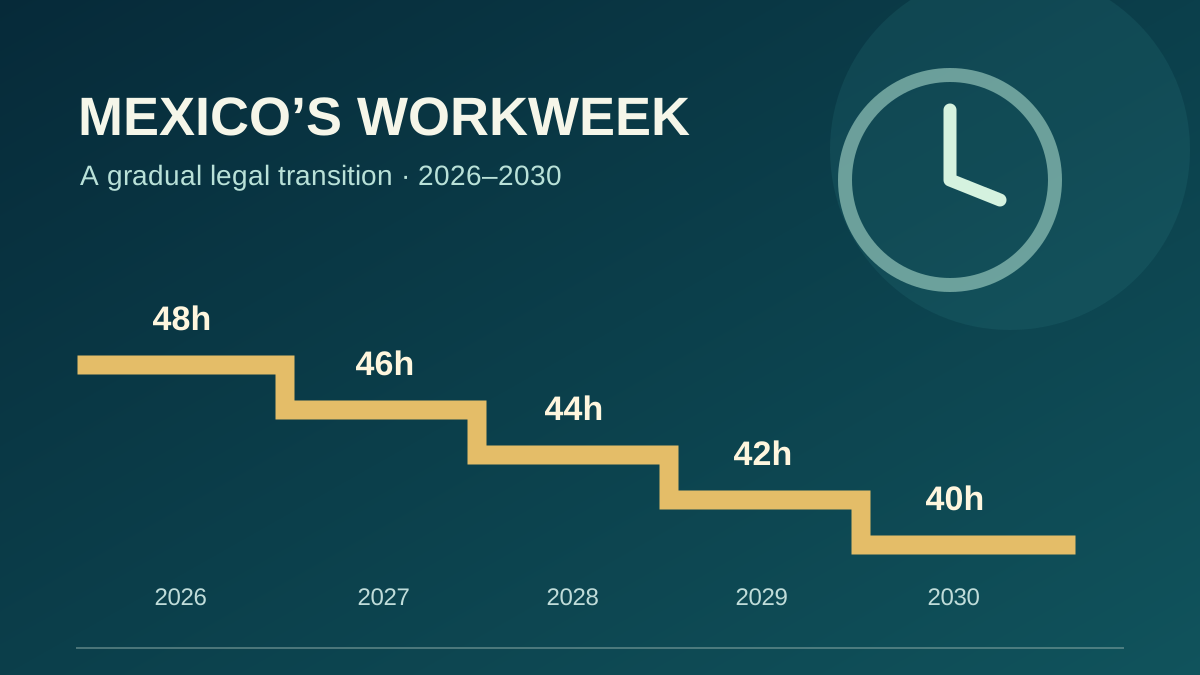
Mexico’s 40-hour working week is law, but its rollout is gradual. Two official decrees establish when hours fall, what happens to pay and why the reform does not automatically create a two-day weekend.
The law is already in place, but the clock has not yet moved
Mexico has put a 40-hour working week into law, yet that does not mean all workers are already entitled to an eight-hour reduction in their weekly schedule. The legislation sets an annual transition. For 2026, the ordinary weekly ceiling remains 48 hours; the first scheduled reduction, to 46, starts on January 1, 2027. The full 40-hour ceiling is scheduled for 2030.
That distinction matters for anyone seeing a fresh headline or online discussion about the “jornada laboral.” The reform is not a new law adopted on November 9. Its constitutional foundation was published on March 3, and amendments to the Federal Labour Law took effect on May 1. November discussion should not be mistaken for the date the measure was passed or the date the shorter week begins.
Sources: Mexico constitutional reform reducing the working week · Amendments to the Federal Labour Law on shorter working hours · Mexico advances towards the 40-hour working week
A four-step timetable, not an immediate eight-hour cut
The transitional provisions in both decrees establish the same sequence: 48 hours in 2026, 46 in 2027, 44 in 2028, 42 in 2029 and 40 in 2030. Each new annual limit is scheduled to apply from January 1 of its respective year. In other words, an employee whose ordinary schedule reaches the current ceiling should see the legal maximum fall in two-hour increments, rather than all at once.
The May labour-law decree explicitly identifies the period from May 1 through December 31, 2026 as time for workers and employers to adjust how work is organized. A business may choose a shorter schedule ahead of the mandatory stages, but the national transition timetable should not be confused with a promise that every job will move immediately to five eight-hour days. Existing agreements, the type of shift and the law’s rules about daily hours continue to shape how employers distribute the week.
Sources: Mexico constitutional reform reducing the working week · Amendments to the Federal Labour Law on shorter working hours · Mexico advances towards the 40-hour working week
Pay protection is written into the reform
The constitutional and labour-law transitional articles say that reducing the ordinary week must not cut workers’ salaries, wages or benefits. This is a central protection: the purpose is to reduce the amount of ordinary working time required, not to finance fewer hours through an automatic reduction in employee compensation.
The practical impact will vary. Someone already working under 40 hours may notice little change in their normal timetable. Someone regularly scheduled at the existing maximum stands to gain more time away from ordinary work as the ceiling drops. The labour ministry says the reform could benefit more than 13 million workers, but that is an official projection of the policy’s reach, not a verified count of people who have already received shorter schedules.
Sources: Mexico constitutional reform reducing the working week · Amendments to the Federal Labour Law on shorter working hours · Mexico advances towards the 40-hour working week · President Sheinbaum announces proposal for gradual introduction of a 40-hour week
Shorter ordinary hours do not guarantee two days off
One major point of contention is what the law does not do. The constitutional provision continues to require at least one paid rest day for every six days worked. It does not establish an automatic, universal two-day weekend. A shorter weekly ceiling and a guaranteed two-day break are different legal questions, even though they are often discussed together.
Reuters reported resistance from unions during the congressional process, while opposition voices criticized the absence of a stronger two-day rest guarantee. Those objections do not undo the enacted timetable, but they help explain why a reform that sounds simple in a headline remains contested. Workers may care as much about the placement and predictability of days off as about the total weekly hours.
Sources: Mexico constitutional reform reducing the working week · Mexico’s lower house approves bill cutting workweek to 40 hours by 2030 · Mexican Senate approves gradual reduction of the workweek to 40 hours
Overtime rules are changing on a separate track
The legislation also revises overtime. The constitutional text provides for a normal extraordinary-hours framework of up to 12 hours weekly, distributed within specified daily and weekly limits, and prohibits overtime for people under 18. The May decree sets its own transitional overtime figures: nine hours in 2026 and 2027, ten in 2028, eleven in 2029 and twelve in 2030. The law also distinguishes overtime pay rates and places limits on additional work beyond the ordinary framework.
This is why the phrase “40-hour week” needs context. The ordinary-hour ceiling is not necessarily a ceiling on all hours actually worked when lawful overtime is added. Nor does the new overtime allowance mean an employer can ignore protections, payment obligations or daily limits. The labour-law text also introduces electronic working-time records, with specific general provisions on their scope scheduled to begin in 2027.
Sources: Mexico constitutional reform reducing the working week · Amendments to the Federal Labour Law on shorter working hours · Mexico’s lower house approves bill cutting workweek to 40 hours by 2030
What workers and employers should watch in 2027
The next clear legal milestone is January 1, 2027, when the ordinary weekly maximum is scheduled to fall from 48 to 46 hours. Employers face choices about staffing, shift patterns and record-keeping; workers will need to distinguish ordinary hours from compensated overtime and assess how their actual schedules reflect the statutory reduction.
The ministry has described electronic records and stronger inspection as tools to support compliance. Whether every workplace changes smoothly cannot be known from the passage of a law alone. The most reliable way to follow the reform is to read the official schedule alongside any later implementing rules and workplace arrangements. As of November 9, 2026, the legally significant news is not a new vote, but the approach of the first mandatory two-hour reduction.
Sources: Amendments to the Federal Labour Law on shorter working hours · Mexico advances towards the 40-hour working week · Mexico’s lower house approves bill cutting workweek to 40 hours by 2030 · President Sheinbaum announces proposal for gradual introduction of a 40-hour week