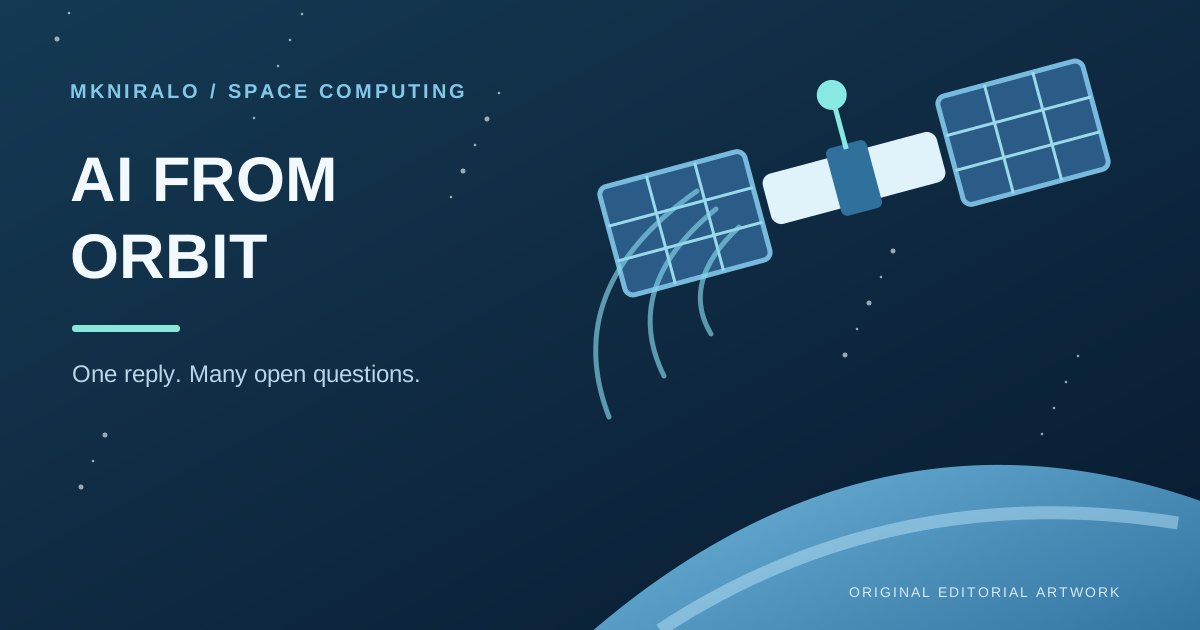
Google's Project Suncatcher has turned a striking research idea into a first on-orbit test. On October 30, 2026, the company said a prototype satellite used a data-center-class TPU to run a Gemma 4 model and transmitted the generated answer back to Earth. The result is important, but it should not be mistaken for an operational data center in space. The bigger story is what engineers must verify before orbital AI computation can work repeatedly and economically.
What happened aboard the satellite?
Google says its prototype launched on October 1 and spent the following weeks undergoing commissioning checks. Engineers powered up the host computer and TPU hardware, then ran initial machine-learning tests. During a ground-station pass above Svalbard, Norway, they asked the onboard Gemma 4 model to generate a short poem. The resulting text was transmitted back to Earth.
Google describes this as the first AI response from a data-center-class TPU in orbit. It also reported follow-up prompts about payload telemetry. These were early system checks, not a public service or a full performance benchmark.
Sources: We've received our first response from the Project Suncatcher prototype satellite · Our Project Suncatcher prototype satellite is in orbit
What does a successful prompt actually prove?
The demonstrated chain is meaningful: a ground station sent an instruction, a processor in orbit ran the model, and the response reached the ground. That is stronger evidence than a presentation about what an unlaunched satellite might do.
But the public announcement does not establish continuous inference, precise latency, comparative cost, sustained power output, hardware lifetime or the ability to handle large customer workloads. Each of those would require additional tests and measurements.
Sources: We've received our first response from the Project Suncatcher prototype satellite · Google's satellite AI server transmits its first response to Earth
Why put AI computing into space?
Project Suncatcher is investigating whether future interconnected, solar-powered satellites could support machine-learning infrastructure. The appeal is the possibility of making use of solar energy in orbit and distributing computing over a network of spacecraft.
That premise is only the starting point of a business case. A meaningful comparison with terrestrial infrastructure would need to include manufacturing and launch costs, power supply, heat rejection, communication constraints, maintenance and orbital lifetime—not simply the amount of sunlight available.
Sources: Meet Project Suncatcher: a research moonshot to scale machine learning compute in space · Learn about Project Suncatcher to put ML infrastructure in space
The hardest questions are physical
Data-center accelerators generate heat during computation. A terrestrial installation can circulate air or liquid and transfer heat through cooling equipment. A satellite operates in a vacuum, so designers must move the heat to radiators that can release it to space. Google's research describes testing approaches involving heat pipes and radiating surfaces.
Radiation can disturb memory and electronics, and repeated changes in temperature create stresses that are difficult to reproduce perfectly on Earth. Google says its next orbital test phase will study how TPU hardware operates under these conditions. A demonstration output is not the same as long-term hardware reliability.
Sources: We've received our first response from the Project Suncatcher prototype satellite · Learn about Project Suncatcher to put ML infrastructure in space
From one satellite to a distributed network
One processor returning a small response can validate an isolated processing path. A larger network needs spacecraft to exchange information at high speed while moving rapidly relative to one another. Google's research describes optical links that demand accurate pointing and reliable communications.
The company's announced next step is a pair of interconnected satellites in 2027. As of October 31, 2026, that remains a planned milestone. Results from a linked pair could help assess future distributed workloads, but would still fall short of proving a commercial orbital data center.
Sources: We've received our first response from the Project Suncatcher prototype satellite · Learn about Project Suncatcher to put ML infrastructure in space
What independent coverage adds
Independent technology reporting has described the announcement as a first step toward testing AI processors in space. Those reports provide context, but the core technical milestone in this article is still based primarily on Google's own account. The company has not released enough public benchmark data to independently evaluate its claimed operating performance.
Readers should distinguish between a tested communication-and-inference event, the provider's proposed system design and projections about a future market. Each is supported by a different level of evidence.
Sources: We've received our first response from the Project Suncatcher prototype satellite · Google's satellite AI server transmits its first response to Earth
The milestones to watch next
The most useful follow-up evidence would be measurements of orbital TPU reliability, power and thermal behavior, the handling of radiation-related errors, and the duration of successful inference runs. For the proposed satellite network, stable optical connectivity and meaningful multi-node computation would be important additional tests.
Project Suncatcher is noteworthy because it is now testing hardware in the intended environment. Whether that leads to useful, scalable space infrastructure remains an open engineering and economic question. The next serious story will be written in measured results rather than in one memorable answer.
Sources: We've received our first response from the Project Suncatcher prototype satellite · Our Project Suncatcher prototype satellite is in orbit · Meet Project Suncatcher: a research moonshot to scale machine learning compute in space · Learn about Project Suncatcher to put ML infrastructure in space