A summit can end with a long statement and still fail to produce an agreement. When G20 foreign ministers finished two days of talks in Atlanta on October 31, 2026, they had discussed energy, supply chains and international crises. Yet the outcome was a statement issued by the US chair, not a joint communique endorsed by all members. The difference is more than diplomatic etiquette. It tells readers how far governments could go in describing problems together—and where political disagreements prevented a common text.
What the ministers actually produced
The G20 foreign ministers met in Atlanta on October 30 and 31 under the US presidency. The concluding document was titled 'G20 Chair's Statement' and summarised discussions on energy security, resilient supply chains and geopolitical tensions. The University of Toronto's G20 Information Centre has preserved the text, linking it to the US State Department.
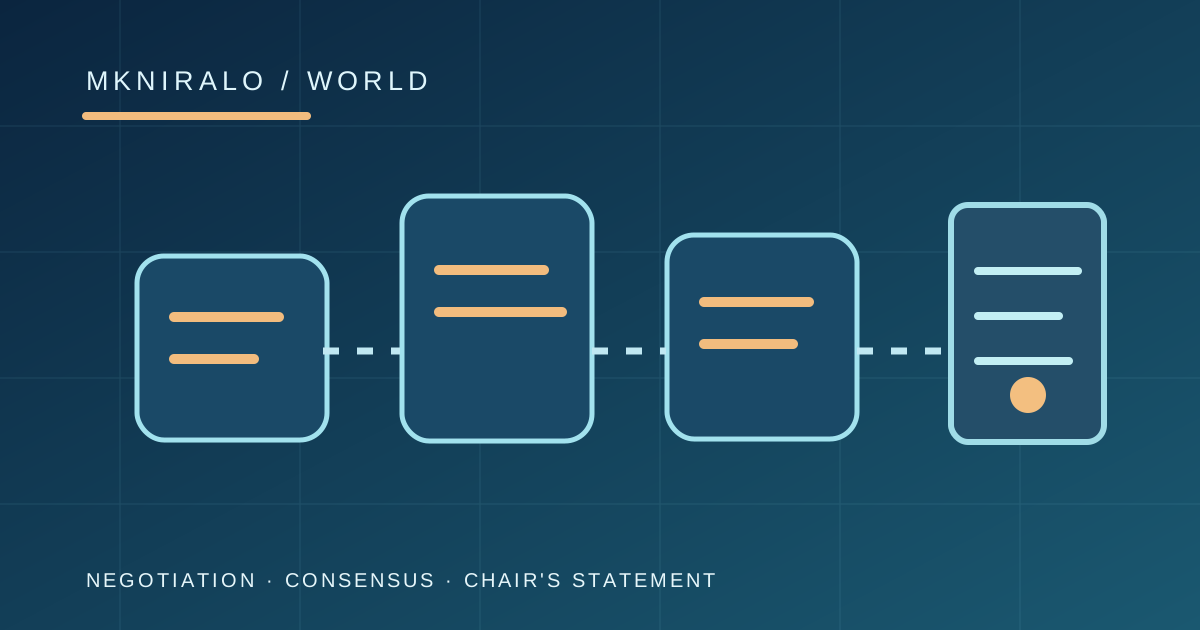
A chair's statement communicates the presiding government's account of discussion. A consensus communique, by contrast, would carry language negotiated and accepted by participating governments. Associated Press reported that ministers could not agree on the major security issues, making a joint statement impossible. It would be inaccurate to describe every sentence in the chair's document as a new international obligation.
Sources: G20 Chair's Statement: Foreign Ministers Meeting, Atlanta · G20 foreign ministers end Atlanta meeting without consensus · Rubio urges G20 cooperation amid rifts over wars
Why Ukraine and other conflicts mattered to the outcome
Independent reporting described sharp divisions over Russia's war against Ukraine and Russia's participation in the meeting. European delegates objected to the planned group photograph with the Russian foreign minister, and the traditional picture was cancelled. Those moments are visible signs of disagreement, though a photograph alone cannot explain the full diplomatic positions of every participant.
The wider meeting was also shadowed by conflict in the Middle East, concerns about sea lanes and disagreements over trade. Participants have distinct positions on the causes of these crises, possible settlements and sanctions. Reporting a lack of consensus does not mean that every country opposed every proposal; it means the gathering did not produce the required shared text on its disputed issues.
Sources: G20 foreign ministers end Atlanta meeting without consensus · Rubio urges G20 cooperation amid rifts over wars · G20 foreign ministers conclude with energy, supply chains, geopolitical discussion
Where the chair found common practical language
The statement spent significant attention on energy access and prices, presenting affordable and secure supplies as important to economic stability. It discussed increasing demand, including from industrialisation and digital technology, and noted that countries have different national energy paths. This is the US chair's policy framing, not proof that all governments endorsed each preferred technology or regulatory judgment in the same way.
Supply chains offered another subject for cooperation. The text highlighted critical minerals, food, investment, refining and recycling, alongside predictability for businesses making long-term commitments. A country can disagree with a rival over war or sanctions while still recognising that fragile transport routes and concentrated materials processing can create global economic risks.
Sources: G20 Chair's Statement: Foreign Ministers Meeting, Atlanta · G20 foreign ministers conclude with energy, supply chains, geopolitical discussion
The shipping lanes that connect geopolitics and everyday costs
The chair's statement explicitly mentioned the Strait of Hormuz and Bab al-Mandab, waterways where maritime insecurity can affect energy flows and commercial shipping. Disruptions may increase logistics costs, uncertainty and insurance premiums for businesses far from the fighting.
Yet a diplomatic discussion of free navigation does not guarantee safe passage the following day. Shipping conditions depend on military activity, port access, insurance and how shipowners assess danger. Governments' commitments, where they exist, must be measured against actual changes on the water rather than only the reassuring words of a communiqué or chairman's account.
Sources: G20 Chair's Statement: Foreign Ministers Meeting, Atlanta · G20 foreign ministers end Atlanta meeting without consensus
Why the absence of a joint communique matters
The G20 brings large economies together but is not a court or a world government. Much of its influence comes from informal coordination and political signals. When ministers issue a jointly negotiated communique, readers can identify a minimum shared position. A chair's statement instead allows the forum to document discussion even when that minimum cannot be negotiated.
This weaker output is not necessarily proof that the entire meeting was useless. Side talks, technical contacts and private exchanges may still be consequential. But those possibilities should not be sold as agreements without an official document or independently verified outcome. The form of the final text is an essential piece of the news.
Sources: G20 Chair's Statement: Foreign Ministers Meeting, Atlanta · G20 foreign ministers end Atlanta meeting without consensus · Rubio urges G20 cooperation amid rifts over wars
What to watch ahead of the leaders' summit
The document looks ahead to a G20 leaders' summit in Miami in December and a UK presidency in 2027. That offers another opportunity to see whether ministers' disagreements narrow, or whether leaders repeat a chair-only formula. The scheduled summit itself does not promise a resolution to any of the conflicts raised in Atlanta.
A careful follow-up should track concrete agreements on trade and critical minerals, verified changes affecting energy and food supply chains, and the language accepted by every delegation. Atlanta demonstrated that major economies still share a need to talk about common vulnerabilities. It also showed the distance between recognising a problem and agreeing on what to do.
Sources: G20 Chair's Statement: Foreign Ministers Meeting, Atlanta · G20 foreign ministers end Atlanta meeting without consensus · Rubio urges G20 cooperation amid rifts over wars · G20 foreign ministers conclude with energy, supply chains, geopolitical discussion
Poland's guest seat became a separate membership dispute
Poland attended the Atlanta foreign-ministers' meeting as a guest at the invitation of the U.S. presidency. Foreign Minister Radosław Sikorski said Washington had proposed making Poland a permanent G20 member and that Warsaw was lobbying for the change. A joint statement from the April 2026 Poland–U.S. Strategic Dialogue had already recorded Washington's strong support for Poland's accession. On 31 October, Secretary of State Marco Rubio again said President Donald Trump believed Poland deserved a seat and hoped to see it, along with other invited countries, return next year.
Russia's Foreign Minister Sergei Lavrov objected, arguing that invitations and new membership should follow the G20's consensus practice. He said Poland's economy did not meet the relevant threshold and rejected the idea that it should represent Eastern Europe. Those are Russia's stated arguments, not a settled ruling on eligibility. The Atlanta meeting ended without a joint communiqué, and no permanent membership change was agreed there.
The distinction between a guest invitation and permanent membership matters. A chair can invite a country to take part in a particular meeting; that does not, by itself, alter the forum's composition. The dispute exposed a wider question about representation: whether the G20 should add another European voice, and how it should reflect the growing economic weight of countries outside its original membership.
Sources: Russia's Lavrov says inviting Poland to attend G20 meeting breaks diplomatic rules · Joint Statement on the Strategic Dialogue Between Poland and the United States · Secretary of State Marco Rubio at a Press Availability