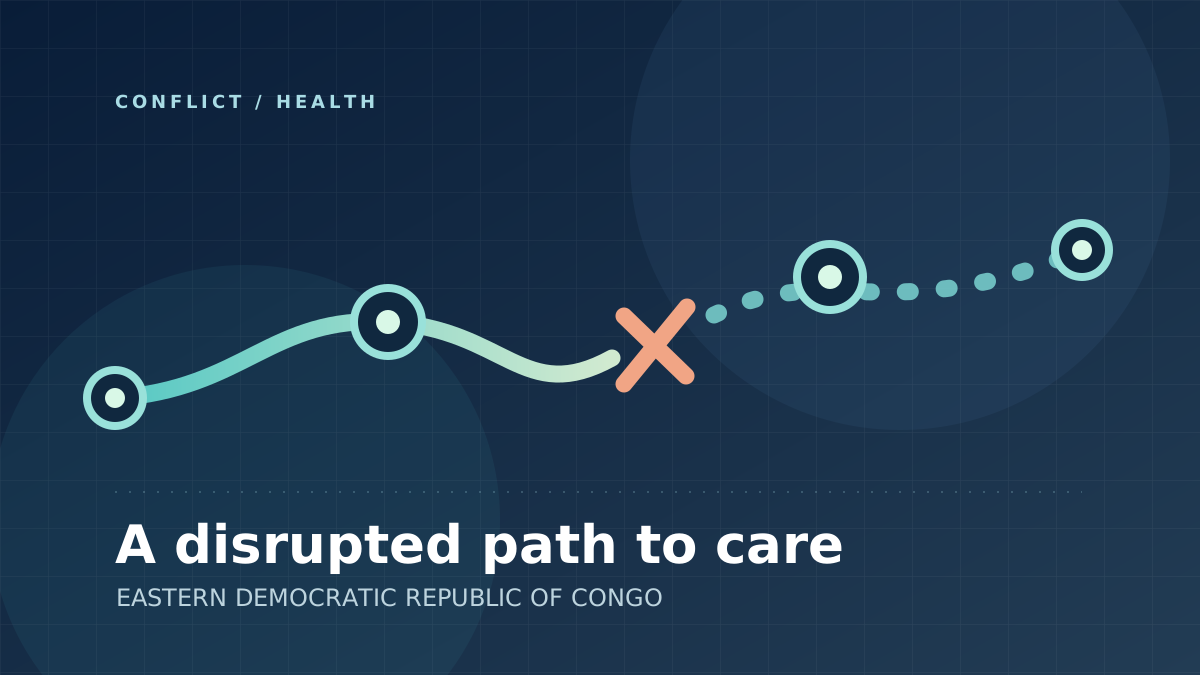
A new Associated Press investigation shifts the focus of Congo's six-month Ebola emergency from the rising case tally to the response itself: whether health workers are paid, vulnerable people are found in time, families receive safe support and aid can be traced to the front line.
The cases the surveillance system did not anticipate
Six months after the Democratic Republic of the Congo declared a Bundibugyo Ebola outbreak, a new Associated Press investigation describes a response struggling to reach the people it is supposed to protect. The most revealing figure is not the cumulative case count. According to the Africa Centres for Disease Control and Prevention, as cited by AP on November 15, 80% of new cases are being detected outside health surveillance. AP does not identify the denominator, the observation period or the precise operational definition behind that percentage. It is therefore an attributed warning about the system's reach, not a precise measurement that can be projected across every district or month.
Finding a patient outside an established surveillance chain can mean that a person became ill before an exposure was recognized, that a suspected case was not referred promptly, or that investigators reached a household only after symptoms appeared. Those pathways are not interchangeable, and the published figure alone cannot tell us which is dominant. The practical implication is nonetheless serious: when a response learns about illness late, it has less opportunity to identify exposed people, support isolation and organize timely care. A large number of recorded cases can coexist with a much larger problem of people never reached at the right moment.
MSF's November 12 assessment separately described substantial gaps in surveillance and the delivery of services to affected communities. Its account of ambulances without fuel and teams without needed supplies is a reminder that information systems depend on transport, staffing and patient trust. A case cannot become an effective public-health intervention simply by being entered into a database. The investigation's central question is whether the response can translate its stated capacity into dependable contact with households.
Sources: Ebola outbreak remains out of control in Congo 6 months into response · Ebola outbreak in DR Congo remains out of control, six months into the response
Frontline workers face a crisis of pay and continuity
AP reports that health workers have repeatedly stopped work over salaries overdue by months, at times leaving patients with confirmed infections without treatment. This is not merely a dispute over administrative bookkeeping. Outbreak control requires staff who can maintain an isolation ward through a full shift, contact people whose exposure may never have been formally reported, and keep basic referral routes functioning when neighborhoods are hard to reach. An unpaid worker may be expected to carry significant personal risk while the services around that worker are unreliable.
The November 12 MSF warning points to poorly equipped facilities, personnel who have not received the preparation they need and ambulances unable to operate without fuel. It is possible to announce funding, mobilize partners and count training sessions while still leaving a treatment site short of the practical resources needed that afternoon. The distinction between money committed at the center and care actually delivered at the edge of the system is especially important in a geographically dispersed emergency.
The available reporting does not establish how often every treatment center has been interrupted, which employer owes each salary or whether the same payment failures apply in all eight affected provinces. Nor does it mean that every worker has joined a strike. But it establishes a real operational vulnerability: if treatment and surveillance teams cannot count on wages, transport and protective supplies, the community cannot reliably count on the response. Repairing that relationship requires sustained delivery rather than another declaration of intent.
Sources: Ebola outbreak remains out of control in Congo 6 months into response · Ebola outbreak in DR Congo remains out of control, six months into the response
The $700 million question is a demand for accounting, not a verdict
In its November 15 investigation, AP says the Africa CDC raised concerns in October about more than $700 million in Ebola aid that remained unaccounted for. The scale of the reported concern deserves scrutiny, particularly when frontline organizations describe shortfalls. But 'unaccounted for' is not interchangeable with 'stolen,' and the AP account by itself does not establish diversion, fraud, an actual cash deficit or the identities of responsible institutions. It does not supply a completed independent audit tracing that sum from donor commitments through recipient accounts to expenditure.
For the claim to be assessed fairly, the public needs to know what the amount covers: pledges or disbursements, domestic or international flows, spending in the current outbreak or a longer reporting period, and grants managed by which agencies. Some funds could be committed but not released; some could be spent but reported under a different accounting schedule. These are possibilities to test, not explanations to presume. The distinction is essential to avoid turning an unresolved transparency concern into an unsupported accusation against particular people or organizations.
The question also has a direct patient-care dimension. MSF says substantial resources have been mobilized without a corresponding level of help reaching patients, health workers and communities. A transparent ledger, reconciled to verified services on the ground, would make it easier to identify whether the binding problem is release of funding, procurement, transport, local implementation or multiple failures together. Until such a reconciliation is independently established, this remains an urgent accountability question rather than a finding of wrongdoing.
Sources: Ebola outbreak remains out of control in Congo 6 months into response · Ebola outbreak in DR Congo remains out of control, six months into the response
Deaths at home and the human reality of burial precautions
AP reports that roughly a third of deaths take place at home or elsewhere in the community, where burials and other procedures may occur without specialist supervision. That reporting highlights a difficult intersection of medical urgency, family obligations and public trust. Ebola can spread through exposure to infectious bodily fluids, including during care for a sick relative or handling a body after death. Effective precautions therefore need to be accessible and explained in ways that allow families to be treated with dignity.
This should not be reduced to a caricature of communities resisting public health. When a response arrives late, an ambulance is unavailable or a family cannot obtain timely information, people may have to make decisions under severe pressure. AP also describes friction between response measures and social and cultural practices. The question is not whether families care about safety; it is whether a trusted, adequately resourced team can reach them in time to offer safer choices.
The WHO's November 6 Disease Outbreak News gives an earlier, different measurement: among 512 deaths reported since October 21, 335 occurred in communities and 177 in treatment centres, using data available as of November 3. That short-period figure should not be presented as a contradiction of AP's broader one-third description; the two refer to different windows and potentially different denominators. Together, they show why deaths outside care remain a critical signal of delayed detection and access. Neither number alone identifies the reasons individual households did not receive help.
Sources: Ebola outbreak remains out of control in Congo 6 months into response · Ebola disease caused by Bundibugyo virus — DRC, Kenya and Nigeria (DON625)
Why the burden on children changes the stakes
The AP investigation cites UNICEF figures indicating that children accounted for 35% of deaths recorded through November 4. Children younger than five represented 21% of all recorded deaths, while nearly 72% of infected children in that age group had died. These figures have different denominators: the first two are shares of total deaths, whereas the last is an age-specific fatality proportion among infected young children. Reading them as the same measure would distort the severity of the finding.
AP reports that many affected children have not received specialized care and notes particular vulnerability among those with conditions such as malnutrition. But the published aggregate figures cannot show which children lacked referral, why an individual child died or whether all communities had the same access to services. Those questions require much more detailed clinical and geographic data than the AP account provides. The numbers do, however, make clear that failures in access cannot be discussed only in terms of surveillance administration.
A young child's illness may depend on an adult recognizing warning signs, finding transport and securing a place where appropriate care is available. Household disruption, distance and insecurity can compound those obstacles. In a functioning response, caregivers need clear information and a reliable path to trained teams rather than blame for decisions made with limited options. The reported burden on young children makes the quality and speed of those connections an urgent measure of success.
Sources: Ebola outbreak remains out of control in Congo 6 months into response
What the dated figures show—and what they cannot resolve
WHO's November 6 Disease Outbreak News, using data through November 3, recorded 10,668 confirmed cases and 5,198 deaths in 67 health zones across eight provinces, with 51 zones reporting a new case in the preceding 21 days. It reported an 86% average daily contact-follow-up rate over the preceding two weeks, below its 95% operational target. These are important background indicators, but they are not a substitute for the November 15 reporting about wages, supervision, burial response and resource delivery. WHO says the outbreak was declared May 15 and was designated a public health emergency of international concern on May 17.
Later Congolese health-authority situation-report listings show an upward trajectory. A November 10 reporting cut-off is associated with 11,114 confirmed cases and 5,433 deaths; the archive also lists a November 12 report with 11,254 cases and 5,505 deaths. The WHO EPI-WIN briefing reported 10,467 confirmed cases and 5,103 deaths as of October 31, while INSP SitRep No. 181, dated November 11, recorded 11,197 confirmed cases and 5,471 deaths. Those figures belong to different reporting dates and should not be blended with WHO's November 3 baseline. AP's separate description of more than 11,000 government-recorded cases does not specify whether its number includes only confirmed infections, so it should not be relabeled as a confirmed count without the corresponding underlying bulletin.
The geographic stakes extend beyond Congo. WHO's October 23 Disease Outbreak News described known-contact transmission after an imported case in Kenya and a confirmed imported case in Nigeria; its November 6 update says no new cases had been reported in those two countries since the previous notice and also describes a UK medical evacuation reported on November 5. These events require careful country-by-country descriptions, not an invented narrative of uncontrolled spread everywhere. Six months in, the best test of progress is whether a person who becomes ill can be recognized, reached and cared for without preventable delay—and whether the institutions financing that work can explain what is actually delivered.
Sources: Ebola outbreak remains out of control in Congo 6 months into response · Ebola disease caused by Bundibugyo virus — DRC, Kenya and Nigeria (DON625) · Ebola disease caused by Bundibugyo virus — DRC, Kenya and Nigeria (DON622) · WHO Health Emergencies EPI-WIN webinar: Update on current Ebola Bundibugyo outbreak · INSP SitReps and WHO reports: dated daily-report archive · INSP SitRep No. 181, reporting date 11 November 2026