A week-44 report published by the UK Health Security Agency on 5 November places the Democratic Republic of the Congo’s Bundibugyo virus disease outbreak beyond 10,000 confirmed cases. The figures are a dated snapshot, not a live count: they cover reports through 1 November and span 67 health zones in eight provinces. The milestone is alarming not only for its scale, but because the virus is a different Ebola species from the one targeted by the best-known licensed vaccine. WHO declared the outbreak a public health emergency of international concern in May.
A record outbreak, measured at a specific date
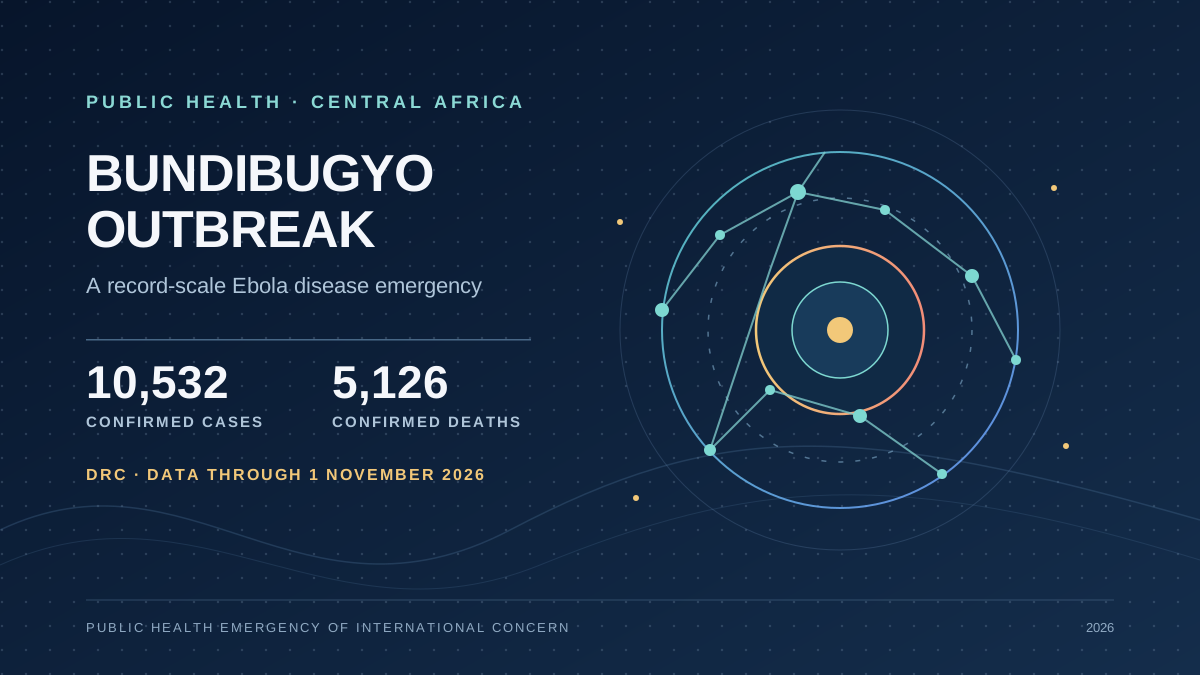
The UKHSA report records 10,532 confirmed cases and 5,126 confirmed deaths in the DRC as of 1 November. It describes this as the largest recorded outbreak of Bundibugyo virus disease and the second-largest Ebola disease outbreak to date. ECDC’s 3 November update independently reproduces the same national totals, explicitly tying them to data available through 1 November. The cut-off matters: outbreak totals change as laboratories confirm cases, deaths are reconciled and surveillance reports are updated.
The outbreak had reached 67 of the country’s 178 health zones across Ituri, North Kivu, South Kivu, South-Ubangi, North-Ubangi, Haut-Uele, Bas-Uele and Tshopo. Ituri remained the epicentre, with 7,431 confirmed cases and 3,492 deaths reported from 28 of its 36 health zones. ECDC recorded 65 new confirmed cases and 23 new deaths in its 2 November update, based on data through 1 November. It also warned that DRC case and death data were under continuous review, noting a 314-death adjustment in the 31 October situation report that was absent from the following two daily reports. WHO’s 6 November bulletin later put the tally at 10,668 cases and 5,198 deaths through 3 November.
Sources: Outbreaks under monitoring: week 44 (week ending 1 November 2026) · Ebola disease outbreak caused by Bundibugyo virus – Multi-country – 2026 · Ebola disease caused by Bundibugyo virus - Democratic Republic of the Congo, Kenya and Nigeria
Bundibugyo is an Ebola virus, but not the Zaire species
“Ebola” is often used as if it described one virus. It is a disease name covering infections caused by several related viruses, including Ebola virus (the species formerly commonly called Zaire ebolavirus), Bundibugyo virus and Sudan virus. The current DRC outbreak is caused by Bundibugyo virus. It is not a newly discovered pathogen: the species was first identified during an outbreak in western Uganda in 2007, and the DRC recorded another Bundibugyo outbreak in 2012. The 2026 epidemic is the country’s second documented outbreak caused by this species.
That distinction has immediate practical consequences. The Ervebo vaccine, widely associated with Ebola prevention, is licensed and WHO-prequalified for disease caused by Ebola virus, not for Bundibugyo virus disease. WHO says there is no licensed vaccine for Bundibugyo virus disease and insufficient evidence that Ervebo protects people against it. The agency advises that Ervebo should be used during this outbreak only within a research protocol. Treating “Ebola vaccine” as a single interchangeable tool would therefore give readers a misleading picture of the protection available.
Sources: Outbreaks under monitoring: week 44 (week ending 1 November 2026) · Ebola disease caused by Bundibugyo virus - Democratic Republic of the Congo, Kenya and Nigeria · Ebola vaccines
The vaccine gap makes supportive care and trials central
There is also no approved specific treatment for Bundibugyo virus disease. That does not mean clinicians have nothing to offer: optimized supportive care can manage dehydration, symptoms and complications, and early access to care improves the chance of survival. But the virus does not have the licensed, virus-specific countermeasures available for Zaire ebolavirus disease. WHO’s outbreak guidance emphasizes rapid diagnosis, isolation, clinical management, infection prevention and control, contact tracing, safe burials and sustained community engagement as the core tools for limiting transmission.
Research is under way, but candidates must not be confused with available products. WHO reported that the Tumaini Phase 2/3 trial of Bundibugyo vaccine candidates began in the DRC on 23 October, with initial participants enrolled in Bunia. WHO expert groups have also recommended two further candidates for evaluation, subject to national approvals. These are research steps, not licensed vaccines or proven protection. The immediate response still has to rely on public-health measures and supportive clinical care while evidence is gathered.
Sources: Ebola disease caused by Bundibugyo virus - Democratic Republic of the Congo, Kenya and Nigeria · Ebola vaccines · WHO Rapid Risk Assessment-Ebola disease caused by Bundibugyo virus, Democratic Republic of the Congo v4
Cross-border cases show different outbreak trajectories
The regional picture is not uniform. Kenya reported its first confirmed imported case on 6 October, linked to travel from the DRC through Uganda. By 26 October, it had recorded nine confirmed cases and two deaths, all within one epidemiologically linked cluster. WHO's 6 November bulletin, reporting data through 3 November, said there had been no new confirmed Kenyan cases since 19 October and no evidence of transmission outside the cluster; all eight secondary cases had been in quarantine when symptoms began. The figures illustrate both the risk of cross-border spread and the value of identifying contacts early.
Nigeria reported one laboratory-confirmed imported case in Abuja on 20 October. The patient, who had travelled from Uganda via Addis Ababa, was medically evacuated to Switzerland on 26 October and was receiving care in Geneva. WHO said 62 contacts had been identified in Nigeria by 3 November. Uganda, by contrast, was declared free of the outbreak on 27 August after 42 consecutive days without a new confirmed case following the discharge of its last patient on 16 July. Uganda had reported 20 confirmed cases, including two deaths. These country updates should not be collapsed into one regional case total.
Sources: Outbreaks under monitoring: week 44 (week ending 1 November 2026) · Ebola disease outbreak caused by Bundibugyo virus – Multi-country – 2026 · Ebola disease caused by Bundibugyo virus - Democratic Republic of the Congo, Kenya and Nigeria · Uganda ends Ebola outbreak following completion of 42-day countdown
Why containment remains difficult in eastern DRC
The DRC’s outbreak is concentrated in a setting where public-health operations face multiple pressures. WHO has described insecurity, humanitarian needs, population movement, limited health-care capacity and funding gaps as obstacles to surveillance and response. A large outbreak spread across many health zones requires laboratories to confirm suspected infections, teams to trace contacts, facilities to isolate and care for patients, and health workers to maintain infection prevention under difficult conditions. The 84.0% contact-tracing rate reported by UKHSA is substantial, but it also means the system was not following every identified contact at the reporting cut-off.
Early symptoms can resemble other common illnesses, making laboratory confirmation important and delays dangerous. WHO notes that transmission can be amplified in health-care settings when infection prevention is inadequate, and during unsafe burial practices involving direct contact with a deceased person. Its risk assessment also identifies community engagement as essential: people need trusted information, accessible care and confidence in response teams. The response is therefore not simply a matter of sending more medical supplies. It depends on sustained local participation, safe referral routes, reliable surveillance and the ability to keep essential health services operating alongside outbreak control.
Sources: Epidemic of Ebola Disease caused by Bundibugyo virus in the Democratic Republic of the Congo and Uganda determined a public health emergency of international concern · Ebola disease caused by Bundibugyo virus - Democratic Republic of the Congo, Kenya and Nigeria · WHO Rapid Risk Assessment-Ebola disease caused by Bundibugyo virus, Democratic Republic of the Congo v4
A severe national emergency, not a global pandemic
On 17 May, WHO’s Director-General determined that the Bundibugyo outbreak in the DRC and Uganda constituted a public health emergency of international concern. The designation called for coordinated international action; WHO explicitly said the event did not meet the criteria for a pandemic emergency. In its 20 August rapid risk assessment, the agency rated the risk very high in the DRC, high for neighbouring countries—particularly those sharing land borders—and low at regional and global levels. That distinguishes intense local danger from the likelihood of sustained international spread.
WHO’s 6 November update said no new country had reported cases since its previous bulletin and advised against travel or trade restrictions. The warning is specific rather than indiscriminate: communities in affected areas need urgent protection and care, while neighbouring states need surveillance and preparedness. The absence of a licensed Bundibugyo vaccine or specific treatment makes that work more urgent, not a reason to assume global spread is inevitable.
Sources: Outbreaks under monitoring: week 44 (week ending 1 November 2026) · Epidemic of Ebola Disease caused by Bundibugyo virus in the Democratic Republic of the Congo and Uganda determined a public health emergency of international concern · Ebola disease caused by Bundibugyo virus - Democratic Republic of the Congo, Kenya and Nigeria · WHO Rapid Risk Assessment-Ebola disease caused by Bundibugyo virus, Democratic Republic of the Congo v4