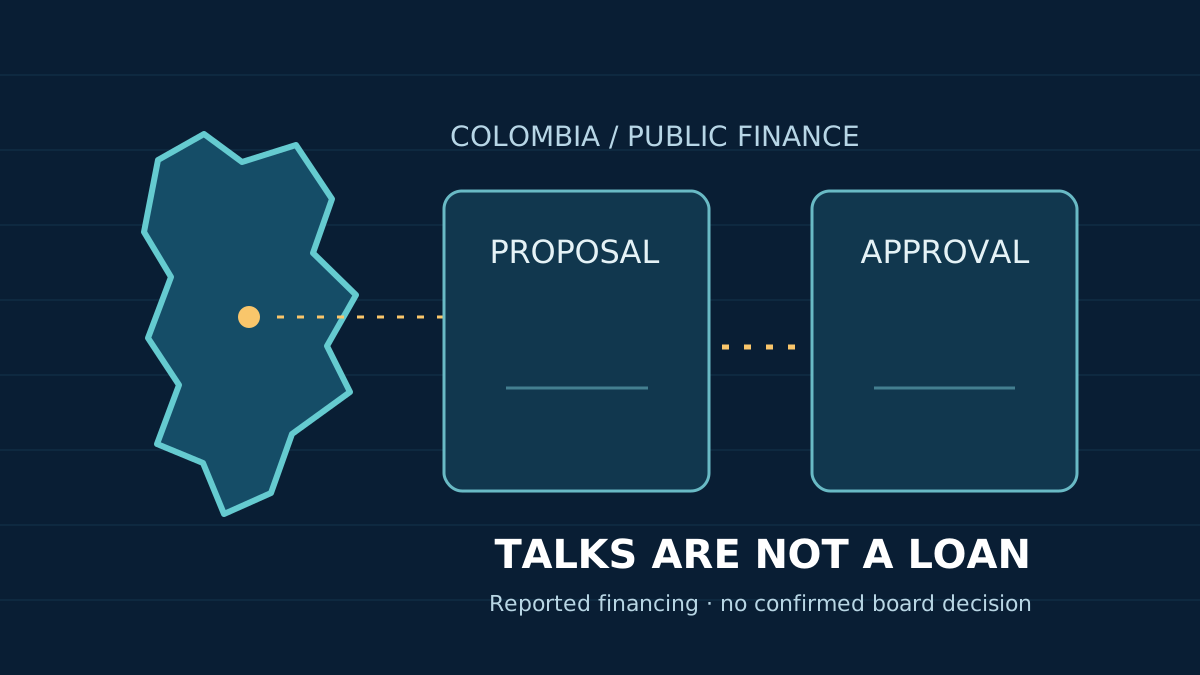
Colombia is pursuing talks over a large financing arrangement with the International Monetary Fund, but the approximately $15 billion figure reported in November is not an approved loan. Reuters reported on November 9 that discussions continued and that people familiar with them expected no decision in the coming weeks. The possible size, lending instrument and conditions remain unsettled. For a government confronting sharply widening deficits, those distinctions determine whether the proposed safety net is an option on paper, a formal commitment or money it can actually spend.
A reported figure, not a signed agreement
Bloomberg first reported negotiations over a $15 billion Stand-By Arrangement. Reuters subsequently cited a source saying the eventual amount could be somewhat smaller and another saying there was no immediate agreement in sight. The IMF offered no immediate comment to Reuters. None of those accounts establishes an approved financing package, a binding schedule of payments or the terms under which Colombia would qualify. A negotiating figure may change when governments and lenders assess financing needs, eligibility and the policies needed to support a program.
An earlier Reuters examination put the possible request in an $8 billion to $20 billion range. That range was an exploration of options, not a range the Fund had promised to provide. Equally, the availability of borrowing under the IMF's general rules cannot be treated as an allocation to Colombia. What matters next is whether officials name a facility and announce a formal request, followed by the Fund's own assessment and any Executive Board decision. Without those steps, the precise dollar amount remains a reported negotiating position.
Sources: Colombia seeking large IMF loan, but no decision expected in coming weeks, sources say · Colombia faces hurdles to meet IMF commitments under possible lending deal
How the discussion reached this point
The latest account follows weeks of preliminary contact rather than a sudden decision to release funds. On September 28, Reuters reported that Colombia's Finance Ministry had confirmed asking for an IMF technical mission to examine the government's fiscal plan and outlook. A technical review can establish a shared picture of economic pressures and test policy assumptions, but it is not approval of financing. The ministry's acknowledgement therefore supports the existence of engagement, not a conclusion that an IMF loan is already available.
By October 8, Reuters was describing the obstacles facing any agreement, including the fiscal measures officials might need to undertake. That reporting identified the Precautionary and Liquidity Line, or PLL, as a potentially suitable instrument. November's coverage then introduced the reported $15 billion stand-by option. The shift in reported terminology is itself a reason for restraint: no public agreement verified for this article settles which instrument, if any, will be used. Readers should not merge different possible facilities into a single supposedly agreed program.
Sources: Exclusive-Colombia has held discussions with IMF, including on securing financing, sources say · Colombia faces hurdles to meet IMF commitments under possible lending deal
The deficit figures are forecasts
The urgency comes from the budget outlook. Reuters reported government forecasts putting the deficit at 7.2% of gross domestic product in 2026 and 9.4% in 2027, with the latter described as a record. These figures are projections made before the years have closed, not audited results. They also depend on assumptions about government revenue, public spending, debt service and whether planned changes take effect. Reporting the 2027 estimate as if the shortfall had already occurred would exaggerate what is known.
The scale matters even with that qualification. A widening gap between public revenue and expenditure increases pressure on debt issuance and on the cost of refinancing past obligations. It can also narrow the government's ability to respond to unexpected emergencies. Financing from a multilateral lender might help manage liquidity pressures, but it does not erase the underlying budget arithmetic. A credible plan for stabilizing debt would have to address the trajectory of spending and revenue over time rather than simply replace one creditor with another.
Sources: Colombia seeking large IMF loan, but no decision expected in coming weeks, sources say · Colombia faces hurdles to meet IMF commitments under possible lending deal
Two IMF facilities with different tests
The IMF describes a Stand-By Arrangement as assistance for actual or potential balance-of-payments difficulties. It can also be precautionary; its label does not automatically mean that every approved dollar is immediately transferred. Access and releases depend on program design, performance criteria and reviews. A proposal for an SBA must therefore be distinguished from an Executive Board-approved commitment, and an approved commitment from each subsequent drawing of funds. The public record cited here does not establish even the first formal approval for the new Colombian talks.
A PLL has a different emphasis. According to the IMF, it supports countries with broadly sound policies and institutions that still face vulnerabilities. Qualification covers external strength, fiscal sustainability, monetary policy, the financial system and data quality. Colombia's central-bank independence and financial framework may count in its favor, according to October reporting, but a sustainable debt position remains a central test. The IMF's own explanation says serious fiscal weakness can prevent qualification. Neither eligibility nor an intention to draw funds should be assumed merely because officials are discussing the option.
Sources: Colombia faces hurdles to meet IMF commitments under possible lending deal · The Precautionary and Liquidity Line (PLL) · The Stand by Arrangement (SBA)
The political cost of financial reassurance
Securing financing could reassure investors that Colombia has a backstop against sudden strains. Yet a facility would not automatically lower borrowing costs or restore fiscal confidence. Lenders and investors will also look for believable commitments on taxes, expenditure and debt management. Reuters reported in October that the IMF had urged fiscal consolidation while spending cuts faced political resistance. Those are competing pressures: officials want relief from financing stress, but adjustments designed to secure that relief may be difficult to pass or implement.
For households, the practical consequences would depend on the detailed budget decisions, not on the headline size of a possible loan. Tax changes could affect disposable income; reductions or reallocations in spending could affect public services and subsidies. Neither outcome should be presented as an agreed IMF condition at this stage. Colombia has also pursued a separate domestic budget initiative often called a Rescue Law. A proposal before Congress and negotiations with an international lender are distinct processes, with separate legal decisions and no automatic connection between their outcomes.
Sources: Colombia faces hurdles to meet IMF commitments under possible lending deal · Colombia and the IMF
The milestones that would change the story
The IMF's public Colombia page and its published lending history provide useful background but, in the materials reviewed for this report, did not announce a newly approved November 2026 arrangement. The Fund confirmed in October 2025 that Colombia had canceled an earlier Flexible Credit Line. The historical facility was not the loan now being discussed, and it would be misleading to describe its former size as available fresh financing. As of this review, reporting about discussions remains stronger evidence of negotiations than of any agreement or transfer.
There are several distinct events to watch: an official description of the requested instrument; a published policy framework; a formal IMF announcement and, where required, Executive Board approval; then financial records of any actual disbursement. A statement that money could be accessed is not proof it was used. A lender's commitment is not the same thing as a payment into government accounts. Until those separate milestones occur, the most accurate description is straightforward: Colombia is seeking a potentially large financial arrangement, and the rescue package reported in headlines has not been approved.
Sources: Colombia seeking large IMF loan, but no decision expected in coming weeks, sources say · Colombia and the IMF · Colombia Cancels the Flexible Credit Line Arrangement with the IMF