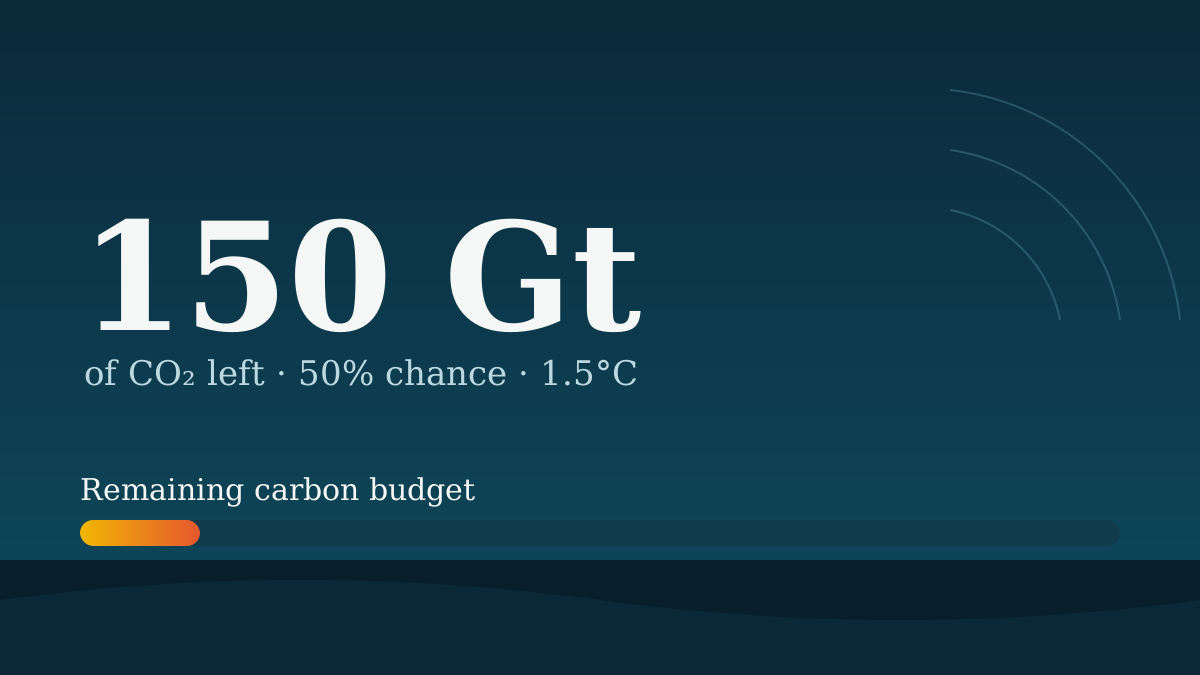
The new Global Carbon Budget gives climate diplomacy a stark number to work with: from January 2027, the world will have about 150 billion tonnes of carbon dioxide left to emit for a 50% likelihood of limiting warming to 1.5°C. At the rate of total CO₂ emissions projected for 2026, that is less than four years’ worth. [1] It is an urgent figure, but it is easy to misuse. It is not a prediction that the world will cross 1.5°C in a particular calendar year, and it is not a timer that runs down at a perfectly constant rate. It is a remaining cumulative-emissions budget under a stated probability. Its value is to show how little room remains for delay, not to forecast the date of a single annual temperature record. That distinction matters as leaders gather in Antalya for COP31. The question is not whether another presidency can publish a roadmap. Two such roadmaps have already been issued by the COP30 Presidency, one on fossil fuels and another on forests. Both are voluntary contributions, not negotiated national commitments. The more useful test is whether governments translate the direction they describe into national plans with dates, finance and measurable coverage — and whether adaptation finance moves beyond announcements into flows that countries can use. The test is demanding because the numbers point in two directions at once: fossil emissions may edge down, but total CO₂ emissions remain high; and the finance gap is still far wider than the sums currently reported.
A small fossil-fuel decline does not close the budget
The 2026 Global Carbon Budget, published as an Earth System Science Data preprint, estimates fossil-fuel and industrial CO₂ emissions at 38.2 Gt for 2026, a central decline of 0.4% from 2025. The uncertainty range runs from a 1.5% decline to a 0.6% increase. [1] In other words, the central estimate is a small fall, but the range does not rule out another increase.
Land-use-change emissions are projected at 5.1 GtCO₂, about 0.2 Gt above 2025. The paper therefore puts total anthropogenic CO₂ emissions from fossil sources and land-use change at approximately 43.3 Gt in 2026, slightly above the 42.8 Gt estimated for 2025. [1] The land-use projection carries lower confidence than the fossil estimate; the authors warn that its 2026 estimate is based on proxies for deforestation, degradation and peat fires.
The remaining 150 Gt budget is reported from the beginning of January 2027. The authors update two estimates: the IPCC Sixth Assessment Report’s 1.5°C budget to 210 GtCO₂, and a lower estimate based on Forster and colleagues’ climate-indicator update to 85 GtCO₂. They average the two and report 150 GtCO₂ for a 50% likelihood. [1] The figure is rounded, and the paper stresses that uncertainty becomes especially consequential close to the 1.5°C limit.
Dividing 150 by the 2026 total-emissions estimate of 43.3 gives roughly 3.5 years. That is the arithmetic behind the paper’s “less than four years” description. It is a rate-equivalent, not a countdown clock: annual emissions will not remain fixed, the carbon budget itself is uncertain, and the calculation does not identify the year in which a particular temperature threshold will be crossed.
Other temperature figures should not be substituted for this budget. The 1.37°C estimate associated with Forster’s work refers to human-induced warming, not the observed annual global mean surface temperature. [10] The World Meteorological Organization reported that the observed 2025 global mean was 1.44°C, with an uncertainty of ±0.13°C, above the 1850–1900 average. [2] Its separate update for COP31 says 2026 is on track to be one of the four warmest years on record, with a January–September average of about 1.47°C. [3] That is not a finding that the Global Carbon Budget has declared 2026 the second-warmest year.
The immediate implication is more modest, and more useful, than a dramatic deadline claim. A central fossil-emissions decline of 0.4% is not yet a durable global decline in total CO₂. The land-use component is still substantial, and the remaining cumulative budget is small enough that a few years of delay matter.
Sources: Global Carbon Budget 2026 · WMO confirms 2025 was one of warmest years on record · State of the Climate Update for COP31 · Indicators of Global Climate Change 2025: annual update of key indicators of the state of the climate system and human influence
A roadmap can organise action without committing a country to it
The COP30 Presidency presented its two international roadmaps on 3 November. [4] They are intended to help carry existing climate decisions into implementation, but the Presidency describes them as voluntary and non-prescriptive contributions that are not subject to negotiation. They do not create new commitments or establish country-specific targets and timetables.
The fossil-fuel roadmap is organised around three connected areas: energy demand, energy supply and the wider economy. Its Belém Readiness Approach is designed to help countries assess their exposure to fossil fuels, identify their capacity to manage change and choose implementation levers suited to their circumstances. It also proposes continued collective work through a TAFF Mutirão extending to 2033. [9]
That is a framework for diagnosis and cooperation. It is not a schedule for when a producer will stop approving fields, when a government will reduce output, how quickly consumers will reduce demand, or which public budget will pay for the transition. The roadmap itself recognises the need to manage supply and demand together: reducing supply much faster than demand can create shortages and price volatility, while maintaining production beyond future demand can leave investments underused and prolong dependence. [9]
The forest roadmap makes the same distinction between a useful architecture and a national delivery plan. [5] Its five complementary areas of action are conservation; sustainable forest management, agroforestry and bioeconomy; combating forest degradation; combating deforestation; and restoration, reforestation and afforestation. It offers a five-step national approach — diagnose, align, target, deliver and monitor, then evaluate and adjust implementation — to help countries translate the Global Stocktake’s forest outcome into domestic action.
The full report also shows why the existence of financing instruments should not be confused with the arrival of money. Its Figure 8 maps 30 international mechanisms for tropical forests, which together account for at least US$25.9 billion in planned, issued and disbursed funds; ten mechanisms have each reached at least US$1 billion. Those categories are deliberately mixed. The figure is not a statement that US$25.9 billion has been paid out to forest countries or communities.
The report’s separate financing table warns that the figures it brings together are not comparable and should not be added across rows. [5] Some entries are payments or disbursements; others are commitments, estimated annual potential or indicators. The report also estimates global forest finance at US$84.5 billion in 2023, of which domestic public budgets supplied US$74.7 billion, or 88.3%. International public finance accounted for US$2.9 billion, or 3.4%, and private finance for US$7.5 billion, or 8.9%. Annual finance needs to rise above US$300 billion by 2030, leaving an estimated US$216 billion annual gap.
A flagship example illustrates the difference between capital commitments and payments for outcomes. The Tropical Forest Forever Facility is designed to use sponsor capital to leverage private debt and pay countries for maintaining standing forests. By October 2026, about US$7.3 billion had been committed to its sponsor tranche, against a US$10 billion end-2026 target; US$30 million had been committed for governance bodies. The report said no forest payments had yet been disbursed. That is not a failure verdict on a facility still being built. It is a reminder that a capital target, an operating institution and a payment reaching a forest jurisdiction are three different milestones.
For COP31, the lesson is not that roadmaps are useless. They can establish a shared vocabulary, identify gaps and connect existing instruments. But neither a voluntary roadmap nor a catalogue of mechanisms demonstrates that a government has changed its production plans, funded a transition or delivered a forest payment. Those outcomes need to be measured separately.
Sources: COP30 Presidency launches international roadmaps to accelerate transition away from fossil fuels and halt deforestation and forest degradation by 2030 · Roadmap on Enhancing Efforts Towards Halting and Reversing Deforestation and Forest Degradation by 2030 · Roadmap for Transitioning Away from Fossil Fuels in Energy Systems, in a Just, Orderly and Equitable Manner
What a meaningful fossil-fuel pathway would contain
A credible COP31 delivery test should begin with the governments that produce and consume the largest volumes of fossil fuels. The test should not be the number of leaders who endorse a declaration or the number of strategies that mention net zero. It should be whether governments formally adopt national production-and-demand pathways that have dates, identified finance and measurable coverage of a material share of planned output.
“Nationally adopted” matters because a presidency document, ministerial speech or consultation paper does not bind a national budget or change a licensing decision. Adoption should be visible in a government decision, law, regulation, official plan or budget instrument, with the authority responsible for implementation identified.
“Dated” matters because a long-term aspiration can coexist with near-term approvals that lock in production for decades. A pathway needs intermediate milestones as well as an end point: when new approvals change, when existing production is expected to decline, when demand-side measures take effect, and when replacement energy and infrastructure are expected to be available. The dates must be specific enough to compare plans with actual production and consumption.
“Financed” matters because the transition has distributional and fiscal consequences. Producer governments may depend on royalties, taxes and export earnings; consumer governments must fund grids, public transport, industrial conversion, household support and energy access. A pathway should identify the public resources, private investment assumptions, concessional support and risk-sharing arrangements on which it depends. A number in a strategy is not the same as an appropriation, a signed financing agreement or money disbursed.
Finally, “material coverage” matters. A country can publish a plan that covers a small pilot or a distant target while leaving most planned production untouched. Governments should disclose the production baseline they use, the projects and output covered, the expected demand trajectory, and the share of planned production emissions addressed by the pathway. The same accounting basis should be used across countries so that coverage can be compared rather than inferred from incompatible national announcements.
This is not a prediction that COP31 will secure such plans. It is a standard for judging whether an announcement amounts to a change in the real economy. The COP30 Presidency’s own roadmap offers a useful starting point by treating supply, demand and the wider economy as connected. The next step would be for governments to make their own pathways official, dated, financed and monitorable.
A separate estimate from Oil Change International adds context to the scale of the fossil-fuel challenge. [6] OCI estimates that fully extracting developed oil, gas and coal reserves could generate 897 GtCO₂. Its oil-and-gas component uses January 2026 Rystad Energy UCube data and stated emissions factors; its 446 Gt coal component is carried forward from an earlier estimate because OCI says there is no comparable updated dataset for developed coal mines. OCI uses its own 130 Gt remaining-budget estimate for its own comparison. That analysis is not a Global Carbon Budget calculation, and its numerator should not be divided by the GCB’s 150 Gt as if the two assessments had been methodologically reconciled.
The distinction is important. A remaining carbon budget is an estimate of cumulative emissions compatible with a temperature probability. An inventory of emissions embedded in developed reserves is an estimate of potential future emissions from a defined set of assets. Both can inform policy, but they answer different questions. Treating them as one calculation would make the argument look more precise while making it less reliable.
Sources: Existing Fossil Fuels Threaten Pollution 7x the 1.5°C Carbon Budget
Adaptation finance is a second test, not a footnote
Even a credible mitigation pathway would not answer the separate question of whether countries can withstand the impacts already arriving. Adaptation finance is not a substitute for cutting emissions, and mitigation finance is not a substitute for adaptation. The two need to be assessed on their own terms.
The UN Environment Programme’s 2026 Adaptation Gap Report estimates that developing countries need between US$255 billion and US$328 billion a year for adaptation, with a central estimate of about US$305 billion annually by 2035 in 2024 prices. [7] The estimate covers 155 developing countries and is based largely on national adaptation plans and commitments. UNEP says private-sector needs are largely excluded and could almost double the overall requirement.
The latest complete year of international public adaptation finance flows from developed to developing countries is 2024. [7] UNEP puts those flows at US$28.2 billion to US$31.7 billion, around US$1 billion more than in 2023. That is far below the estimated need. The report says that even if the COP30 aspiration to triple international public adaptation finance by 2035 is achieved, the resulting US$85 billion to US$120 billion a year would cover only 20% to 29% of the inflation-adjusted 2035 requirement of about US$420 billion.
The price basis matters. The US$305 billion central estimate is expressed in 2024 prices; the US$420 billion denominator used for the 2035 coverage calculation is adjusted to 2035 prices. Comparing the nominal 2035 flow range directly with the 2024-price needs figure would misstate the gap. The 20%–29% range is UNEP’s comparison on a consistent 2035-price basis.
The report does not provide a complete 2025 international public flow total. It notes early indications of higher multilateral development bank financing, but that does not establish the full level of public flows or show how much reached recipient institutions and projects. A credible delivery test therefore needs more than a pledge total: it should track commitments, approvals, disbursements and recipient-level use, with attention to grants and concessional finance, access barriers and the capacity of local institutions.
That is where the language of “mobilising finance” needs to become more exact. A pledge can be politically significant; an approval can move a project forward; a disbursement can put money into an implementing institution’s hands. They are not interchangeable. For communities facing floods, heat, drought, coastal erosion or water stress, the relevant question is whether finance is accessible in time to build protection and reduce losses — not whether a headline target has been announced.
The summit has opened; the outcome must still be measured
The Antalya Leaders’ Summit is taking place on 11 and 12 November, with the first part of the high-level segment for heads of state and government beginning on 11 November. [8] Formal COP31 negotiations continue beyond the leaders’ meetings. This assessment is limited to information available by 11 November 2026 UTC; it does not assume that the summit or negotiations have produced an agreed fossil-fuel outcome.
The questions to put to governments are straightforward. Which major producers and consumers have adopted national production-and-demand pathways? What dates and interim milestones do those pathways contain? What public and private finance is committed, appropriated and disbursed? How much planned production do they cover? And what evidence shows that adaptation finance is moving through the pipeline to countries and communities?
A new roadmap can help answer none of those questions by itself. Nor can a single carbon-budget figure. The 150 Gt estimate is a warning about cumulative limits, not a prediction of a particular temperature crossing. The roadmaps are tools for implementation, not negotiated national schedules. The adaptation figures are a measure of the distance between needs and reported flows, not proof that every pledge has reached its intended recipient.
The practical test for COP31 is therefore not whether the conference produces another compelling framework. It is whether governments make their own pathways official, date them, fund them, disclose how much production and demand they cover, and show that adaptation finance is reaching the places that need it. The budget leaves little room for delay. The evidence of delivery should leave little room for ambiguity.
Sources: Antalya Leaders' Summit at COP 31